That would be No.
Currently I’m reading Blood Meridian by Cormack McCarthy. Every engrossing page contains vivid imagery of nature and man’s inhospitable thirst for death and suffering. Its theme remains constant: humanity’s predilection for acts of futility.
So it made sense for me to consider the result of the Scottish referendum on similar terms.
All that remains is to pick over the how, the why and what will follow.
Sadly the result confirmed that many Scottish people cannot, or even worse choose not to see the current political and sociological perniciousness that characterises Great Britain today. Perhaps they’re still married to a sentimental idea of what being part of Great Britain used to stand for; the welfare stare, the creation of the NHS and solidarity against fascism in two world wars being the main facets of its social cohesive. Clement Atlee’s leadership was its high water mark. The slow erosion of those facets since has been insidious, exacerbated by Thatcherism, homogenised by Tony Blair, and then crudely lionised by the current Coalition of Losers.
Part of me enjoys the spectacle of this decline as through collective complicity it’s thoroughly deserved. How the empire was built – through worldwide subjugation, in the name of hubris and greed, working under the pious and illusory banner of democratising countries and civilising ‘the natives’ – is perversely at the root of its decline. Its subjects have allowed themselves to be subjugated by another surrogate empire of elitism created within it, deregulated capitalism. Even worse they’re immured into allegiance to it through a sense of entitlement that it should and does work for them, its genesis a transposed mythology of belonging to affluent conditions that was never theirs or earned. Today it has many manifestations; Thatcher’s brand of screw-you-over aspiration, provincialism, the bullying and ridicule of virtually all minorities, and the vacuous vainglorious consumerism of shite from a defective mainstream culture that’s satisfied with remaining within its own mediocrity. All of this fomented and inculcated by a hysterical media which feeds it and feeds from it.
The delusion that this decline, particularly in altruism, levels of education and individualist thinking, isn’t happening, is now the zeitgeist. In fact you could say it’s more of a faith than anything. I’ve been there, just last Thursday in fact, in the thrall of it, the abyss of hope, where cultured rational thoughts often perish, as district after district agonisingly voted No. Denial is seductive, just like the smell emanating from a curry house as you walk by. To immediately succumb to the inevitability of the alternative, is just too dismal, and that’s why you believe in the narrative. Denial is also reductive, and the inability or unwillingness to perceive it is even more so.
The main difference between the calls of unionist solidarity and sovereign self determination is those defenders of the unionist faith, particularly from the left, need the fanciful notions of workers solidarity and other socialist values returning to fashion to assuage and eventually permeate the culture of mainstream politics. Such traditions have long since been expunged from Westminster’s core values, as they have very little in common with the largest demographic in Britain’s electorate – a politically apathetic swollen bourgeois with mortgages. By voting Yes, the subsequent belief was, and is, that we could devise a political system that would be voted for and held to account by the people of Scotland. It wasn’t a solution to many of society’s ills, but it was a start.
There’s no starting over in Westminster. And in the aftermath, having voted Yes, it was reassuring to be left in no doubt about it. The politicking with May 2015 in mind started immediately, with the rotting carcass of the independence referendum becoming the latest meal for Westminster’s vultures to squabble over. Within twenty-four hours Cameron’s devolution proposal was throttled, threatened by the various bureaucracies and plutocracies that a party political pissing contest always stirs up. It’s clear that Cameron, with the help from other ideologues like Gordon Brown (I’ll get to him), paid lip service to giving Scotland more powers. It’s the hegemony at their finest, appearing to disagree to agree, ‘Yes, Scotland, we want to give you more devolved powers, but we’re trying to position ourselves so that we can preserve/win the support of the voters in our largest voting block (England) whilst giving away as little as possible to Holyrood.’
Cameron never had any intention, or the support of the house, to offer it. His strategist, Lynton Crosby, might be an arch right wing cunt from the school of Murdoch con-artistry, but that also means he’s an excellent exponent of appealing to our inherent desire to believe in the decency of a source and what it should represent, irrespective of the overwhelming prior evidence to suggest we shouldn’t. As George Orwell rightly pointed out, ‘they [the proletariat] can be granted intellectual liberty, because they have no intellect’. While much of the populace does lack intellect, it’s idealism without foundation that always vindicates political cynicism. Once again a litany of idealists, many of them voting for or supporting the No campaign because they wanted Scotland to remain in the UK, but with greater autonomy, blindly believed that the disintegration of the greater powers pledge after the No vote was ‘necessary’, as Westminster needed to ‘take their time’ to ‘get it right’.
Considering this, and when surveying the political landscape with Scotland, as a region, in mind, the further devolution pledge was a manoeuvre that carried no downside for Cameron or his party. Up here the Tories have little traction or votes to lose, and they don’t need Scottish votes for re-election. For being completely incompetent, and as part of the Better Together campaign that lobbied so hard for the preservation of a sitting Tory government, Labour have decimated their base in Scotland. That Ed Miliband and Gordon Brown both lied…sorry pledged, a timetable they couldn’t deliver just strengthened the PM’s hand. In a vain attempt to save face Labour were always going to repeal any proposal initiated by Call-Me-Dave for more devolved powers, claiming them insufficient. There will be no powers of any significance granted to Holyrood now. Objections from Westminster MP’s, rightly it has to be said, about the unfairness of more significant powers and autonomy being granted to Scotland, but not other regions in the UK, will put pay to that.

I, and many others, criticised Russell Brand when he encouraged people not to vote, but now I get why he said it. We live in a culture that derides people for thinking differently and for refusing to accept that what currently resides in Westminster is the pinnacle of democratic fairness.
Since the result of the referendum we’ve had a myriad of No supporters from the rest of the UK and people who actually voted No, like the journalist Alex Massie, patronising the various movements that have come from the Yes campaign’s embers as being directed by petty ‘neo-Jacobite’ tendencies. God forbid anyone or any group, in a democracy, should have the temerity to challenge and pinpoint its inadequacies in representing them or the people who, for whatever reason, have capitulated to its veracity. The message from most to the Yes campaign was clear; ‘You lost. Now stop being bad losers, shut up and fuck off. Back into your place, and never bring it up again.’ You could understand this sneering somewhat if many on the Yes side were questioning the validity of the result, but nobody remotely sane did. The resolve of the losing side to build again, in an attempt to ultimately succeed, essentially following democratic process, was being derided. That’s where we’re at. Even the silly lefty platitudes of the liberal minded in an honourable attempt to diffuse any resentment were indicative of the cultural virus of systemic servitude. Typical sentiments such as the world being better with fewer borders is harmless, but also complete nonsense. Perhaps someone should tell them that in real terms the EU has none. Any vote that helps to maintain the legitimacy of these attitudes, however sanguine or sinister, is a galling prospect.
No doubt some haughty person will tell me that voting isn’t about winning, and while true, more than anything it should be about the exploration of alternatives, which, in turn, would necessitate significant divergences on policies. George Orwell, again, rightly prophesized in Nineteen-Eighty-Four that:
All the beliefs, habits, tastes, emotions, mental attitudes that characterise our time are really designed to sustain the mystique of party and prevent the true nature of present-day society from being perceived.
In the context of today if I could be so bold as to amend that observation: these mental attitudes are now held by the much of the electorate, media and by politicians to maintain the mystique not of party, but of choice. This mystique of choice prevents the true nature of present-day politics from being perceived. If people believe they have a choice then they will believe that the political process works.
It is this way as most people, even if deep down they know it doesn’t, still want their vote to count, so they vote for parties first and policies second. They make this concession within the framework of an entrenched consensus that only two parties can win a general election, and so invariably that often means plumping for the lesser evil (of the two) based on how they perceive the other. If most people extricated themselves from such a meagre cultural expectation, and voted for policies not parties, then any cross party ideological conglomeration would surely be diluted.
But a No vote has ensured we continue in that ‘tradition’ of limitation. Worse yet, not only has it condemned Scotland as a worldwide laughing stock and that of a region, but it renders every Scottish vote in a UK election meaningless. As it does those MP’s representing Scottish interests and their constituents in Westminster. Take Friday’s vote in the commons for Britain to join the bombing campaign against Islamic State forces in Iraq. The outcome of the vote was inevitable, but regardless of whether you agree or disagree with it, the members of the largest political party in Scotland, the SNP, all voted against the action. Those six votes made up fifteen percent of those who voted against it throughout the house, forty-three. In real terms, regardless of what party they represent, Scotland would have been dragged into a conflict without the say of any of their fifty-nine MP’s mattering.
Coming soon there will be other examples of Great Britain’s ‘weighted’ democratic representation. You are now powerless to stop either the Tories or Labour from taking us out of the EU with a referendum. With UKIP’s popularity rising – they’ve snatched Douglas Carswell and the appropriately named Mark Reckless from the Tories recently – there will be one. Labour will want to settle the issue for good, and it will inevitably appeal to the core support of UKIP and the Tories, who carry the megalomaniacal Little Englander myopia that isolationism will purify and preserve their cultural values. If successful it’ll separate the UK, and Scotland, ridden with debt, from the world’s largest trading block.
My hesitancy to vote will be a struggle to maintain as the general election gets closer. I’ve always voted and it’ll be a wrench to break that habit. But right now finding reasons why I should vote next May is proving difficult. Superficially a tactical vote against Labour seems tempting, particularly as my constituency in North Glasgow has been one of their strongholds for years. Sadly many of their seats hold large majorities, so wiping them out, at least in 2015, isn’t likely.
If I do vote it’s likely to be for the SNP, but just what is the point in sending any candidate south into Westminster’s ghastly cabal, condemning them to drown in the sea of its centre right groupthink? There are admirable exceptions, like Glenda Jackson, but they are a minority, and invariably they are marginalised as back benchers for not towing the party line. Iain McKenzie certainly didn’t, as he was sacked as a parliamentary aide almost immediately after voting against military action in Iraq. I haven’t even mentioned the highly contentious issues of the House of Lords, an unelected chamber that has the ability to obstruct or alter policy initiatives, or that Great Britain doesn’t even have a defined separation of church and state.
The Scottish elections in 2016 are another matter of course. Here I will certainly be entering the ballot box where I will vote for one of the following; Scottish Greens, Scottish Socialist Party or the Scottish National Party. That also means I’ll be voting against all the ghastly parties that supported Better Together; the Tories, Lib Dems, Labour and the grisly right wing triumvirate of Britain First, BNP and UKIP.
While I currently align myself with the SNP, I won’t be joining them. When it comes to voting I believe in being free floating and open to the alternative. The Greens and the SSP should have their chance to entice me with their initiatives between now and then. The Scottish elections are also a forum where I can actually influence things, primarily to preserve free prescriptions and university tuition. In my and many others crosshairs are Scottish Labour. For showing reverence and obedience to the Tory party in this referendum they are due a kicking, and I intend to part of that.

Will Johann Lamont still be in charge by 2016? She intends to be and we can but hope. For a start she’s a pathological liar and complete incompetent (as seen here, here and here). Look at that picture above for the Better Together campaign. She’s standing outside an ASDA in Falkirk, with a herd of her idiot followers grinning away, one carrying a placard that reads higher prices. Yes, ASDA, a huge supermarket chain worth billions, threatening its Scottish consumers during a recession with price rises if the country was to become independent is definitely something to gloat about. When it comes to acts of complete cuntishness why settle for half measures? Why not go the Thatcherite route and stand outside a foodbank, goading its users by waving £20 notes in their faces as they leave sheepishly?
Speaking of Tory bastards, Jim Murphy is a fucking parasite. Most parasites are hard to detect, but Jim is a unique case, as he’s averse to shame. Before the referendum Jim’s name carried little weight beyond his constituency. Not now. An awful legacy of this referendum is that he’s gained (some) national exposure. The shitty soapbox tour had no effect on the outcome, but seeing a man berating passers by in town and city centres throughout Scotland with a reclaim Labour by voting No directive, carries a lot of weight among those who blindly believe that always voting Labour, no matter what, is a solution.
I perused a number of different forums with English based Labour folk discussing the referendum. I did so because they were coming at it from a point of view of mild detachment. Quite a few saw Murphy as an admirable character. Whether they meant relative to others I’m not sure. One even called him a conviction politician. You can throw up now.
Thankfully up here in Scotland we’re on to him. He’s exposed himself to be the epitome of a champagne socialist. He talks of inequality, yet he couldn’t be bothered to vote against the bedroom tax, his expenses claims are exorbitant (approaching £200k this year) and he’ll happily take a ten percent pay rise. If there’s a silver lining it’s that Jimbo’s attached to Labour a party that has betrayed its principles and disillusioned many of its Scottish members, many of whom have defected to the SNP, the SSP and the Scottish Greens since last Thursday. His seat in East Renfrewshire will be targeted by the many factions of the Yes campaign. Here’s hoping that he’ll soon be sent packing into political irrelevance which includes bi-annual appearances on the scorn inducing Question Time. Mind you, I can see a better template for his future. He only need look at George Galloway, a magpie who cynically floats towards whatever simplistic anti-establishment zeitgeist is currently trendy, usually it’s the Western imperialism and military industrial complex is the root of all evil trope he shamelessly stole from Michael Moore, exploiting it not for justice or equality, or RESPECT, but wholly to maintain his own relevancy.
Speaking of relevancy, Gordon Brown’s stock has risen again. He’s like a turd that won’t flush. You’d think he’d keep schtum after his hideous failures as Prime Minister and Chancellor. Nope. His recent re-entry into the referendum vanguard is hypocrisy at its most exasperating, as his actions, while in power, never suggested any desire to grant Scotland more powers. Today he’s a backbencher with no power whatsoever, yet he’s going around making vows with the enthusiasm of some ned pissed on Bucky who now believes he’s a cross between Usain Bolt and Ian Paisley. As with Jim Murphy, the entirely of Gordy’s political career is wholly dependent on appealing to that poisonously forlorn meme held by the save Labour, bring it back left and make the UK better mob. They panted in unison at his hatefully verbose, itinerant, anti-Scottish Better Together speeches. In the grip of their own ideology they’re easily entranced by a ‘great’ speech that renders Gordy’s incompetence and perpetual lying while in charge irrelevant. It also validates Gordy’s message that we’re Better Together under the austerity he helped implement, yet he has received almost a million pounds over the last year through handshake deals with the suits whose nests he helped feather, and through his invectives against the straw man of Scottish Nationalism.
Hopefully the feeling of bitterness pervading my thoughts, and making me embarrass myself with irrational and vicious efforts on Twitter – even if the targets, such as Blair McDougall, that horrible disgustingly fat snide bastard, deserve it – will pass, as I’ll be a better person for it. But part of me wonders if it can. Is it possible to assuage the disdain with which I now view two million Scottish voters? If we’re to ever gain independence a good proportion of those minds will need to be changed, and that requires patience and engagement far beyond my means. For now my feeling towards those who voted No, wherever they fall on the spectrum, is this – what the fuck were you thinking? You voted to strengthen a faltering Tory government, for the guarantees of a new offensive in Iraq, that seemingly has no timescale, or plan; the continuation of deeply destructive austerity, no matter who is elected next May; the waste of resources that is trident; endemic and systemic tax avoidance by billionaires and large corporations; an ongoing RBS bailout which has lost all the taxpayer funds used to initially save it (£46B); a cartel of gas and electricity providers who hike prices with impunity, squeezing folk for every penny they can get until they freeze; a banking culture built on derivatives trading and excessive bonuses even in failure; ATOS expansion; more zero hour contracts; fracking (coming soon to West Lothian!); further NHS Privitisation; the annexation of oil in Scottish waters (strangely no longer running out any time soon), none of which will trickle down in that fraudulent economic model of wealth creators that many politicians, with imbedded Thatcheristic aspiration, offer their worship to; more foodbanks; wages increasing well under inflation; new laws to make strike action more difficult; pay freezes for nurses while politicians give themselves ten percent more; the mirage of another housing price boom to con a supine middle class pre-occupied with their mortgages; and yes, the worst of the cuts have yet to arrive, to clear a debt that’s rising.
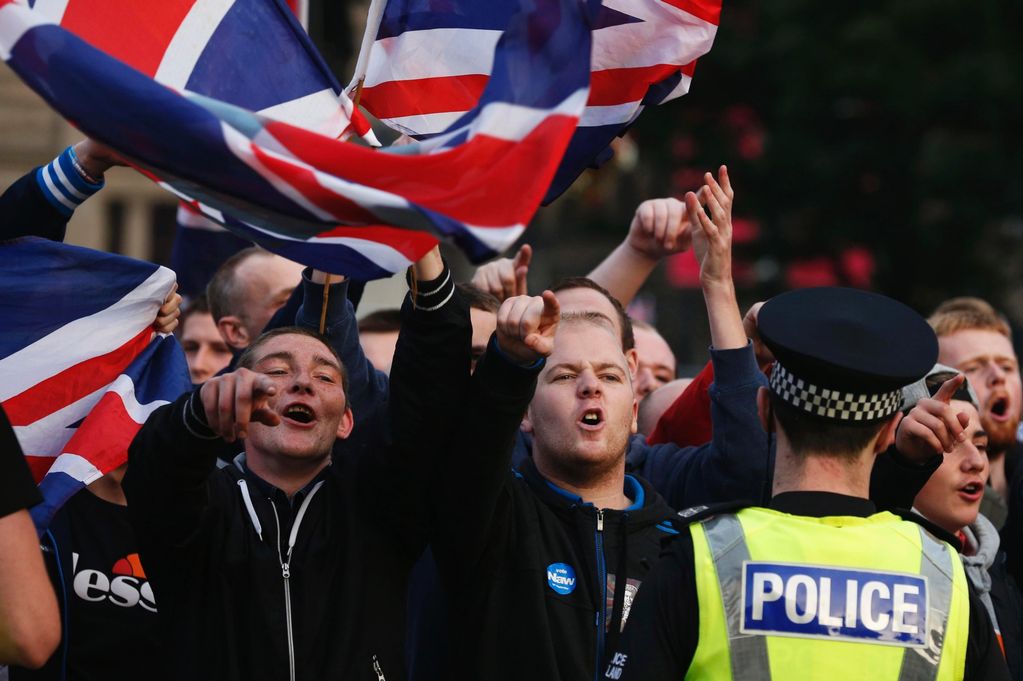
Last Friday was hideous. The worst part, for me anyway, was walking to work in the morning. I passed complete strangers in the street and no longer glanced at them with disinterest but with a resentful suspicion bordering on contempt, did he vote No, did she? Then I saw some Union jacks flying brazenly. I could sense the smugness brewing. Then later on it spilled out, thoroughly emboldened with a No vote, the Union’s ugliest face revealed itself. A mob of comically insecure Orangemen and women, Neo-Nazi’s and the breathtaking arrogance that usually can be found where stupidity lurks, gathered in George Square in Glasgow, to hurl abuse at Yes voters or anyone who may look like one, spit at or beat up passers by, particularly those ‘who looked a bit gay’, burn Saltires, racially abuse anyone who wasn’t white protestant, male and who defines themselves as British.
Many in the No campaign will say that these people and their actions don’t represent them, but that wasn’t the case before last Thursday, was it? Many were unconcerned that the Orange Order marched through Edinburgh, or were willingly oblivious to the venomous attacks by right wingers, be it physical, orated or written, against the Yes campaign.
Not that I’m proud of this, but my immediate reaction to Friday night’s events was equally unsophisticated and toxic; fuck the United Kingdom and those in Scotland who voted to maintain it, may they be the ones to suffer the consequences of Westminster’s impending scorn more than any other.
But that attitude is just as pathetic, and the wrong way to look at things, as almost everyone in Scotland will suffer the consequences of a No vote on some level, especially those No voters who will come to regret that decision. These will be unifying forces behind the next movement for independence.
In his resignation speech Alex Salmond said defiantly ‘that the dream [of Scottish independence] will never die’. He’s right.
Yes voters starting again on the paths to achieving that dream cannot lose sight of the fact that independence will always be the means to the end. The dream is a much grander prize – autonomy.
A week on, and having calmed down, there’s little doubt now that independence for Scotland is inevitable. This was just the beginning, the first round, in which we landed a blow that shocked the complacent defending champion, making him wobble and slither on the ropes as his equally complacent and arrogant acolytes looked on, aghast. For the first time they saw everything they believed in struggle under the duress of genuine contention.
Another legacy of this referendum is that it’s strengthened the resolve of those who voted Yes, and we’ve made many of those who voted No think about independence and its advantages. Perhaps, now, in the aftermath, having seen that nothing will be done to change Scotland’s subservient position within the UK, they’re thinking what if too.
It’s a shame that it’ll take another round to land the knockout blow. It will take a generation, perhaps two, with continued suffering for some, to crystallise any introspective doubts they had about independence into the realisation that what devolution we have, or fight to get in the interim, isn’t enough. While a prospect that seems underwhelming compared to independence, the fight for more devolved powers, no matter how meagre they’re likely to be, has become an important step in ultimately acquiring sovereignty. It will allow the Scottish parliament to showcase its preference for continued investment in free university education, to prioritise health and public services, the things that the people of Scotland voted for, despite the budgetary constrictions set by its superior in Westminster.
But for now we can only lament the reality: we were so close to full autonomy, today. Good, bad or otherwise it would’ve been ours, our votes would’ve mattered, only for most of us to reject it and send the establishment home without having tae think again.
For shame Scotland. For shame.
 Wichita Lineman Was A Song I Once Heard
You must be logged in to post a comment.