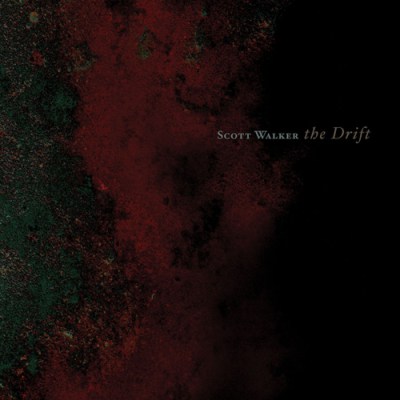
Because it’s so diverse, there are many ways to approach Scott Walker’s discography. Most tend to discover him from his earliest, most popular, incarnation, either as part of The Walker Brothers, or after he went solo with a string of quintessential late sixties albums. I was one of those people.
So when heard back in the middle of the last decade that he was making another album, I immediately thought, great, there’s a good chance we’re in for more songs like ‘Plastic Palace People’, ‘Montague Terrace (In Blue)’ ‘Jackie’ ‘30th Century Man’ ‘The Old Man’s Back Again’, and probably his most famous effort, his cover of Jacques Brel’s ‘If You Go Away’ (Ne Me Quitte Pas). To name but a few.
Needless to say I was wrong. I mean, where do you start?
In truth I was hesitant to even write a piece for “The Drift”, as I’m not sure anything written about it can do justice to its sheer structural complexity, ambiguity and nuance.
What I incorrectly expected “The Drift” to sound like, or the notion of what it should sound like, was based on my insufficient knowledge of vast swathes, make that eras, of Walker’s output. I was completely unaware of “Tilt”, which he released in the mid-nineties, “Climate of Hunter” in the mid-eighties, and his, unfairly according to many, aborted late seventies comeback. Having not heard them but listened to “The Drift”, I presupposed that inserting these eras in-between “Scott 4” and “The Drift” could provide a linear map of Walker’s dramatic metamorphosis.
Having listened to that missing chunk of Walker’s career after the fact, nothing, and I do mean nothing can prepare you for “The Drift”.
And perhaps that’s the point, or one of Walker’s main points with “The Drift”, nobody is truly ready to confront the abrasive repulsiveness of human nature and the culture it has helped construct, when done so through the medium of music. We tend not to use music to convey such ideas.
It begs the question as to whether Walker envisaged, back in his popular incarnate, the music he’s making now, or even if this concept had any sort of genesis in that era. Even in his ‘heyday’ Walker always approached subversive or politicised content, but with a conventional sound. Now he’s completely eschewed any of the artifice required to capitulate to any mode of conformity. He’s even resorted to using unconventional methods to create the effects and layers of sound on his last two albums. For example he uses the sound of massive machetes being sharpened (?) on ‘Tar’, a song from his most recent album “Bisch Bosh”. That sort of thing could be considered, from an external perspective, as being self-indulgent. Where Walker earns the benefit of the doubt, and separates himself from the pack, is the thematic content he investigates, or creates by juxtaposing random, seemingly unrelated, cultural events and extremes.
So it’s with some irony that ‘Cossacks Are’, the first track on the album, approaches the fringes of a conventional composition. There’s a guitar riff to start, then the punishing layers of drums arrive, which, with the title in mind, are appropriately reminiscent of war marching drums. It’s topped off by a hissing sound, like that of the pressure in a piston being released. I’m hesitant to find out what Walker used to create that sound, or what it symbolises. Together all of it fits with the song’s title and the song’s main motif; ‘Cossacks are charging, charging in the fields of white roses, Cossacks are charging in’. In the context of this album that image is one of the more straightforward Walker evokes. However other lines, including the next, inhibit any attempt to compartmentalise lyrics, and ascribe meaning. This is a theme that will run throughout all that songs, even if a thematic interpretation has been supplied by Walker, you’re kept guessing as to what certain lyrics are supposed to mean, ‘That’s a nice suit/that’s a swanky suit/Been a pope like no other/I’m looking for a good cowboy’. Then there’s this – ‘Touching the shattered lives it unearths/A nocturne filled with glorious ideas/A chilling exploration of erotic consumption’ – does this mean the hypocrisy of wars fought on behalf of religion? How the glory ascribed to heroism in war is false and has been and continues to be used as a commodity? Or how about this; ‘You could easily picture this in the current top ten’. Is Walker taking the piss this time? Is he doing both? Is he bemoaning the vacuous state of modern popular music? Or that we’ll consume anything regardless of its lyrical content?
You’re left with so many questions that I tend to believe that Walker aimed to construct “The Drift” so that it would make you pose these questions, and to motivate you to search for the answers. You could take each lyric in isolation, and extract meaning, or use what you believe to be the song’s overarching narrative, and go from there. Intentional or not, that’s the great skill of “The Drift”, each listener extrapolates what they can from each song, and that their existing belief or opinion they’ve attached, or interpreted, is expedited, be it analysed, strengthened or changed.
On repeated listens of “The Drift” you do become far more confident in deciphering the pattern, that Walker’s using each song to make a point of some sort. The question is what? On ‘Jesse’ Walker’s pretext is that 9/11 and Elvis Presley’s still born brother are somehow interlinking examples of the effects of the death of America’s cultural hubris, when the central paragons that buttress its own mythology are visibly and viscerally destroyed.
With Walker providing this context, deciphering the lyrics takes on an entirely different quality. In ‘Jesse’, the first line stands out; ‘Nose holes caked in black cocaine’. My take – this is Walker’s way of bemoaning the disposable and cynical visual idiom at the root of media driven popular culture. As an ‘event’, 9/11 immediately became a marketing tool for reinvigorating patriotism, celebrating the martyrdom of those who perished, and a grotesque money making spectacle, with all of it at the retraction of libertarianism. Its mesmeric nature – why else did we watch it for hours? – superseded what you knew to be the terrifyingly real consequences of watching the towers fall. The image of people wading through that thick dark dust in the immediate aftermath of the World Trade Center collapsing, marries Walker’s lyric and something Karl Marx once said: ‘Religion is the opium for the people’. Well here I suspect Walker is implying that Religion has been supplanted by our fascination with disasters or crises, as they can now be unashamedly consumed for pleasure with a safe degree of detachment. Such events have always acted as a vehicle for a form of covert pleasure, or wonder if you prefer, but now the emphasis has shifted, with the media annexing it into an organised virtue. In the era of Twitter, Reddit and twenty-four hour news channels, gawking at death and destruction is not only encouraged, but it’s seen as normal to do so, ensuring we become further conditioned and desensitised. Elvis’s physical and mental decline was also a matter of public consumption. Black Cocaine was used as camouflage. In the eyes of many, even in decline, Elvis Presley was the ‘King’, that title allowed him to be cast as a figure without the need for empathy. That is until he died, unceremoniously, unglamorously, humiliatingly on the shitter. The World Trade Center was the most imposing building on the Manhattan Skyline until it crumbled, humiliatingly. Neither of these events are as humiliating or degrading as our consumption of them, or the inevitability of us unashamedly mythologizing people, or events, with toadying, cowed retrospectives, just to cleanse our morality.
It’s hard to say what the best song on the album is, because this isn’t a piece of work that can be judged against a standard or an expectation. However, ‘Jesse’ clearly takes some beating, by anything. Not only for the enticingly esoteric concept of Walker juxtaposing Elvis and 9/11, but once you become aware of the song’s meaning, its composition works to enhance its message. The orchestra of string instruments creates a deep drone, before a slow creeping guitar that reverses on itself works to create a sense of unremitting dread, which only increases when Walker’s imperially discerning accent enters the fray. The dread builds, as the drone gets louder to mirror the pauses between Walker’s creepy narrative, eventually leading to the chorus where Walker screams in a pained tone; ‘Famine is a tall tower/A building left in the night/Jesse are you listening?/It casts its ruins in shadows/Under Memphis moonlight/Jesse are you listening?’ Finally there is the eerie dual popping sound, which occurs periodically, and is the skillfully isolated audio of the moment when the towers started to collapse.
Given the relentlessly dystopian tone of this album, the subject matter and its title, I came to the conclusion that each song on “The Drift” represents the many facets, or faces, of our drifting towards destruction. At least that’s what it has made me believe. While the human race will survive for some time yet, what shape will it be in? What shape is it in now? Despite the advancements in literature, science and medicine, we’re a species prone to repeating mistakes and that insidiously finds ways to poison itself and its surroundings.
This is central theme of ‘Cue’, where Walker, without irony, I suspect, empathises with a virus. Lyrically he subtly vacillates between anthropomorphising its thought process, ‘I will follow the aerosol patterns’, to documenting its physical effects, ‘From scratchless I ascend’, as it spreads indiscriminately across the globe, ‘Now embark for the Ivory Coast’.
As you’re paralysed, or eventually, after multiple listens, enthralled, it’s easy to forget the importance of the music in helping to convey meaning. On ‘Cue’ the lyrics fit seamlessly to its impossibly rich background. Walker not only creates a sense of dread, but he does so with the listener being fully aware of the impending doom of his narrative.
It all starts with that forlorn trumpet, the first few bars carry an optimism, which soon dissolves into being solemnly macabre, almost overdubbing as it fades away. All you’re left with is Walker’s voice, those creeping strings and a muted, distant drumming, that always threatens to overwhelm, or arrive, but never does. The creeping of the virus is conveyed through the intermittent plucking of slackened strings, from multiple Cellos or Double Basses. Screaming Violins and Violas arrive as Walker howls in frustration at the virus’s inability to adapt quickly enough, ‘Immunity won’t feed on the bodies/Bones closing/Too soon at the tips/Won’t feed on the bodies’. This is followed by Walker chanting Bam repeatedly, then the same number of audible blows to the carcass of some animal. The noise itself sounds like nails being hammered into wood. It gives an audible manifestation of the brutal effects of the virus’s silent work.
Like most of “The Drift” the ending to ‘Cue’ teases and on first listen disorients you. You’ve psychologically prepared yourself for the banging of the slab of meat again. The build up is the same, but instead you’re given the dreaded strings and muted drum, which create a layer over the chorus; ‘Stars led to sky/Lash led to eye/Herpes to clit/Then stopped’. This time the song ends abruptly after ‘stopped’. This suddenness, I imagine, is the actuality and totality of death, and the end of the virus’s journey and its success. Walker is making a statement about how we view our mortality, and spend most of our living lives deluding ourselves about what reality of the end entails. The combination of Walker’s depiction of mercilessness psychological and physical suffering in most of his songs, when set against the nothingness of death, makes a mockery of this fear.
Of course you’re entitled to be completely bemused with the notion, particularly on first listen, that this is an album that you’d choose to listen to. The question then becomes what compelled me to listen again?
That would be trying to understand ‘Jolson and Jones’. In particular what ‘punching a Donkey in the streets of Galway’ has to do with the grossness of spring, the River Dix, Curare – which is a South American poison – which, repeatedly ‘Brogue cries out from the street’. This is set against booming clock chimes, a pulsating, pounding industrial synth, and the sound of someone walking down the steps into the street to meet Sonny Boy, where the proclamation that I’ll punch a Donkey in the streets of Galway occurs, before Walker vocally mimics the sound of the Donkey’s death, or at least that’s what I think it is. And then there’s this soliloquy, which precedes a strangled schizophrenic sax and Walker’s repeated chants of Curare:
The chair had been shifted ever so slightly say five feet or two centimeters
The prints of my fingers dusted from doorknobs
A lamp had been dimmed
Some sawdust where a ring had been
Where nice girls were turned into whores
Gardens with fountains where peacocks had strutted
Where dead children were born
The splendor of tigers turning to gold in the desert
Pale meadows of stranded pyramids
Is all of this derived from random experiences, real and subliminal, that Walker’s had? And just who are Jolson and Jones? You can spend hours and hours re-listening, scrambling for answers, and I have. Each time my interpretation shifts, and I can’t wait to return to have another go.
And that’s the bottom line, despite all the gimmicks, the oddities and repulsiveness of Walker’s content, the demonic Daffy Duck impression on ‘The Escape’ encompassing all three, no matter what you think of “The Drift”, you will have a reaction to it.
Which brings us to an empirical truth – when you encounter anything especial you always remember it; how it felt, how you reacted, what you thought at the time, even if your memory alters and embellishes it over time. The same is true of art, all great art, whether it be sculpture, paintings, performance and music, is memorable. I’ll never forget “The Drift”, how it felt, how I reacted, what I thought at the time I first listened to it, or how it’s altered my view of things over time and how that’s altered my view of it.
You suspect that Walker knows that “The Drift” will be the finest thing he’ll ever do. It’s a work full of contradictions, appropriately, like the human psyche. It transcends memory, into an experience of a personal introspection. “The Drift” makes you think about the darkest recesses of humanity, your humanity, and how you’re expediting “The Drift” towards the formality of its irrevocable decay.
Go on, give “The Drift” a try. I dare you. Scott Walker dares you, dares you to think, to think and improve yourself, to stop ‘drifting’, as it were.




You must be logged in to post a comment.