Ah spring time, the nights are getting longer, and it’s finally light outside when I make my way to work. Small mercies. The spring equinox also signals the time of year when all the major issues in the various leagues around Europe are close to being decided. Up until this point it had been a strange Premier League season, with so many teams either in contention for European places or relegation. The usual sub divisions that have appeared in seasons past were slower to reveal themselves this. There seemed to be a squeezed middle, which many of you will no doubt be able to empathise with in a more obvious form. Only time will tell if this will become the norm in the future, given the ever increasing disparity between the financial have and have nots, I suspect so.
Thankfully for the purposes of this column, things seem a bit clearer than they did in January, when I did my halfway report. I’ve provided a link if you want a good hearty laugh at how awful I am at predictions. Yet like the degenerate gambler at the blackjack table who’s in a drunken catatonic stupor after pulling an all night session where he’s lost the kids Uni tuition, pawned the wife’s jewellery and remortgaged the house, I’ll always believe I’ll get it right next time.
We now know there are three sides with a legitimate chance of winning the league, with three sides competing for two Europa League places, and as many as nine teams in the hideous scrap to avoid relegation.
As per usual I’ll supply my previous predictions; preseason, at the quarter way and half way points, as well as my new final prediction. And why not, there’s something nice about basking in the hypocrisy of someone else’s fickleness.
Will I be able to keep this column under 10,000 words? Doubtful, so don’t bother reading on if you have a life, you already know I don’t. You’ve been warned.
The Riff Raff (The Relegation Candidates):
CARDIFF CITY
Current League Position: 19th
Pre-season Prediction: 18th
Quarter Way Point Prediction: 15th
Halfway Prediction: 16th
Final Prediction: 20th
I’ll freely admit that I knew nothing of Ole Solskjaer’s managerial and coaching credentials when I heard he’d gotten the job. In a way my perception of the hire was jaundiced by the disappointment of Vincent Tan not appointing himself as manager. My reasoning was malicious, Cardiff are terrible, so why not, at the very least, make it interesting as a form of vacuous voyeurism? On the back of this I jokingly suggested in January that Solskjaer should get his boots on if he wanted to really help Cardiff survive. Is it a joke now?
Things haven’t improved since Solskjaer took over, just seven points from their last eleven games. That has to change. Quickly.
Steven Caulker, a centre back, is their second highest scorer with four. That needs to change too.
Unsurprisingly there’s a chronic lack of quality throughout this team and squad. It’s a shame Craig Bellamy’s thirty-five now. Then again, if he was younger he wouldn’t be playing for Cardiff City.
As it stands they’re not scoring enough goals, tied for second fewest with Norwich City and Sunderland, only Palace have scored less, and yes, this will be a recurring theme among the Premier League’s underclass. No wonder Colin Wanker looks so smug these days when he appears on BT Sport’s dreadful football coverage – Ian Richardson excepted, obviously.
Initially I thought, of the bottom teams, on paper at least, they had one of the better January windows. Ken Jones would offer pace and a physical presence, and Wilfried Zaha, while clearly overhyped, would offer some degree of unpredictability which had been seriously lacking. There’s the possibility of Cardiff benefitting from Zaha’s ostracisation by David Moyes. This isn’t an indictment of his ability, just ask Ross Barkley, but even so rejection usually motivates players. Zaha is playing to save his Manchester United career, as there’s the very real possibility that David Moyes won’t be there when Zaha returns from his loan spell at Cardiff.
Now that the Liverpool game is out of the way, other than Chelsea, who they play on the final day, their run in looks favourable. Again this is ‘on paper’, just like the supposed quality of their January signings, which haven’t panned out so far. I reckon four wins from their next six games would save them. They’ve won six games out of the previous thirty, and so you see where this is going.
Just a thought, but playing two strikers more often might be an idea. Solskjaer did so against Liverpool, but neutered any possible advantage by playing three leaden footed centre backs. Yes going four-four-two may seem archaic, but if you’re shite, not scoring and are running out of time, having more bodies further forward is at least a logical step to solving one of those problems. My skin is crawling at the thought of Colin Wanker and Harry Redknapp’s burgeoning bromance towards me for my proposal.
Here, I’m picking them to finish bottom. One of the benefits of relegation could be the departure of Vincent Tan. Cardiff fans deserve better, and surely they’d take relegation if it means he fucks off? I will confess he was amusing at first, here I compared him to a ‘theocratic dictator who has mirrors on every wall in his mansion’. Now I see him as just a sad middle aged clown on a power trip. Meanwhile Cardiff fans are left to rue what might’ve happened had Malky MacKay remained in charge.
FULHAM
Current League Position: 20th
Pre-season Prediction: 13th
Quarter Way Point Prediction: 12th
Halfway Prediction: 15th
Final Prediction: 19th
What a mess. And yes, it’s been caused by another clueless owner.
Fulham’s owner, Shahid Kahn, now has the distinction of owning two of the poorest performing teams in both the Premier League and the NFL. In Fulham’s case farcical would be a better adjective. His actions since taking over Fulham suggest that both his franchises (vomit) aren’t suffering due to a lack of luck but simply ineptitude informed by hubris. I know nothing of how he runs the Jacksonville Jaguars, and I don’t care, and neither do Fulham fans. What I can glean, at a glance, is that the Jaguars are shite and have been for years and Kahn hasn’t made things better. This only becomes an alarming piece of evidence when placed in direct conjunction with the goings on at Fulham in the short space of time he’s been around. He’s turned what was a stable outfit into a complete basketcase. If ever a perennially ensconced midtable club wanted to ensure relegation, it would use Fulham’s season as a blueprint.
We might as well start with the most obvious problem, having three managers in one season. I won’t even bother gathering any facts or figures to support my claim that this sort of upheaval never ends well, as anyone in their right mind knows this. The question then becomes is Shahid Kahn in his right mind?
Here are the records of Fulham’s managers this season:
Martin Jol: G: 13 W: 3 D: 1 L: 9 PPG: 0.76
Rene Meulensteen: G: 13 W: 3 D: 1 L: 9 PPG: 0.76
Felix Magath: G: 5 W: 1 D: 1 L: 3 PPG: 0.80
We’re dealing with small samples here, of course, but that each of the Points Per Games records is similar would make the more analytically inclined deduce that the manager wasn’t the problem, and that Fulham’s decline was inevitable due to a chronic lack of investment, and a club that attempts to sustain itself on cheap signings and aging cast-offs from other Premier League clubs is only heading for one eventuality.
Still, I have a number of questions that seem completely at odds with any modes of rational thought. At least I’ve put them in sequential order;
Did Kahn want Martin Jol as manager? And if not, then why let him start the season in charge?
Why was Meulensteen brought in as a coach when he’d last been a manager at Anji whatever the second name of that new nuevo riche Russian club is? And why, when he became manager, was he given so little time in charge?
Where was the sense in appointing ‘Average’ Alan Curbishley, who hasn’t managed in over five years, to a role he’s never done before? Only to sack him three months later?
Why sack a manager and replace him just after the January transfer window’s closed? It always winds me up when clubs do this. It’s bonkers.
Why, when you’re bottom of the league, do you make mass changes to the squad? For clarification those out: Hughes, Berbatov, Ruiz, Senderos and Taarabt, and those in: Heitinga, Kvist, Holtby, Dempsey, Cole, Tunnicliffe and Mitroglou. In particular why loan out Berbatov, your top scorer, and buy a replacement, Mitroglou for £12m, who has only just now, in March, returned from injury? Yes, bringing in Lewis Holtby on loan was a smart move, he’s far too good for Fulham, but it’s like buying a Porsche 911 after having burnt your house down.
Despite all of these affronts to logic they still have a chance of surviving. They’ve conceded seventy – fucking seventy! – goals this season. That seems impossible. The Premier League everyone! The win over Newcastle wasn’t convincing, but we’re long past the point where performances even remotely matter. Fulham need wins and preferably they need a succession of them.
Now that the Manchester City game is done with, their remaining run in offers a large helping of hope, with a dash of cruelty and schadenfreude for the gawkers who always revel in watching other clubs drown slowly – Everton (H), Aston Villa (A), Norwich City (H), Spurs (A), Hull City (H), Stoke City (A) and Crystal Palace (H). Can they win five of those games? Yes. It’s not inconceivable that they could win their last three games to survive ala ‘Arry with Pompey a few years ago. Will they emulate this feat? Absolutely not.
Where there’s impending tragedy there can be comedy. Enter Felix Magath, and more specifically Jan Aage Fjortoft’s stories of Felix Magath’s methods when he played under him at Eintracht Frankfurt. They’re priceless. Here are the best ones:
SUNDERLAND
Current League Position: 18th
Pre-season Prediction: 15th
Quarter Way Point Prediction: 18th
Halfway Prediction: 20th
Final Prediction: 18th
They have two games in hand. This is good. But they’re both against Liverpool and Manchester City, and they’re both away from home, where Sunderland have only won three games all season. Not so good.
They’re yet another side who struggles to score goals, joint second fewest in the league. Of their strikers Fabio Borini looks the best bet. At the very least you know he’s going to play at one pace, the only one he knows how to, with a rabid, Tevez-esque energy that only Latin players seem to possess. Giaccherini and Adam Johnson seem the most likely to create something. But Giaccherini doesn’t always start, which is a mystery. As much as there is to admire about Adam Johnson’s game, it’s a bad sign if he’s your top scorer, and even worse if he’s your top scorer by some distance. He has seven goals, which isn’t bad for a winger, but that’s twice as much as any other Sunderland player.
If anything will consign them to the drop, other than allowing Paolo Di Canio to remain as manager at the start of the season, it’ll be their central midfield. It contributes little to their ability to attack (as pointed out above) or defend well, they have conceded the sixth most goals. Seb ’whinger’ Larsson and Lee ‘clatter ‘em’ Cattermole are both dreadful, but Poyet continues to select them. I know it can’t inspire Gus to look at Craig Gardner and the ginger lad in training every day and talk himself into them being a solution, but improvement is improvement, and at the very least Gardner occasionally contributes a goal, and Colback, yeah that’s the ginger’s actual name, isn’t likely to get himself sent off routinely like Cattermole. You could forgive Cattermole the odd red card if he was half as good as Roy Keane, but that he isn’t is part of the reason Sunderland are so poor.
Much hinges on Adam Johnson. At his best he’s one of the few players on any of the relegation contenders who is capable of creating and scoring and he’s got a place in Brazil, and more likely a possible move to a better club, to play for between now and May.
Without looking at their remaining fixtures, my gut said they’d survive, albeit by default, but having looked I’m less confident they’ll stay up. They still have to play Manchester City, Liverpool, Everton and Chelsea, teams who’ll all be playing for European places and League titles. As easy as it is to ridicule Manchester United and Spurs for their respective seasons, it’s a different proposition for Sunderland, with their many problems, to go away and get a result at Old Trafford and White Hart Lane.
It’s a shame really, as Poyet is a more capable and ambitious manager than most of the other sides in the relegation scrap can claim to have. Had been in charge at the start of the season Sunderland would surely be better placed heading into a difficult run in. It wouldn’t surprise me if they finished bottom.
CRYSTAL PALACE
Current League Position: 17th
Pre-season Prediction: 20th
Quarter Way Point Prediction: 20th
Halfway Prediction: 19th
Final Prediction: 17th
The problem for me is that I have to pick one of Sunderland, Fulham, Cardiff and Crystal Palace to survive. Four doesn’t go into three. If only it did…
Things to make you smile: The prospect of seeing a Tony Pulis side relegated. No offense to Palace, it’s not your fault he manages you, you didn’t ask for him, but my team Liverpool plays them on the penultimate weekend of the season. To paraphrase King Kev ‘I’d love it if we beat them. Love it…and relegated Pulis’. I hate Pulis, can you tell? The skip hat and nonce coat wearing ‘have it’ ‘they don’t like it up’em’ homeless man’s Charlie ‘Long Ball’ Hughes twatcunt.
Things to make you sad: That a team managed by Tony Pulis, that has only scored nineteen goals all season, might survive. It’s more depressing than Marouane Chamkah’s futile attempt to counteract male pattern baldness. The poor man needs an intervention, and the Premier League needs shaving too.
I have to pick one of these teams to stay up. It’s Palace. They have twenty eight points, that’s three more than the three currently below them, so I’m taking them (the points). Fuck me. Fuck my life. It could all come down to the last day when Fulham play Palace at Craven Cottage. I won’t be watching.
WEST BROMWICH ALBION
Current League Position: 16th
Pre-season Prediction: 10th
Quarter Way Point Prediction: 10th
Halfway Prediction: 12th
Final Prediction: 16th
Another team who struggles to score goals. The game against Cardiff City at the Hawthorns next weekend will decide much, win that and they’re probably safe, or at the very least well on their way to being so. I don’t know much about Pepe Mel, but I’ve seen three West Brom games since he’s taken over and it’s clear he’s trying to encourage a more meticulous and discerning brand of football. However that’s not easy with Victor ‘Mini Purple Aki Anichibe up top.
Now we have a break in proceedings for a rant.
Once again we see the FA’s shameless hypocrisy in relation to their contribution to the ‘Kick It Out’ racism campaign. I can accept, with reservations, that Anelka’s ‘quenelle’ salute exists on ambiguous ground. There’s a debate as to what it means, and what Anelka intended it to mean. Most right minded folk believe in a person’s right to innocence until guilt is proven, but the FA exist in their own vacuum, free to make it up as they go along. They aren’t answerable to any higher body, and, as with any body that isn’t democratically elected into power, it soon abuses power for vanity and self interest. We’ve seen players railroaded and branded as racist with evidence that is at best circumstantial. Whatever you may think of John Terry, he was acquitted in a court of law of racist abuse, yet the FA still banned him. Remember Robbie Fowler supporting Liverpool’s dock workers with a t-shirt years ago, the FA fined him.
All these examples of attempting to sanitise footballers and their behaviour becomes petty grandstanding when set against the weekly racism, xenophobia and homophobia displayed weekly on terraces up and down the country. Will the FA do anything about this, which is far more insidious and vile? No because it’s easier to publicly shame some footballers than some faceless moron. Here they can look tough without recourse, while everyone else looks on and sees, quite clearly how transparent you and your part in the campaign has become because of this. It’s a campaign of moralising self interest, it’s designed to homogenise football with the specific goal of making money, not for the betterment of football’s culture. It’s insulting to people who suffer from actual forms of racism every day. A lack of jurisdiction is often evoked, that it’s a matter for police, for society. As Thatcher once said, there’s no such thing as society, but in such a society there are organisations like the FA. Selfish to the core.
We should ask why the FA has come to exist in its current format with its own mandate. One of the most damaging sociological legacies of Thatcherism is our acceptance of institutional ineptitude as inevitable. We are a culture that encourages and judges aspiration based upon financial improvement, and it is gamed so that to be aspirational is so often linked to modes conformity. And as such conformity gets applied in a wider context and becomes the cultural expectation. You, and your clubs, conform to the FA’s silly kangaroo court, because to defy it would cost them, and ultimately hurt your club. And if you accept that, what’s next? You accept unelected coalition governments, and their ghastly destructive policies. You accept bedroom tax and austerity. We’ve become a culture of capitulators, where instances of injustice, or improper justice, are common place.
So when Anelka got railroaded, very few spoke out to decry it. We have created a culture of people who likely haven’t had an original thought in their lives or have been brought up actively discouraged from doing so, and why not? They’ll do as they’re told. You’ll accept anything.
Time to fight back. Don’t fund the FA. Don’t attend FA cup games and in particular don’t attend their fucking glamour England international friendlies at their soulless £900m white elephant. Where the best seats, reserved for the VIP’s, are always empty when the second half kicks off.
As for Nicolas Anelka, all I’m in a position to do is judge him as a footballer. If this is the end then in a way it’s fitting. It mirrored the tenor of his career, good, occasionally great, but you knew it wasn’t going to last.
NORWICH CITY
Current League Position: 13th
Pre-season Prediction: 17th
Quarter Way Point Prediction: 17th
Halfway Prediction: 17th
Final Prediction: 15th
Liverpool (home)
Manchester United (away)
Chelsea (away)
Arsenal (home)
That’s their last four games of the season. Brutal. Of course we’re looking at it through the lens of the present, by the time Norwich get there they may already be safe, in practical terms, and how motivated will these sides be? United’s domestic season is likely to be completely over, Arsenal’s title challenge is virtually over now, and will Liverpool still be involved in it by that point? And anyway why can’t Norwich take something from those games? Especially the home ones where they’ve had a good home record since the turn of the year, where they’re undefeated – Three wins and three draws.
I personally don’t think they’ll need anything from those final four games to survive. Once again the law of diminishing returns applies. Can you see any of the bottom three clubs finishing above them? They play West Brom and Fulham before those final four games, win those and they survive, comfortably. Nothing more needs to be said at this point.
Finally, just a quick comment on Chris Hughton, and all the consternation that occurred when his position supposedly came under threat recently. His being anointed a sacred cow amused me, as he is now the only manager in any of the four divisions ‘of colour’ – first, phrasing it in that way is patronising, and second, that he is or was one of the few non white gaffers playing their trade in professional management was likely an accurate representation of British demographics. But there’s no angle to that, is there?
Anyway he’s still in situ, and more power to him. He seems like a nice bloke surrounded by a sea of corrupt white shite.
SWANSEA CITY
Current League Position: 15th
Pre-season Prediction: 16th
Quarter Way Point Prediction: 16th
Halfway Prediction: 11th
Final Prediction: 14th
Another team that’s suffered due to the uncertainty over their manager’s long term future. Michael Laudrup no longer has one.
Michu has returned for the run in. Between him and Wilfried Bony I’m picking Swansea to survive, because goals, goals. Because goals, because Colin Wanker sez goals lad. The equation is simple, get Pablo Hernandez, Jonjo Shelvey, Bony and Michu on the pitch together and they’ll stay up comfortably. No other team in this section has remotely that amount of quality to call upon. And I always back talent.
However, I’m disappointed in Huw Jenkins. There are so many idiot chairmen around these days, that it’s always nice to see one succeed through common sense and long term planning, all of which has been put at great risk through a rash sacking.
WEST HAM UNITED
Current League Position: 14th
Pre-season Prediction: 11th
Quarter Way Point Prediction: 11th
Halfway Prediction: 18th
Final Prediction: 13th
Despite all the problems, injuries, and red cards to his first choice attack, Big Sam has West Ham (hey it rhymes) in a decent position to survive. I almost put them in the ‘Shite, But Safe’ section. The reason? They have thirty one points, it seems like enough, especially with eight games left. They’re six points clear of the drop, so they basically need to be three results worse than the bottom three: Cardiff City, Sunderland and Fulham between now and May to go down. Unlikely. My confidence in their survival is also partly based on their remaining fixtures. They play Hull City at home, West Brom away, Sunderland away and Crystal Palace at home. They only need to win two of those games to stay up. It wouldn’t surprise you if they took points from one or all of their remaining home games against Spurs (whose season in the process of collapsing) and Manchester City and Liverpool, while both are title contenders, they’re more vulnerable away from home as all sides tend to be.
This isn’t a side you enjoy watching, as it’s suffered from a lack of flair that Sam has usually indulged, particularly with Djokaeff and Okocha at Bolton. His existing options to add some ingenuity and unpredictability aren’t great; Joe Cole is finished now, Vaz Te is average and injured, and that’s it. Jarvis is a decent winger, but neither he nor Stewart Downing play with much ingenuity. Jarvis looks to use his pace to hit the by line (Moyes is interested), while Downing, usually deployed on the right flank, cuts in on his stronger left foot to whip in crosses. This strategy has worked better recently since Andy Carroll has returned to work in tandem with Kevin Nolan, but long term, West Ham won’t achieve anything other than mediocrity with such functionality.
West Ham’s fans are aesthetes, so how long will they put up with the bare minimum, retaining their Premier League status, while using the rugged survivalist football Big Sam specialises in? Goldie and the smut hound may see it differently, just as long as that Premier League bounty keeps coming… …and in the meantime there’s another reason to want the Hammers to stay up. It doesn’t get any better than this, does it?
No Man’s Land:
HULL CITY
Current League Position: 12th
Pre-season Prediction: 20th
Quarter Way Point Prediction: 19th
Halfway Prediction: 13th
Final Prediction: 12th
Look, I’ve ridiculed Steve Bruce plenty, but he’s a decent middle manager who doesn’t overburden himself with unnceccessary complications. If you’re struggling to score goals, because your main striker, Yannick Sagbo, is pish, and you lack alternatives, sign some strikers. So he heeded Colin Wanker’s advice and spent money on the attack. Jelavic and Long have already played their part, putting Cardiff City away. Shane Long may be ordinary, unless you’re Irish, in which case he’s a cross between Alan Shearer and Kevin Keegan, but at least he’s got pace and strength. Nikica Jelavic, if nothing else, is a canny goalhanger. Both are huge upgrades for Hull City over Sagbo leading the line alone, isolated.
There were reasons for concern after their home loss to a Manchester City side down to ten men for most of the match, there was absolutely no skill, ingenuity or most worryingly belief on show. Thankfully much of the Premier League is rotten, and that includes West Brom, who they beat this weekend at home. That gives them thirty-three points. Barring a catastrophic collapse, similar to that which has befallen Steve Bruce’s nose, they’re safe.
Shite, But Safe:
ASTON VILLA
Current League Position: 11th
Pre-season Prediction: 14th
Quarter Way Point Prediction: 14th
Halfway Prediction: 14th
Final Prediction: 11th
Sigh.
Too many points already, or so it seems. Anyway, let’s see how they cope next season after Benteke’s gone. Paul Lambert’s still a fraudulent anachronism and Randy Lerner’s spending very little. Perhaps, like Everton (who’d be a good destination for Benteke) – who also flirted with relegation for a sustained period – Villa are just too big a name to go down. They’re certainly helped by the ever expanding Premier League underclass. Then again the same thing was said about Leeds United, and they’ve still not returned. Flirt with the drop enough times…
Just to clarify – I’d have nothing against them if they played better football, but other than Stoke (and even that’s debatable now) and Palace (for obvious reasons) no other team is worse to watch. It’s all about running in straight lines and looking for knockdowns from Benteke’s chest. Fabian Delph is the only one who you could envisage playing in a more cultured side. Imagine if every team played like this? Football would die. I wish this incarnation of Villa would, by any means necessary. Given the dire state of their squad it probably won’t for a few years. It’s a real downer, let’s just move on.
STOKE CITY
Current League Position: 10th
Pre-season Prediction: 16th
Quarter Way Point Prediction: 16th
Halfway Prediction: 11th
Final Prediction: 10th
Meh, whatever, again.
Eh what else? Petey boy Crouchy deserves to make the England squad, but won’t, because Roy Hodgson is a…yeah, emmm…
…Oh, while we’re here, get a load of this.
This thread was dedicated to the build-up of their home game against Arsenal a few weeks ago, and they wonder why they’re so disliked. Weirdos. There’s myopia, then there’s denying that Ryan Shawcross broke Aaron Ramsey’s leg. I’m not suggesting he intended to, by any means, but to suggest the challenge didn’t cause Ramsey’s injury is just bizarre.
Anyway I’m going to take solace in the fact that Mark Hughes is their manager, and that nearly all sides decline, eventually precipitously, under his stewardship. I’ve watched several of his post-match interviews this season. Imagine if a reality doc about Mark Hughes exposed the ghastly truth that he applied his always hard done by attitude to all parts of his life?
Mark arrives home after a hard day at Stoke’s training ground, aka the potato fields, he’s tetchy as Charlie Adam threw up on him for the second time this week. Mark is greeted by his wife. ‘I’ve got the dinner on luv’ Mark looks increasingly vexed, ‘what’s wrong’ she asks, ‘It’s isn’t fair’ replies Mark, ‘If only you were better looking and had bigger tits, then I wouldn’t be so average in the sack. It’s a complete injustice to me, so it is’.
Midtable Mediocrity:
NEWCASTLE UNITED
Current League Position: 8th
Pre-season Prediction: 12th
Quarter Way Point Prediction: 13th
Halfway Prediction: 8th
Final Prediction: 9th
What’s that saying? Oh yeah – Birds of a feather stick together. It was no surprise that Mike Ashley stuck by Alan Pardew after his altercation with the nameless and faceless second rate Hull City player. To be fair to Ashley, and I have no reason to be, he was right to keep Pardew. The tough guy has done well this season given a lack of transfer funds, getting Loic Remy on loan was one of the signings of the season, getting anything useful out of Ben Arfa is an achievement, and he lost his best player, Yohan Cabaye, to PSG in January.
Also, while we’re at it, I refuse to call it a headbutt, or even an attempted one, it wasn’t.
The good news is that Newcastle United are safe, Tyneside’s police horses are completely safe and Joe Kinnear’s gone. Getting rid of Mike Ashley won’t be easy. Hardened arteries are looking the best bet at this point.
SOUTHAMPTON
Current League Position: 9th
Pre-season Prediction: 9th
Quarter Way Point Prediction: 7th
Halfway Prediction: 9th
Final Prediction: 8th
You’ve heard it daily now for a few months, and it’s insufferable and insulting to the Saints – can they hold onto their best players? Now the talk is focusing on their manager too. That part, at least, is understandable. Spurs, increasingly desperate, are currently run by an idiot (scroll down for that in more detail) who tends to be a victim of appointing fashionable flavour of the month types after losing patience too quickly with the previous one he appointed. Mauricio Pochettino is the latest name to be linked to them. He’s done a very good job with Southampton. I always come away impressed by his team’s tactical organisation and how you can see his coaching abilities conspicuously embodied in the improvement of Southampton’s young players since he arrived. If you beat Southampton, you’ve really earned it.
They could have four players on the plane to Brazil, of course this relies on the OFC (Old Fucking Codger) aka Roy ‘budgie faced cunt’ Hogdson actually having a clue. Regardless, not even Hodgson is inept enough to leave Luke Shaw and Adam Lallana at home.
Heading into the Spurs game they still had an outside chance of Europa League qualification, but that’s gone now, they now sit six points behind Manchester United in seventh, having played a game more than those around them. Had they held on against Spurs there was scope to finish sixth, as they still have to play some of the sides surrounding them; Newcastle, Everton and Manchester United.
I’ve put them in the ‘Midtable Mediocrity’ section simply because I think it’s too little too late, and seeing as I get so many predictions wrong I might as well, at this point, if nothing else, show some bloody conviction, even if it’s to pick something as borderline irrelevant as a midtable finish.
One final point, I like the fact that Pochettino still does his interviews through an interpreter. His reason seems innocuous enough – that he doesn’t want to be misunderstood or misquoted. What it does do is bring out the sneering resentment of all the little England xenophobes and wide boys that have invaded the sports media. ‘It’s wong dat dat dere foreigna can’t speak English innit, how he gonna get dem ideas of his across?’ Meanwhile they’re blissfully unaware of the irony that none of them can speak a foreign language, and I bet Pochettinho can already speak English better than they can. Arseholes.
Europa League Contenders:
TOTTENHAM HOTSPUR
Current League Position: 5th
Pre-season Prediction: 6th
Quarter Way Point Prediction: 6th
Halfway Prediction: 7th
Final Prediction: 7th
Dat’s a facking disgwace, innit?
My use of Timmy ‘funnelling’ Sherwood’s idiom is appropriate, as I have to ask, just when is Daniel Levy going to come under some serious scrutiny for being an awful chairman? Once again too many have been blinded by his ability to sell players for big money, Thatcher’s children always in the thrall of cash, eh? It’s quite clear he’s a good businessman, but he’s also living proof that making good football decisions isn’t synonymous with business acumen.
Here’s a list of the managers and directors of football who he’s either inherited, hired and fired since becoming chairman, and the durations they were in charge in brackets:
Directors of Football:
Damien Comolli (2005 to 2008)
Franco Baldini (2013 to present)
Head Coaches/Managers:
George Graham (sacked by Levy in 2001)
Glenn Hoddle (2001 to 2003)
Jacques Santini (sniggers) (2004)
Martin Jol (2004 to 2007)
Juande Ramos (2007 to 2008)
Harry Redknapp (2008 to 2012)
Andre Villas Boas (2012 to 2013)
Tim Sherwood (2013 to present)
This list isn’t exhaustive either, it doesn’t include David Pleat’s various caretaker stints, there have been three of those, or Clive Allen’s one time. So that’s eight head coaches/managers and two directors of football hired, £575m spent on players over twelve years, and all Spurs have to show for that is one fourth placed finish and a league cup in nearly thirteen years under Levy’s chairmanship. Still, Daniel Levy’s net spend stats will look great on an Excel spreadsheet: £211m spent net, which works out at roughly £17.5m per season, seeing as you didn’t ask.
That he’s vacillated between the continental European director of football model and the traditional British manager controls all structure, is an indictment on his judgment, and his lack of conviction in sticking with any method. It’s the darts thrown at the dartboard analogy, throw enough and you’ll eventually hit the bullseye, right?
I just wonder whether that one time they qualified for the Champions League lead to some delusions of grandeur of what they should be achieving year in year out. That Harry Redknapp was sacked at the end of the following season for having the temerity to finish fifth and reach the European Cup quarter-finals suggests so.
We have to consider the possibility that being a huge fan of a club and running said club isn’t an ideal combination. In such circumstances the ability to exercise emotional detachment to make clinical decisions and to be able to see your own flaws can be easily compromised. You care, likely too much, seeing your team fail and underachieve hurts, you’re the chairman, so you’re ultimately responsible. You’re responsible for selling Gareth Bale late in the window, giving Franco Baldini little time to spend the money from his sale. You oversaw Baldini spend a fortune on mostly second rate players with a first rate transfer kitty. He still has his job, why? Despite all that cash spent you went into the season without a competent left back. Then, like the fan you are, you overacted to a 5-0 home drubbing by Liverpool, when a cooler head would’ve recognised it was just one game, and that Spurs were five points off fourth place with more than half the season left to play. But no, you decided that Tottenham’s chances would be enhanced if the manager/head coach job was bequeathed to Timmy Sherwood.
That Sherwood’s achieved virtually the same points per game average as Villas Boas, and the same goal difference, leads you to the conclusion that while neither were or are the solution, they aren’t the big problem. They’re a variable, that’s been varied within a wider pool of variations, and as such it’s eliminated them from anything more than being marginally responsible.
While Sherwood is clearly unqualified for management at this juncture, let alone this mess, he has been cruelly teased with an eighteen month deal, which even he can see offers absolutely no guarantee of his position and stability to a club that badly needs it. He’s been handed a squad which is bloated in certain positions – does any club in Europe have more central midfielders? – deficient numerically, particularly up front, and is largely constituted of players who are overrated. Kyle Walker is one of those who fall into the overrated category. Yes we have to account for the fact that Roy Hodgson is the England manager, but he’s not the only one who rates Walker, who is one of the stupidest players I’ve seen, at any level. All of this guff supports the narrative that Spurs are contenders, or should be. Their goal difference, currently standing at zero, after thirty-one games, suggests otherwise.
Bottom line – despite the farcical goings on in Salford this season, no club goes into this summer with more uncertainty than Spurs. I have no idea what will happen, and if recent history is anything to go by, neither, I bet, does Daniel Levy, which is a sobering thought for Spurs fans.
MANCHESTER UNITED
Current League Position: 7th
Pre-season Prediction: 3rd
Quarter Way Point Prediction: 5th
Halfway Prediction: 5th
Final Prediction: 6th
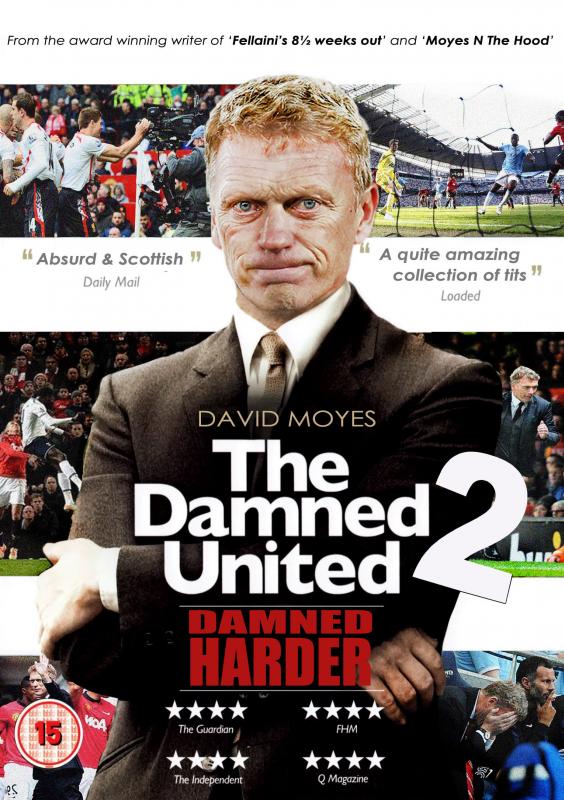
Right so I’ve gotten that pot shot out of the way, let’s get serious now…
I could write two thousands words on the causes of this mess, and I have. Oh sweet validation nom, nom, nom…
Right okay, now I will be serious. There’s an interesting phenomenon at work here, exemplified by a line from the brilliant True Detective which is applicable in this context: ‘namely what is owed between us as a society for our mutual illusions’. Some United fans are mutually, with plenty of encouragement from large swathes of the hapless televisual and print media, colluding to wishfully believe the desperate and delusional narrative that’s been peddled that United’s dire season is primarily not Moyes’ fault. At this juncture it’s hard to decipher what percentage wants him out, and what percentage wants him to remain. During their pathetic loss to Liverpool the majority of fans supported the team, clearly. Privately, however, you do wonder if they back Moyes and whether, in this instance, their supporting the team should be construed as synonymous with supporting the manager. Either way it could easily be construed as support for the manager by those who have a vested interest in wanting to see him succeed. The club might just be happy that this impression is being propagated, as they now look completely daft having given Moyes a six year contract, and after their teeth clenching slogans of Moyes being ‘the chosen one’ who’ll make sure ‘the story continues’. Another angle is that United have been successful for so long that some are convinced that the club has become immune from any long term failure, perhaps as they belong to a generation which has never experienced their club going through a sustained period of mediocrity. This partly informs the belief that David Moyes will turn it around with time, not because he’s anything good, but because he’s at United.
The media are responsible for infusing this narrative with their perpetual, insidious, hateful brand of petty xenophobia and Thatcheristic aspiration, the kind where people are primarily rewarded for being like their kin, and by that I mean they exist on the same intellectual plane, and are unable or unwilling to conceive of the world other than it is. David Moyes has paid his dues you see. He’s worked his way up the levels, he’s worked hard, therefore he deserves this. You can tell he wants it. He’s earned it, having won nothing. This calibre of candidate is preferable to giving it to some flashy foreigner with a better resume, obviously. Seeing Moyes succeed would validate many of their narrow beliefs – namely that ‘our’ football mores and traditional beliefs can still transcend foreign structures and ideas which have produced better results for decades now, some of it in English football no less. Perhaps there’s a perception that this European influence, of having a tiered management structure, is starting to pervasively take hold in English football, so we need to see evidence that the way we do things is still the right way. Moyes succeeding and United seeing it through would redress the balance. United are complicit with their own moralising crusade, in the face of an age where managers are disposable, they’re taking the stance of giving their man time. That he’s a second rate manager at first rate club doesn’t seem to matter.
Of course these are just, just theories, not facts. What we have heard is a combination of the players being blamed, that Ferguson didn’t plan for the future and left Moyes the duff hand of an average squad, and that this isn’t Moyes’s squad, and because their movement in the transfer market has been numerically, not financially, insufficient to date, it has hampered him in shaping it. The other reasons for the decline in United’s performance, which are unfavourable to Moyes, have been given less play; that Moyes’s training methods are seen as monotonous and archaic by many players and have lead to injuries to key players, specifically Rooney and Van Persie. The accusation that he’s tactically rigid, at best, is apparent to anyone.
Here are the facts: David Moyes inherited the league champions. He’s spent £60m plus on Juan Mata and Marouane Fellaini. There have been no significant departures. Adnan Januzaj, probably the most gifted young player to come through United’s ranks since Paul Scholes, has broken through and made an impact. At worst United have the fourth best squad in the league, it could easily be argued their squad is better than Liverpool’s or Arsenal’s, yet they sit well out of contention for anything, other than Europa League qualification.
Of course they’re still in the Champions League. We’ve seen mediocre sides win it before, but a mediocre side managed by David Moyes? You can overcome having a side with certain components that are mediocre, as we’ve seen in the last decade with Porto, Liverpool and Chelsea to name three. But can you overcome having a mediocre side and a hapless manager? Unlikely. Chelsea’s run in 2012 seems to be the hope, the template. But they had a better defence, they had Mata and Drogba and they got very lucky. United will have to eliminate three of the following; Dortmund, PSG, Atletico, Real, Barcelona, Chelsea and Bayern Munich, who they play in the quarter-finals, to win it. No, I thought not.
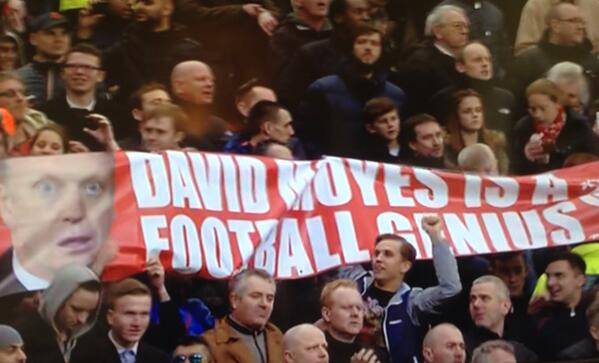
Back to Moyes. What does it say about him that fans of opposing clubs are openly begging for him to stay on social media, or are making sarcastic banners like this? –
The signing of Mata and how Moyes has utilised him has been an embarrassing episode (the irony here is that it’s obscured an even bigger embarrassment for Moyes, the signing of Fellaini). Mata’s one of the best number tens in the league, a club record signing, who Moyes has banished to the wing, where he’s been largely ineffectual and has looked either demoralised or perplexed as to what’s happening or what he should be doing. It sums up United’s season, and in my opinion, why Moyes is completely unsuited to the job. He seems to have no concept of where he is and what that should require of him – ingenuity and bravery. Despite mediocre results and football, he’s attempted to change nothing. In the game against Liverpool last weekend Moyes was faced with a tactical problem to solve, how to counter-act a diamond midfield. It caused United problems and Liverpool dominated for the majority of the match. Despite watching his team struggle Moyes made no change to the system or the zones in which his team operated. With Januzaj and Mata both tucking in, it suited Liverpool’s narrow set up. United failed to take any advantage of the space out wide, while Liverpool had plenty of space on the counter attack and even when United got back in numbers they still found space beyond United’s outnumbered and statuesque central midfield. There are three possible explanations as to why Moyes did so little and none of them bode well, either he didn’t think something was wrong (unlikely), or he did see it wasn’t working but didn’t know how to change it (possibly), and lastly he saw it wasn’t working but he decided to stand pat and have faith that things would turn around. This one is the most likely candidate in my opinion. David Moyes is entitled to believe that his methods got him this job, so why would he change now? You can’t expect a mediocre like Moyes to be self critical and analytical in the face of his ego being invigorated exponentially as United’s ‘chosen one’.
I made the joke on Twitter, quoting “Goodfellas”, that giving Moyes this squad is ‘like putting a silk hat on a pig’. And that applies to their football too, Moyes has some regal talents eating out of a trough. They’ve gone from football which used to be high octane, ambitious and relentless to a drab negative mess. Don’t underestimate the effect this has on the Premier League’s brand. To have a United side that’s so pedestrian and irrelevant is bad for business.
Speaking of bad business there’s Wayne Rooney’s new contract. We’ve seen Rooney extort United before, but this time felt different. No Ferguson or David Gill this time to keep his demands in check. Moyes is beleaguered, Woodward, new to his position, is in a tough spot, and the Glazers aren’t around. Rooney, or more likely his advisors, capitalised. On United’s part it was clearly an emotional decision, not a calculated one, which they negotiated from a position of weakness. Now they’re heading into next season with an aging, occasionally unfit and at times unengaged player who is due £80m plus in wages over the next five years. This will have to be very likely founded without Champions League revenue for at least one year, and with millions having been wiped off United’s value on the stock market. Even though the ‘dire’ state of the squad has clearly been overblown, it does need funds invested, and invested well, particularly in the central defensive and midfield positions. Given Moyes’s use of Mata and that he’s already had a go at fixing the midfield issues by signing that useless donkey Fellaini, with United’s immediate prosperity on the line, would you be confident in David Moyes doing further buying and selling?
This clearly has scope to get much worse before it gets better.
The good news for United fans, as exemplified by Liverpool’s turnaround, is that things can change quickly, provided The Locust (as I’m now calling him) isn’t around much longer.
Gary Neville said that clubs like Manchester United don’t stay quiet for long, and I agree, but the longer David Moyes stays in charge, and people believe the narrative that surrounds him and club rather than the palpable evidence on the pitch, the longer it’ll be before they’re making noise of the positive kind.
EVERTON
Current League Position: 6th
Pre-season Prediction: 8th
Quarter Way Point Prediction: 8th
Halfway Prediction: 6th
Final Prediction: 5th
About right where they should be. Now that sixth place qualifies for the Europa League, with Man City’s win in the League Cup final, they should have European football next season. It would be fitting if they finished ahead of United, for obvious reasons, the main one being for the good of football. Regardless, I fully expect them, being a resolute mob, to capitalise on the impending Spurs collapse. Can they catch Arsenal? If there were more games remaining I’d give them more of a chance. According to this they have a ten percent chance of finishing fourth.
They’ll also be hoping that their former manager gets canned. If he isn’t he’ll be back, looking to plunder Everton, ironically no longer Everton as he left it, to ‘Evertonise’ Manchester United. Likely candidates include; Seamus ‘braindead’ Coleman, Ross Barkley, who Moyes didn’t use much, but has developed very nicely since Moyes departed, having been tutored by a better coach (which he outlines here). Kevin Mirallas has been Everton’s best player this season, and one of the better attacking midfielders in the league, he’s yet another who’s improved since Moyes departed for United. I’m sensing a theme here. Then there’s Leighton Baines. No doubt Moyes wishes there was a rule that meant he was conjoined at the hip with Bainesy irrespective of contractual obligations to clubs. Baines has signed a new contract, so at least Everton will get a bunch if Moyes comes a calling. One thing Everton have done well in recent times is receiving above market value for their players. They once received £24m for Joleon Lescott, yes it was from Manchester City, but still.
It hasn’t been all good news though. They got spanked at Anfield, which dashed growing hopes of a power shift on Merseyside for the umpteenth time. Whenever Everton have done well to position themselves to transcend their local rivals they’ve fallen at the final hurdle, and it’s been happening for nigh on two decades now. Add Bill Kenwright’s inability to help them and the sense of frustration is palpable and growing.
Signing Aiden McGeady was Martinez’s first big gaffe since taking over. He’s a triple threat – shite, fat and lazy. Martinez is likely to learn, given Everton’s limited finances, that such mistakes can be costly. Consider this – Lukaku, Traore, Barry and Deulofeu (I still can’t spell his surname without checking) will depart for their parent clubs for nothing, many of Everton’s stalwarts are aging, and their most valuable assets; Baines, Barley and Mirallas will attract serious interest. This side could look completely different by next August. There will probably be one or two key departures this summer, it’s imperative that Martinez isn’t one of them.
Fourth Place Contenders (Title Pretenders):
ARSENAL
Current League Position: 4th
Pre-season Prediction: 4th
Quarter Way Point Prediction: 3rd
Halfway Prediction: 3rd
Final Prediction: 4th
‘Wenger Out’ eh? Dickheads. Look at what’s happened at United this season. Take a moment.
It’s difficult to see them winning the league from here. For a multitude of reasons:
They’re Arsenal, and they haven’t won anything in eight years.
Right okay, that’s a shit reason. Over a length of time probability and opportunity render the informed truths that are always based on historical facts as irrelevant. One day Arsenal will win the Champions League. Honest. Whether we’ll live to see it is another thing entirely.
There are better reasons why they’ll find it hard, currently they’re missing three of their best players; Theo Walcott, Jack Wilshere and Mesut Ozil. Only Ozil will return this season. Aaron Ramsey is yet to return at the time of writing. You need your best players available for the run in. It’s just that simple.
Ozil and Wilshere are Arsenal’s most creative attacking midfielders, and crucially the best at retaining possession, which Arsenal have struggled with recently. Ramsey’s goals have been sorely missed. Walcott’s pace and direct running adds necessary variety to the attack.
They’re seven points behind Chelsea with eight games remaining. They have a 1.1% chance of winning the league according to these metrics here.
The realistic goal should be to win the FA cup – finally! A trophy! – and to finish third, gaining automatic qualification to the group stage of the Champions League. The last thing a top side needs is that annoying third round playoff, likely against a decent side, coming off a shortened pre-season due to the World Cup in which many of Arsenal’s players will participate. And if they win the FA cup, which they should, then they’ll be involved in the Charity Shield, which is another game on the calendar at the start of the season.
The next three league games will decide their chances. They play Swansea City at home, Manchester City at home and Everton away, after that they have no games against top six sides, it’s all relegation fodder, or teams likely to be on the beach (Newcastle).
While results are everything at this point of the season, and beating Spurs last weekend was huge, the performance, and the manner of it wasn’t convincing. I can’t remember the last time Arsenal sat so deep and absorbed pressure like that – during the George Graham era? Not only that they were so poor in possession, not only accuracy of passing, but a lack of movement, a lack of adventure to attack space and be available for the man on the ball. This Arsenal side is the slowest it’s been in years, with Walcott out the only other player with genuine pace is Oxlade Chamberlain, who doesn’t seem to know what he’s doing half the time.
This weekend that caught up with them, as they folded at Stamford Bridge, just as they did at Anfield last month. Not even that bizarre red card, wrongly given to Kieron Gibbs instead of Oxlade-Chamberlain, can be used as an excuse, they were already two down at that point and under the pump. Once again we saw Arsenal fail to press the ball as a unit while the back line stepped up, with ten men. This doesn’t work, and yet they have a propensity to do the nonsensical when things start to go awry.
It was hard to envisage Arsenal winning the league with an attack spearheaded by Olivier Giroud and or Lukas Podolski, with Mikel Arteta anchoring the midfield. If only they hadn’t pissed about for most of last summer. They never had a realistic chance of signing Luis Suarez, but had they paid up for Gonzalo Higuain…well, yeah. It’s imperative that Wenger is more decisive this upcoming summer if Arsenal are going to get back to challenging for and winning leagues.
Title Contenders:
LIVERPOOL
Current League Position: 2nd
Pre-season Prediction: 5th
Quarter Way Point Prediction: 4th
Halfway Prediction: 4th
Final Prediction: 3rd
Now this is a team that doesn’t lack pace or quality in attack. Clearly. Suarez and Sturridge alone have scored more goals the three quarters of the clubs in the Premier League. Staggering.
They’ve been the most exciting team to watch this season. That doesn’t mean they’re the best, that’s yet to be decided, but I can’t imagine many neutrals would begrudge them winning the league.
There’s also little doubt that Brendan Rodgers is the manager of the year. Liverpool finished seventh last season, twenty eight points behind the champions. They’re challenging for the league, and have a genuine chance of winning it with eight games remaining. That’s an incredible turn around. Another facet to admire about Rodgers is his ability to maximise a player’s talent. We’ve seen Sturridge flourish since he’s arrived from Chelsea and been utilised properly for the first time in his career. Sterling, Henderson and Flanagan have all improved immeasurably since Rodgers took over, and Suarez is playing the best football of possibly anyone around right now.
Then there’s Steven Gerrard and this new role that Rodgers has assigned him. I was sceptical at first. It’s important to analyse why that is. I’ve always seen Gerrard’s wide repertoire of skills as best utilised in attack, and no wonder, during the 2008/09 season, the last time Liverpool were relevant, he was the best attacking midfielder around. But as Liverpool now have Sturridge and Suarez as well as Coutinho and Sterling as attacking midfield options, Rodgers needed to find a balance and to find a role for Gerrard.
Several aspects of Gerrard’s abilities have often come into question down the years. One of the primary accusations was that he lacked game intelligence. It was always a bogus assertion; Gerrard’s instincts are to go forward, when positioned as one of two central midfielders that left him in a position where he could affect all aspects of the game, but expecting him to do so equally is both unrealistic and impractical. It’s why Rafael Benitez often didn’t.
But many did when he played there. He was given the deluxe package you see. That means everything; strength, pace, height, technique, vision, and a fearlessness that meant he was never afraid to seize the moment or take on any challenge put in front of him. That lends itself to having self confidence and belief and a desire to use those abilities wherever possible.
Just as Sergio Busquets and Andrea Pirlo are classified as defensive midfielders, really they are deep lying attacking orchestrators, using their skill to initiate attacks from their own half. That their technique is so certain, it allows them to receive the ball back to goal, just in front of the centre backs, with complete confidence to turn on it and face the opposition goal, even under pressure. Add in excellent distribution and this frees up more time and space for the attacking players in front of them to do damage. That Rodgers attempted to replicate this with Gerrard has been a masterstroke. In hindsight it seems so logical. Rodgers has now constructed a team where Gerrard no longer feels compelled to do things that others cannot, as they now can. And it has liberated him to do the one thing his team needs from him now – to use his range of passing and self confidence to shoulder the burden of being the instigator of Liverpool’s fantastic attacking output.
There was an interesting (and enjoyable for me of course) aspect to watching Liverpool’s performance against United at Old Trafford last weekend. For all the talk that David Moyes needs time and money to reshape this United squad to fit his tactical paradigms (try not to laugh), Rodgers fielded a Liverpool side in which all ten outfield players were at the club last season, a season in which they were mediocre for large swathes of it. It just goes to show that coaching, good coaching that is, and being a manager who believes in a concept, yet is constantly prepared to analyse his ideas and be malleable to subtle changes within its structure, can transcend certain disadvantages, namely money, time, and in this Liverpool side, a lack of depth.
There are few excuses, if any, left for Liverpool if they fail to finish within four or five points of the champions. They have the best player in the league, they have the top two strikers, and the lack of squad depth hasn’t been a factor for them recently, and it shouldn’t be from here on in. They have no other competitions to worry about. You can bet your arse Rodgers won’t reach for excuses if Liverpool fails to win it from here. He’ll be looking to rectify the reasons why we didn’t for next season.
It’s tempting to look at the remaining fixtures and identify the two home games against Manchester City and Chelsea as the games that will decide the destination of the league title. But we all know it doesn’t work that way. Who saw Chelsea losing to Villa last weekend?
Realistically Liverpool should be of the mindset that they need to win seven of their remaining eight games, drawing the other, to win the league. Can they handle the pressure? Can I?
MANCHESTER CITY
Current League Position: 3rd
Pre-season Prediction: 1st
Quarter Way Point Prediction: 2nd
Halfway Prediction: 1st
Final Prediction: 2nd
Yes, they have games in hand, and if, if they win them, they’ll go top, but I’d rather have the points on the board, especially as they’ve not been playing well (relatively speaking) as of late and Sergio Aguero’s still out and is uncertain to return.
Negredo has dropped a level, and I’d argue that Dzeko is a superior player anyway, but Pellegrini prefers the Spaniard it seems. However, creating and scoring goals hasn’t been an issue all season, defensively is where they look suspect, and the central midfield pairing still looks imbalanced. It certainly cost them against Barcelona, whether it will cost them the Premier League title is less certain. Yaya Toure has little interest in defending, particularly tracking runners, and given his immense attacking contribution that’s understandable. One of the reasons he left Barcelona – other than to get paid and play with his brother – was to play in a more advanced position for the first time in his career. He probably felt he’d earned it for all his wasted years spent breaking up attacks at his many stops and masquerading (well, it has to be said) as a centre back for Barcelona, when he could be doing this. A genuine partner for Fernandinho will surely be procured in the summer window, meanwhile City will just have to muddle through with these two, and with Silva, Nasri, Milner and Navas helping out. 🙄
It’s staggering that for all the money that’s been lavished on this squad, there are still some terrible deficiencies in it. Fernandinho aside, City’s summer spend didn’t alleviate many of the existing issues. Martin Demichelis has started too many games this season and if you need to use Joleon Lescott at any point, for any reason, you’ve wasted what should be a huge advantage. Jack Rodwell and Javi Garcia are the back up central midfielders. None of this is good. But most of it can’t be laid at the door of the new management team at City. It’s hard to sympathise with clubs like Chelsea and City, given the immense advantages their resources gives them, but they have been unfortunate that Stevan Jovetic, a superior player to Edin Dzeko and Alvaro Negredo, hasn’t been fit nearly all season, and that Sergio Aguero has also missed eleven games (so far) through injury. One wonders what the partnership of Aguero and Jovetic would’ve produced. There’s always next season for that.
My reasons for not picking them to win the league are two fold, first is their run in. I can see them dropping points in a few matches, namely Liverpool (away), Everton (away) and maybe Manchester United (away) though I’ll probably regret putting that one in. Perhaps they win all of these games and make me look foolish, it wouldn’t be the first time.
And secondly I’m still not convinced by Manuel Pellegrini. Is he a better coach than Roberto Mancini? Of course I realise that it’s very hard to quantify such arguments. He’s a better fit, philosophically, for what Txiki Begiristain wants to implement, but is he really the best option for the long term? I know of Pellegrini’s record, his achievements at Villarreal and Malaga seem reasonably impressive given the profile of those clubs, but I don’t see the cause for all the hype that surrounded his appointment by the self anointed experts on social media, and based on what I’ve seen from City this season, I don’t see a clear upgrade. Mancini, at least, has several league titles and domestic cups on his resume with Internazionale and Manchester City. Though perhaps that was down to opportunity. Maybe Pellegrini would have a similar haul if he’d had Mancini’s opportunities? Now he gets the chance. The nagging impression I have is that several managers, like the manager of their main rival for the title, would’ve gotten more out of this squad than he has this season, and that the destination of the league title shouldn’t be in doubt.
The Favourite:
CHELSEA
Current League Position: 1st
Pre-season Prediction: 2nd
Quarter Way Point Prediction: 1st
Halfway Prediction: 2nd
Final Prediction: 1st
You can look at this two ways, that changing your position shows you’re open minded, and are malleable to evidence and or changing circumstances. It’s that or you’re a weak prick who doesn’t have the conviction to stick with his original pick. I won’t be offended if you pick the latter.
Before last weekend my pick edged back to Chelsea. Then Aston Villa happened.
Dispatching, or rather slaughtering Arsenal at home brought me back into the fold, just.
But of course, as per human nature, I always look for ways to betray myself. I did this a few hours ago and now I’m looking at the fence of cowardice longingly again. I gave my best attempt to dispassionately predict the remaining league games, and this is what I came up with:
Chelsea – 86 (+51)
Manchester City – 85 (+65)
Liverpool – 85 (+59)
Arsenal – 78 (+27)
Too close to call.
Still I’m picking them based on a few factors. City’s run in is tougher and Mourinho’s just a better manager than Pellegrini. Unsurprisingly they have the best defence. The signing of Matic has made a difference. He’s a classy operator that can finally both liberate and supply Chelsea’s vast array of quality attacking midfielders. He completely bossed Arsenal’s midfield at the weekend.
Chelsea also have Eden Hazard, what a gem. If not for Luis Suarez he’d be the heavy favourite for player of the year, he’ll easily win the young player award. Premier League watchers should enjoy him while they can. I see him being vain enough to be enticed by the thought of becoming a Real Madrid Galactico. And it’ll happen within two years.
The hesitation I have is whether continued participation in the Champions League, and I fancy them to get past PSG in the quarter final, will hamper them in the league. Any potential semi-final would bookend the league game against Liverpool at Anfield. It’s likely that Chelsea will need something from that game. Still, that’s a long way off.
I can take solace in certain constants, like my hatred for Roman Abramovich, always pictured in the stands gurning like a mentally defective daytripper that’s perpetually perplexed as an insignificant chunk of his misappropriated billions fizz about on a billiard surface, with the odd plastic flag getting waved unenthusiastically. This is the face of greed being good, and it working.
Mourinho is the other one who deserves much scorn. He’s a rancid totem of a mediocre culture that is declining. A sociopath, who, to validate his existence, encourages a celebration of hype and bewilderment at such a shameless display of distasteful, rude egotism. That he gets it is a sad spectacle, and it makes it difficult for me to be magnanimous about his vocational abilities, which are significant.
And if you believe, as I do, that style is the answer, then seeing this Chelsea side triumph over Liverpool or Manchester City should give you cause for pause. Chelsea fans don’t care, but I don’t care much for them and their Nazi salutes either.
To put it simply, given the mediocrity of their remaining schedule, if they can avoid defeat at Anfield then they’ll be heavy favourites. Sadly the task of getting a point (or better) at Anfield falls right into Mourinho’s wheelhouse, and he now has all the pieces to achieve such a result. Chelsea will get that point at Anfield and win all their remaining games and win the league.
You know what, perhaps I will watch that Fulham versus Palace relegation six pointer after all.
Enjoy the rest of the season folks, if you can. Peace out.




You must be logged in to post a comment.