
Maybe you haven’t heard. GTA VI was released last week. Around the same time Michael Carrick was mercifully released from his duties as Manchester United manager.
GTA V first appeared in 2013. The same year that Alex Ferguson retired as Manchester United manager.
Why do I mention all this? Well, it’s thirteen years between the releases of GTA V and GTA IV, and United have, in that time, hired and sacked seven permanent managers. A diffuse bunch with differing styles of play, clout, number of trophies won (or none), Premier League experience (or lack of) and connection to the club (or not); David Moyes, Louis van Gaal, Jose Mourinho, Ole Gunnar Solskjaer, Erik ten Hag, Ruben Amorim and Michael Carrick.
That’s the same number of managers as United had in their previous sixty-eight years. I’ll concede this comparison is somewhat unfair, as that extended period included the tenures of Matt Busby and Ferguson.
Just how many more managers will United get through before GTA VII arrives?
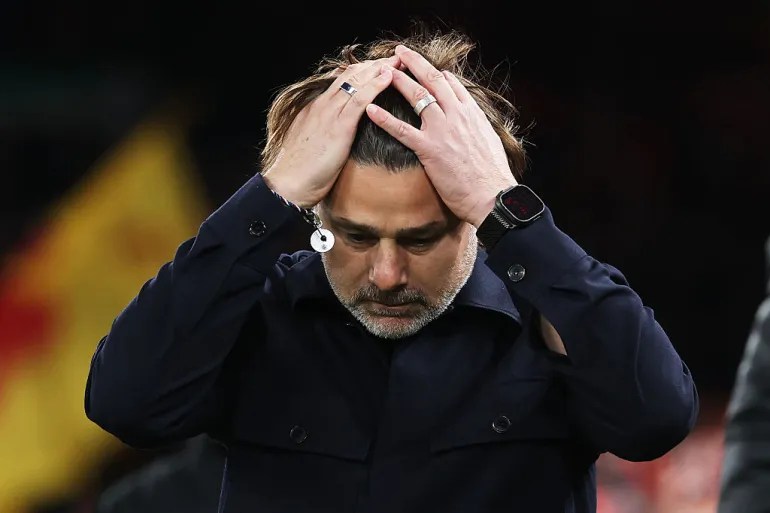
First up, Maurico Pochettino. Given recent history, Pochettino still being in post a year from now, with no imminent threat of redundancy, would represent stability.
Stability. Manchester United have become the antithesis of it. A lack of vision plays its part, but the root cause of this post-Ferguson malaise is rather straightforward – historical myopia meets consistently dreadful recruitment.
Fans of the club would reflexively push back on the above, and retort with ownership representing the large slice of the blame pie. First, the Glazers, who have disgracefully siphoned over a billion pounds from the club in a Leveraged Buy Out to pay for their ownership of it. Followed now by “Sir” Jim “Catweazle” Ratcliffe, the local lad made billionaire cheapskate, who sacks dinner ladies at Carrington, lives in Monaco but indulges in xenophobic rhetoric that insinuates Renaud Camus’ Great Replacement Theory has merit, supported Brexit and has presided over United wasting tens of millions sacking three managers in as many seasons.
Blaming the ownership comes with conflicting emotions for United fans, including embarrassment, when we recall Alex Ferguson’s ego and greed playing a significant hand in the Glazers gaining control of the club. Ferguson’s tawdry legal battle with John Magnier over the stud rights to the racehorse Rock of Gibraltar resulted in Magnier, United’s largest shareholder at the time, selling his shares to Malcolm Glazer, making the latter the majority shareholder, partly, it is claimed, as a fuck you to Ferguson. The man who oversaw the most successful period any English club has enjoyed domestically, could also be considered the genesis of the club’s current nadir.
Is this a nadir though, or just a reversion to a default state that periodically affects all top clubs? I mentioned historical myopia earlier. The hand wringing at being an also-ran is egged on by United’s branding and an addiction to courting media attention. Both fuel a sense of exceptionalism that simply isn’t congruent with the entirety of United’s past.
Outside of the Busby and Feguson eras, United have won the league twice in their history. There have been lengthy trophy draughts and times where United weren’t relevant on the pitch. They got relegated in 1974, six years after winning the European Cup. Considering United’s history in its totality, even for half of its post-World War Two history – what we’re witnessing now; inconsistency, mediocrity, teased by unsustained spurts of promise, the odd domestic cup now and again, is the norm.
This holistic doesn’t accord with a selective mythology that the peaks are the factory setting and its marketing department’s perpetual obsession with superficial and arbitrary measures of United’s scale; having the biggest stadium, most fans worldwide and being the most famous club. United could boast they were the most successful English club until a few years ago. What matters most? Worryingly, the wrong answer – a proclivity for grandiosity, hype and mis-placed priorities is shared by Ratcliffe. His vainglorious legacy project – the barmy, hideously expensive and garish new tent stadium proposal – feels utterly tone deaf whilst the club languishes in the relegation places and the roof on the current Old Trafford periodically leaks.
It is possible for Manchester United to meet their lofty expectations. Doing so requires quality players and having a cogent plan. And so now we arrive at United’s biggest impediment – they haven’t signed enough good players over the past decade, largely because they haven’t had a discernable plan. It’s really that basic.
You could get into the weeds of a chicken-or-egg deliberation, that the recruitment’s team incoherence has been caused by the managerial churn. Or vice-versa. Regardless of whether Marouane Fellani suited a Louis Van Gaal side, we can all agree he was not a Manchester United calibre player to start with. Neither was Harry Maguire. Luke Shaw arrived under Louis van Gaal in 2014, and still survives today. Also still in situ – the recruitment team that saw Michael Carrick start the season without a reliable central defender or another centre forward that could alternate with the injury prone Benjamin Sesko.
I think back to an incisive anecdote from Roy Keane, where he recalled a defeat to Aston Villa at home at the beginning of his first season at United. Keane wasn’t unduly concerned, because, as he put it, he looked at the established players and leaders United had at the time who had won the league title the season prior; Steve Bruce, Paul Ince, Mark Hughes, Gary Pallister, Denis Irwin, Eric Cantona, Ryan Giggs and Peter Schmeichel, not to mention the great crop of youngsters United had coming through; Paul Scholes, David Beckham and Gary Neville, and thought “we’ll be alright here”. And they were.
Nobody would dare claim that any of the current squad match up to the players United had then. Or will form part of a United side that can challenge for the league in the future. Some may say Bruno Fernandes. I’d argue his cod reputation is indicative of United grasping for relevancy during a barren period. We’re told he’s one of the best players in the league, yet he has never sniffed a league title or Champions League. In reality he often folds, stops running and whines when they need him most but sometimes performs when the pressure is off. He’s their captain, and that he is perfectly embodies an institution in decline.
At Anfield, Pochettino saw a decade long legacy of transfer market incompetence up close. This is a squad full of frauds, malingerers, second raters, with many of them lacking substance to match the hype that is applied tangentially by virtue of playing for United.
Pochettino strikes me as a sane, straightforward man. Taking one of the premier jobs in club football is wise as the opportunity tends to come around only once. But for Pochettino getting the United job now is a gnarly paradox – while the club’s name still carries real heft and success would bring reverence, just look at what he’s working against.
Having bravado that you can hone any rough edges and forge a winning culture sounds great in theory, but competence is no match for this omnishambles. Not when there’s no stomach for a multi-year process. United, as a collective, are addicted to shortcuts. That the club have sacked managers in each of the last three seasons has set a damaging precedent – they’ve primed the media and fans to expect the manager to go when results go awry. Throw in inheriting a substandard squad and building a successful side under said conditions feels improbable.
For that reason, I don’t think Pochettino will work, because I don’t think this “model” of expecting him to overcome a multitude of incompetencies does. United have already tried it, seven times. United fans will be placated, momentarily. Pochettino offers hope that things may turn out differently and that’s easier than contending with your failings. Still, when the mediocrity of the players and recruitment staff run him out, at least GTA VI is now about.


You must be logged in to post a comment.