The Great British summer. Bluebottles swarm around massive dog shits festering on roasting concrete. Warmer air elevates the potency of body odours, petrol fumes, dog piss and the remnants of discarded beverages. Glass shards from bottles line the gutters. Dogs get to lick discarded ice cream cones instead of their own balls. The sound of a hundred Seagulls on the prowl for half-eaten junk food. Drinks just out of the chill cabinet. Windows are down, exposing the true extent of bad tastes in music. Ice cream vans finally appear from hibernation with their cheap twee jingles. Middle aged married men are occasionally freed to do DIY in their sheds. The low pitched hum of air-conditioning systems in a thousand miserable offices. The sight of pristine bowling greens. Overhearing agonising conversations about holidays being planned. The various verbosities of carefree cunt kids on their summer holidays. That satisfyingly sulphurous stench of meat being incinerated on barbeques. Fat bastards showing too much skin and the proud parading of tan lines and sun burnt skin. Rain, and the incessant moaning about it, as if it is somehow unexpected. The drone of a distant lawnmower. Wimbledon. Glastonbury, and the insufferably earnest BBC coverage telling us how great it is. All of this will soon be upon us.
Bi-annually there’s an addition to these tropes that embellishes and for some defines the season as truly memorable – England’s involvement in a major football tournament.
Why is it so enjoyable to watch England fail at football? Even if it’s exceedingly annoying, it isn’t just the highly disingenuous, wearisome, and fickle media hype that becomes suffocating during the tournament. It can’t be that I’m Scottish and a fan of the Scottish football team, people in other countries like seeing England fail too. Am I being overtly parochial because it’s England, a supposed ‘hated’ rival? I can’t say yes, many other things English are quite likable, and I’m simply not that bothered by how England perform in other sports, whether it’s cricket or rugby, or if they beat Scotland in some sporting context.
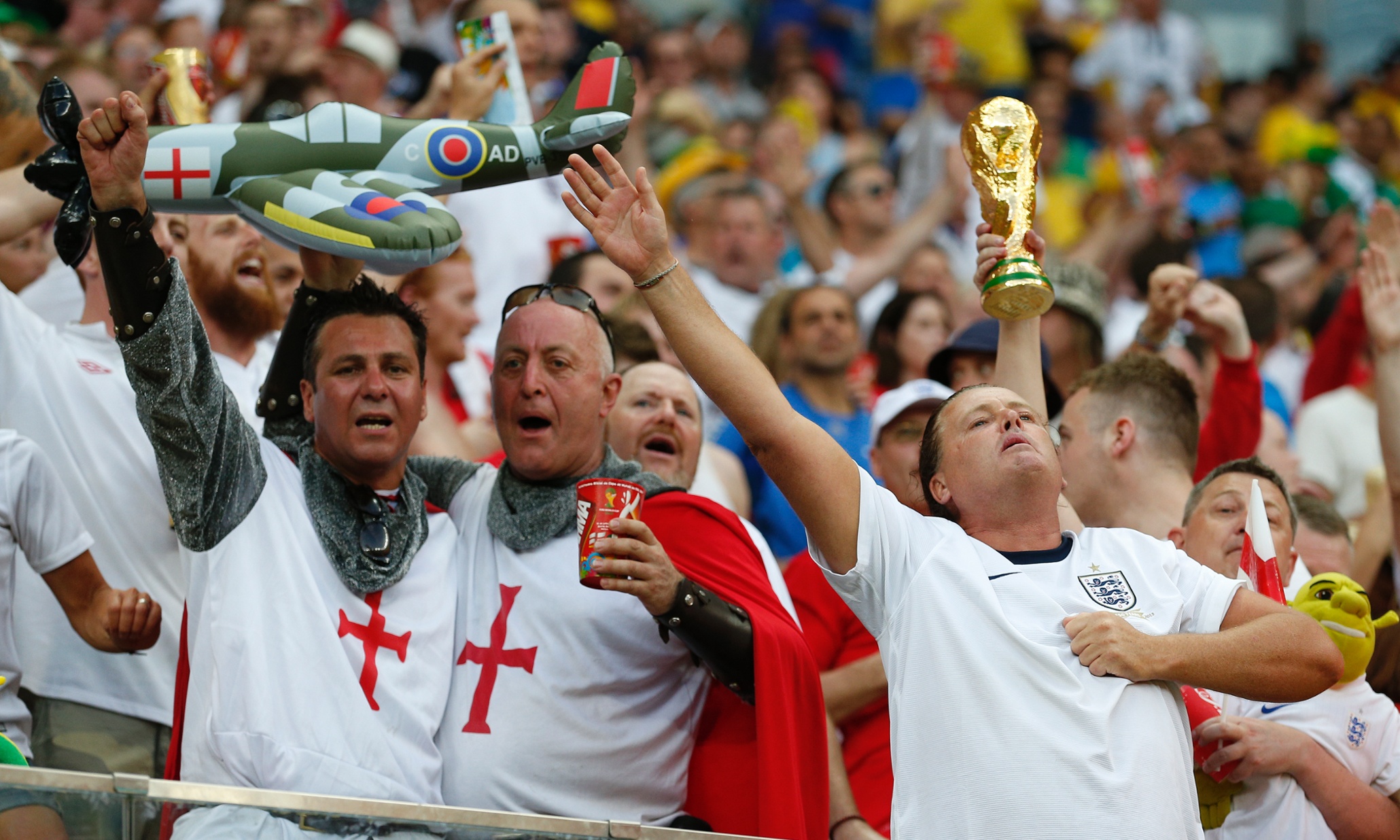
My specific issue, as I suspect it is for others, is that supporting the English football team now requires necessary adherence to a specific nationalistic dogma. This malaise, a collective primeval lobotomy, whereby a style of snide 1850’s jingoism becomes the vogue, the kind that sees chainmail being worn, “Ten German Bombers” sung and the theme tune from “The Great Escape” played on a loop by some attention seeking cunt with a trumpet, is an extreme strain of how people behave when it’s taps-aff weather (going topless to everyone else unfamiliar with the dialect). Rare occurrences tend to liberate us, offering a release from normalcy of routines, and when it’s part of a collective or consensus this encourages an indulgence in its associated behavioural traits, as these are seen as a more acceptable substitute for latent, often personal, grievances.
But it’s a bittersweet experience for these Little England fans that intertwine their self-worth and the preservation of their cultural identity into supporting the England football team. It should be a release, but it’s not, as their recent performance in the sport fully embodies the terminal decline of several sacrosanct cultural facets. The chart success of the song ‘Football’s Coming Home’ before the 1998 World Cup, for a second fucking time, was telling. Its self-congratulatory prose harkened back to past glories (an analogy for a crumbling empire) with the accompanying vomit-inducing hubris that this could be revived. That it succeeded over and above its comedic and self-deprecating rival ‘Vindaloo’ (which emphasised admirable traits of modern British culture – inclusivity and humour) is a microcosm of the myopic, craven, covert bigotry that perpetually lingers in the average unthinking, indoctrinated psyche and that freely ascends during England’s involvement in a major tournament, and what’s more it’s encouraged under the guise of ‘supporting’.
Though often blamed, expectations of success aren’t driven by the media alone; they’re too cynical for that. However, their cynicism is responsible for imbuing what already lurks beneath. As Euro 2016 is hosted in France, who’s looking forward to their inevitable headlines or television montages that reference Agincourt, Waterloo, or the two World Wars won on French soil against those ‘Gerry bastards’ (when in truth the Americans bailed us out on both occasions)?
All of this shite feeds into a sense of cultural superiority imbued by historical precedent, a specific part of which is believing that football, real football, is English, that it’s unique, and that the game is defective or rigged or just played plain wrong (all of these can be considered as euphemisms for sophisticated) if England fail. With every failure to ‘bring it home’, and re-establish the game’s authenticity, the irritable self-loathing xenophobia that motivates the next opportunity to be a ‘St. George’s flag twat’, parade around in a special (in so many ways) plastic England hat given away by The Sun, or sing songs quoting historical achievements and victories, becomes more sinister. Instead of taking pride in having successfully transposed the game to all four corners of the globe, a lasting legacy where in all but a few countries it is now the sport, England fans seethe resentfully that several of these countries have gotten better at it and have been more successful than they have, ‘at our game’. This is exacerbated by the acknowledgement that, deep down, it was caused by the hedonism of their forefathers, to take a part of home wherever they went. This still happens of course, tens of thousands go to Spain on their summer holidays, only to then spend half their time languishing in British themed pubs.
Supporting England with this aggressive vigour is one of the last conduits where a mass show of nationalist pride can be excused as the euphoric prospect of England winning at something, just one more time. At its worst, most base form, defeat, or the delicious, crushing agony of a penalty shootout loss, confirms that the culture is past its peak. They can’t accept that they’re just another saggy bum in the prison shower, the hubris of Englishness, and its inherent superiority, a given right, won’t allow it.
You’re seeing a vulgar variant of it now being transposed to and wielded during the EU referendum to support an Out vote, and we saw it used during the Scottish referendum on independence too. Some tried to beg the Scots not to leave, a desperate action that managed to humiliate everyone. It was a feint accent of the same traditional expectation; that they owned us, that we belonged to them, because that’s the way things are, and always have been. They used to own quite a few more places, but they’ve gone their own way now, and England used to be decent at football too, they even won the World Cup once.
Another element that makes supporters of the England football team so loathsome is the irrationality of their obtuse overconfidence. For players it can be excused, as some is necessary to succeed, but in a supporting context its constitution induces winces and cringes. We see this bipolar behaviour among supporters of all football clubs – they spend most of their time obsessively and mercilessly picking apart the flaws of their teams and the players who play for their club, only for it to be willingly forgotten and replaced by unwavering faith once the game is due to commence.
An extreme example of this myopia is reserved for Wayne Rooney. There has been a concerted effort throughout the years by journalists, talking heads and certain fans with a profile that all feed from or benefit from the immense wealth involved with the coverage of English football, to perceive Rooney as better than he’s actually been. He was once introduced at an awards ceremony as ‘special’ (though he was right, as Rooney certainly is in other ways) and often since as ‘World Class’, whatever that means.
In a way the continuation of this complex is understandable. It was once bestowed on Kevin Keegan, Bryan ‘Tampax’ Robson, Paul Gascoigne, Gary Lineker, then the ‘Golden Generation’ – Gerrard, Scholes, Shearer, Lampard, Fowler and yeah, Beckham, while all good players, never quite emulated the greatest players of their era, particularly at international level. It’s easier to blame them for failing England than perhaps embracing the truth that English football is defective, hidebound, shackled to its own idea of identity, and the hype that’s invested in maintaining this is detrimental to a needed philosophical reformation. The consequences of the notion that football mad England has to produce elite talent, and ‘always does’, is being felt now. They have a weak clueless manager, a new, largely untested side, and Rooney has nowhere left to hide. Not that he could; fat and content, with a laughably inflated sense of self (from years of underserved, obsequious praise), and certainly neither fit or on form, he’ll be given central billing by yes man Hodgson, based on his litany of goals in pointless friendlies and his perpetual failure to live-up to his cod reputation at major tournaments.
Who could forget Rooney’s dismal performance against Italy during the first game of the World Cup in Brazil? Most English fans and his media supporters, that’s who. Straight after the game the excuse that he needed to play through the middle ‘to be effective’ was wheeled out. How this affected the rest of the team and its chances of succeeding became an irrelevance, or, even worse, it was presented as a cure all solution for the team’s tactical and intellectual inferiority. Hodgson, being the weakling he is, acquiesced to the pressure or perhaps he just agreed with it? Rooney scored, England were pathetic and lost the second game to Uruguay and went out, but at least Rooney’s status as the crown jewel, the potential saviour at the next tournament, was maintained.
Still, continuing with this delusion is the safe choice for everyone, and good for us who enjoy seeing England fail. Another Rooney shite-fest will absolve those guilty by association for it, as it posits Rooney and Hodgson as scapegoats for this underachievement. The process can then be repeated, reserved for the next saviour – probably Dele Alli, because there must be one. This process is a gift for the FA, a hypocritically pious organisation happy to deflect and obscure its archaic and covert modes of operating from modernity, inclusivity and accountability.
Speaking of mediocrity – Roy Hodgson, the master of it, is still in situ. How marvellous. He’s exacerbating England’s dismal record of failure at major tournaments, in Brazil he couldn’t even get them to the Quarter-Finals to be thrashed or lose on penalties, but at least he’s English. Indeed, Hodgson is likely to revert to safety as England produced their most negative football in living memory at Euro 2012, where they went out on penalties to an average Italy side. A more attacking philosophy was adopted in Brazil two years later where they finished bottom of a piss weak group. There was poetic justice too, as the great Luis Suarez, much reviled by the English media and many fans, because the mercurialness of his brilliance is the antithesis of the modern English inferiority complex, became England’s executioner.
Even better, this time expectations are genuinely heightened, they had a perfect qualifying campaign, winning ten out of ten games against an assortment of second and third rate dross. Anything but reaching the semi-finals, which England have failed to do since Italia ’90, will be viewed as failure this time. It’s as if the last two tournaments didn’t happen. But it’s a ‘new team’, which brings its own narrative – new hope. The Golden Generation has gone, to be replaced by a bunch who are either a combination of brainless (Jordan Henderson, Danny Rose and Kyle Walker), grossly overhyped (Dele Alli and John Stones), past their peak (Wayne Rooney and Gary Cahill) and injury prone (Jack Wilshire and Daniel Sturridge). But really, let’s be thankful they’ve fallen for their delusional trap again, do we want the English tubthumpers to revert to a mode of introspection that encourages self-criticism, truth and reconciliation? To accept that the star above the crest was an aberration? Of course not.
Look, I accept it’s both extremely warped to derive joy from seeing such anguish, and that International football, now the poor relation to club football, is viewed as this important. Perhaps Scottish football fans, who accept our mediocrity and tragicomic failures as inevitable with humour and grace, would be like England fans if we invaded a bunch of countries in the name of and won a World Cup? Maybe, and I always look to be fair and inclusive where possible. So let me be empathic – this specific cycle of delusion surrounding the England national team and how it affects its subjects and observers is an entirely healthy means of projecting and confining historical and future prejudices on to a medium that has diminished consequences. In fact, this phenomenon is the one true thing we can all believe in, some of us just believe in its formulaic process more than others, some of us think it’s richly deserved, and some of us even enjoy it. May it never change. Here’s to another summer of schadenfreude, because I just can’t get enough.
All the arguments have been had, multiple times; what do the motivations behind our involvement with the Tomb Raider franchise tell us about our perceptions of gender equality and progressivism? Does the incremental intangible sophistication and overt desexualisation of the main protagonist over the years mirror the changing attitudes in society, or has society forced these changes within games and the gaming world? Or was it just the scope of realism afforded to developers through technological advances? Perhaps the early cartoonish incarnations of Lara Croft was one big, long, post-modernist joke, and the character created, in part, to rile those who obsessively (and therefore pointlessly) raged against forms of cheap female objectification?
You’ll be aware of these arguments; they may or may not have merit, but, well, who cares? I mean, it’s a fucking game, man. The suggestion that anyone would be aroused by a heavily pixilated, unnaturally proportioned figure is odd, but then again we live in a post Jessica Rabbit world that has Bronies in it. So, yeah, maybe some are, but where’s the harm? Whatever floats your boat, I suppose.
Anyway, such debates miss the true strength of the Tomb Raider games, and the reason the franchise has succeeded, namely its ability to combine combat with engrossing narratives that necessitates the player match the inquisitiveness of the character’s legend and finds gratification from using the old grey matter to solve the game’s puzzles. At its best it managed to offer an enticing suspension of reality by combining fanciful elements of future-esque technology with old world mythologies, think a sophisticated Harry Potter-esque world, only without a sanctimonious and myopic author lording it up on Twitter like some rotten embittered has-been.
It’s been over a decade since I last played a Tomb Raider game, so comparatively this second game of the reboot (technically within the Lara Croft timeline it’s a prequel – hence the name) contains multiple drastic enhancements. Improvements in graphics and physics are par the course in this era of games. Still, I’m playing the game in 4K with the settings on medium and well, the detail of the landscape and the characters is impressive despite having been gaming at a 4K resolution for months now. It’s the attention to detail too; clothes rip, Lara’s skin gets cut, bruised, dirtied and bloodied, and her clothes fray. Lara’s movements are fluid and her physical capabilities (not only her measurables) are somewhat realistic; she can no longer hold her breath for three minutes, and she can’t break the Olympic long jump record from a standing start. Then again, just to repeat, this is a game. It would be no fun if Lara accidently fell off a ledge twenty feet up only for the game to say abruptly – game over – Lara’s got a sprained ankle, no more climbing or rappelling for three weeks.
What makes Rise Of The Tomb Raider great is the addition of integrating survival activities and tactics to its successful formula. It forces you to be inquisitive to survive – over and above what even a hardened fan of the series would normally be. You can’t survive and complete the game without doing at least some of it. You need to gather resources (collecting salvage metals and animal skins, as well as gold coins to buy crafting tools) to build and improve/acquire weapons and pouches which increase the amount of ammunition you can carry – you can also loot dead opponents, another nice feature. You’re also rewarded with improved survival and combat skills, this incentivises searching all the crevices, nooks and crannies the game offers. There’s nothing worse than the thought of missing a reward or a secret, because that means you’re not playing the game properly. This elongates the game, making it seem longer than the directly associated campaign events and missions would be if you played them without distraction.
Hunting for animals, in particular, is quite good fun. If you’re a wildlife lover this game might not be for you, as Lara is certainly no WWF member. Eventually, more egregiously, you gain the ability whereby the rough locations of ‘exotic animals’ (in certain cases that’s a euphemism for endangered these days), such as Bears, Boars, Stags and Snow Leopards, appear on the map. There’s something very ‘White Hunter Black Heart’ about encroaching into a Bear’s den and choosing how to antagonise and kill it. All I know is John Huston would’ve approved of such vanity hunts, and within this fictitious realm of diminished consequences so do I. Mind you, if you agree with Germaine Greer’s assessment that Steve Irwin and his like was/are asking for it by brazenly trifling with nature for sheer self-aggrandisement, you’ll be glad to know that the larger animals are quite dangerous and or difficult to kill. All of the death sequences at their hands, sorry paws and teeth, are visceral (and yes I’ve seen them all now). Seeing Lara’s throat being ripped out by a Bear is significantly more gruesome than the effect of a long fall (which you see from a distance), being shot by a Trinity henchmen (collapsing with a groan as it fades to grey), being impaled on spikes, or getting caught in a strong water current which pulverises her against the rocks.
Lara is tiny, comparative to the other characters. Even other female characters seem to tower over her. Some may see this as an unnecessarily cynical modification of Lara’s stature to engender sympathy within the player for her character sans her skimpy attire, but clearly she, and the game, is an analogy of how small Mother Nature can make humans when we’re stripped of the many technological advances that sees us often thrive in inhospitable climates and terrains. What Lara’s eventual Pocket Rocketness certainly does do is aid the game’s narrative, as, at the start, her youth and diminutiveness is part of the reason her adversaries take her for granted. She looks and sounds like a naive girl, and they hope she is, however her confidence in combat grows the better she (and you) become at it. In particular I loved one sequence, and was completely surprised, when she attacks a squad of eight or so (I too much fun gunning them down to count) Trinity stooges, and one of them shouts ‘take her down’, to which she replies, ‘come on then, come and try’. Not very lady like, but it’s clearly a signal that her naivety’s been replaced by self-belief. Plus, it reminded me of Dad’s Army’s Lance Corporal Jones’ exclamation ‘that they don’t like it up ‘em’. In fact, the only thing that would’ve topped this quip is after Lara had finished them off there was a cut scene where she said something equally dismissive along those lines.
As with most games, shooting, or rather free aiming, is far quicker with a mouse than the gamepad. Sadly, if, like me, you’re on a gamepad, but use a mouse to free aim, the default controls compromises the use of special rounds of ammubition. You could of course change the button to left trigger instead of right in the options (so you could still use the left mini-stick to control Lara’s movements whilst shooting), but I’ve gotten used to this configuration now. However, as with all games, every other action; moving, jumping, climbing, etc is far more intuitive on the controller. I had a go at climbing a rock face on the keyboard and it was pure misery, also, those chaotic, and brilliant, quicktime cinematic sequences where you have to move quickly as ice and rocks are falling, and pathways are crumbling all around you, are nigh on impossible to complete on an unintuitive port designed for typing. Overall, the ‘Survivor’ setting, which is the most difficult of the difficulty settings (and this is the only setting I’ve tried), manages to successfully straddle the difficult line of being neither too easy nor too hard.
Many of the levels are openish world and challenges and side missions can be done in any order (or not at all), but why wouldn’t you? Unless you’re desperate to conclude the game’s story sooner, but that would be a waste. Usually the narrative in most games is secondary to the gameplay, but in Rise Of The Tomb Raider it’s important, as Lara’s past is inextricably linked with her current quest, and wanting to understand that is key to understanding what’s going on. Finding the documents littered over the levels from various figures and eras, with their differing motivations, further fleshes out the story. Even better, thus far, having only completed half of the game, there has been one completely unpredictable twist during one of the cut scenes, hopefully there’ll be more.
I only have a few mild criticisms of the game – first, there aren’t enough puzzle tombs. There are nine in the game. It’s called Tomb Raider, give me more. So far I’ve only done four. They all posed their own challenges, and while the solutions for some presented themselves easier than others, one in particular had me stumped for a good solid hour. It’s a satisfying irritation which makes you question your own intelligence, followed by relief as you feel the inner warmth of sheer vindication develop when you finally solve it, or, in certain cases, get the timing right.
The option of any DLC content is a nice, but at £7 each for what are two side missions seems a little steep, and why couldn’t there be DLC puzzle tombs? I reckon those would’ve been very popular. The other quibble is semi-related, the unlockable rewards, particularly the trading cards thingy, is an idea incorrectly executed. Why cards? It seems gimmicky at best, petty extortion at worst. It’s doubly frustrating for those of us who go looking for the challenge of the game’s highest difficulty immediately, from start to finish, only to discover that these unlockable rewards and certain advanced settings have been oddly conflated as extras. Why not just have these in an advanced settings menu, or the others as in game rewards/collectables? For example it would’ve been good to turn on Lara’s susceptibility to the cold (‘frostbite’ gradually losing heat – meaning you have to return to a base camp periodically) on or off before I started my current save game.
But there is no such thing as perfection, and you don’t need any of these garnishes anyway, this game is challenging and interesting enough, as is its story, so no one who plays Rise Of The Tomb Raider can have any significant problems with it. It not only pays homage to the game’s considerable legacy, but this edition of the reboot has improved its template for future releases.



 Wichita Lineman Was A Song I Once Heard
You must be logged in to post a comment.