
 Manchester United fans should be petrified, as the similarities between David Moyes and Roy Hodgson are becoming patently clear
When David Moyes was announced as Manchester United manager this past summer, I immediately thought of the speculation that had occurred over the two to three years prior. I remembered being amused at the prospect of Moyes being lined up to take over as Manchester United manager, but at the same time as an outsider it made absolutely no sense to me. I – and I assumed so did most others – could see and decipher exactly what David Moyes was. At no point did I consider anything about him to be synonymous with what it would take to manage a cultural monolith like Manchester United, and on top of that replacing Alex Ferguson, who also has his own monolithic quality.
So it was no surprise that when they actually hired Moyes all hell broke loose. Okay so I’m being disingenuous when I say ‘all hell broke loose’, as I’m talking about the internet. And when I say the internet I mean Twitter, which seems to find itself in a perpetual zoo like state. It consisted of mainly Liverpool, Arsenal, Chelsea and Manchester City fans, actually football fans full stop, gloating and laughing. This did make sense, but it only served to emphasise why Manchester United hiring David Moyes made absolutely none. I was gobsmacked, flummoxed, then gobsmacked again, and in a way I still am. My attempts to understand it are logical, as while some may not want to admit it, our lives are a continuous intellectual exercise where we try to make sense of things, often on a level which suits us. That could mean we attempt to find a better understanding of ourselves, other people, whether Marmite tastes nice or not, or why someone would choose to wear white socks with a suit.
It only started to make some semblance of sense when I remembered that Liverpool football club hired Roy Hodgson as manager in July 2010.
So the only lesson here is one I already knew: that football clubs make mistakes. But in the case of Manchester United hiring David Moyes there didn’t seem to be any logical reasons as to why they would make such a gaffe.
Compared with Hodgson’s hiring by Liverpool, the hiring of Moyes becomes even more indefensible when you analyse the state of the respective clubs at the time both men were given their jobs. Liverpool were mired in a boardroom civil war and a fight for their existence, while being run by a combination of footballing illiterates and financial chancers trying to make a name for themselves by making footballing decisions. They felt empowered to do so as we were coming off a season in which the club floundered in Europe, the league and both domestic cups. There was a clear division, perhaps not equal, but a significant portion of the fanbase wanted a change of manager, god knows why. United didn’t have any of these excuses. They’re one of the best run clubs in the world. They’re the current league champions. Yes replacing Ferguson was always going to be hard, but they could’ve and should’ve done better than David Moyes, especially as Ferguson informed the club of his decision to retire well in advance of the summer.
Like Gillett and Hicks did with Liverpool, the Glazers have saddled United with acquisition debt. This is manageable as long as the club remains competitive in the league, but more importantly qualifies for the Champions League every year. The continuation of this was secure while Ferguson remained in charge, but now that Moyes is in charge, it’s far less certain. What happens if they fail to qualify for next season’s competition? Or fail to qualify two seasons in a row?
The only reason Roy Hodgson survived six months at Liverpool was due to the club being taken over. The new ownership, initially at least, didn’t want to rock the boat and make a change. Fortunately they had absolutely no attachment or responsibility for Hodgson being there. They inherited him, and it soon became apparent with him came the possible threat of relegation if he remained. If you invest a lot of money in an asset, the last thing you do is allow everything to become undermined by one person. Unless there’s a takeover at United, Moyes was and is the choice of Ferguson, Ed Woodward and the Glazers. All the main decision makers have backed his appointment as the one to continue United’s success on the pitch, and in turn ensure their commercial success and survival off it.
Having watched United flounder in the league so far under Moyes, it’s hard not to descend into a gloating tone for this piece. It’s also hard to show any sympathy for Manchester United fans at this time, as they’ve had it so good for so long. What I can do is empathise to a degree, it’s agonising to have success and to lose it when it’s not your doing. They’re managed by David Moyes. They didn’t ask for it, for him rather, but they’ve got him, and they’ve got him for (conceivably or inconceivably) the next five seasons after this.
I also know there aren’t many things worse than the club you support being managed by somebody so completely devoid of charisma. Or, better yet, to compare him to Ferguson, someone who clearly lacks self belief and the burning indignation at the mere thought of finishing second. If you’re the fan of a club who consistently wins stuff or at worst challenges for it, it’s difficult to believe in a new manager who doesn’t have either the track record of success, or gives the impression, especially if they’re a younger manager, that they know they will eventually reach the top.
At fifty years of age, and having won nothing in his managerial career, David Moyes fits neither of these descriptions.
If you look at the career arcs of Hodgson and Moyes they are similar in one respect, neither of them managed a top club until they turned fifty. In the case of Hodgson that was Inter Milan. To be accurate Hodge-Podge was forty-eight when he landed the gig at Inter, but he didn’t last long. The only lasting impression he made was to drive Roberto Carlos out of the club and to Real Madrid by consistently playing him out of position. Hodgson, unlike Moyes, never could settle in one place for long. In his ‘thirty-seven years of top flight management experience’ he’s had twenty-one jobs, including his current and already comical stint with England. Moyes, at least, cannot be accused of disloyalty or wearing out his welcome too soon. Prior to joining United he had only managed Preston and Everton. He got Preston promoted, and saved Everton from relegation soon after he arrived, and got them into Europe on a couple of occasions. Not bad, but not great either.
Most top managers, who had or are having successful careers, earned their first stint at a top club at a relatively young age. Think of any example since World War Two – and there aren’t many exceptions – and they started to make it, at the latest, in their early to mid forties; Shankly, Happel, Busby, Ferguson, Cruyff, Capello, Hiddink, to Mourinho, Benitez, Guardiola and Klopp now. These men all have one thing in common, no, not just trophies, but the ambition to ascend to the top. Andre Villas-Boas has managed Porto, Chelsea and Spurs and he’s not even turned forty yet. You are who you are. It’s true that the opportunity to manage a big club needs to present itself, but these clubs need to feel that you’re a viable candidate for them to hire you. So why has it taken until his fiftieth year for David Moyes to get his shot?
What the Hodgson at Liverpool fiasco and the developing one at United with Moyes have taught me is that there’s absolutely nothing wrong with being a middle of the road manager at a middle of the road club. The kind of midtable club whose ownership or support doesn’t expect you to achieve anything beyond their means, and more crucially yours. There’s comfort in knowing that’s what you are and that this is an environment in which you can thrive, particularly in the Premier League. Much as we like to ridicule their mediocrity, is it really that bad being Sam Allardyce, Steve Bruce, Bobby Martinez, Mark Hughes, Martin O’Neill, Ian Holloway or even the likes of Chris Coleman? They could be worse, like Simon Grayson, who every time I look up seems to be managing another Yorkshire based club in the lower divisions, taking them nowhere fast. They’ve all had their relative successes too; promotions here, the odd domestic cup there, etc. In Allardyce’s case he seems to have a knack of getting clubs promoted and keeping them in the Premier League.
The problem with this lot, like Moyes and Hodgson, is they’re completely uninspiring, and, in the main, play a monotonous brand of football. The clubs that hire them only seem to share one objective: Premier League survival for continued access to the riches of its TV deal. In this context dull football which leads to midtable mediocrity is acceptable as the means is justified by the end result. That’s the purpose Moyes served for Everton, and he did it well. As I’ve said there’s no shame in that. Everton’s finances during Moyes’s reign were perilous thanks to the fecklessness of Everton chairman Bill Kenwright. So Moyes deserves credit for navigating them through a decade of this nonsense. But if you’re a top club with actual aspirations of winning something, and have the resources to achieve it, you need someone better than a middle manager. You need someone who doesn’t think like one, or who has been inured into becoming one for most, if not all, of their managerial career to date. You need ‘a winner’, you need someone with the attitude of ‘a winner’, who carries himself like one and just as importantly expects to win. You also want to see them show the desire and drive to win at the highest level and to get there as fast as they possibly can.
While the Hughes’s, the O’Neill’s and the Allardyce’s all seem to happily exist on the perpetual managerial merry-go-round propagated by midtable clubs, Moyes has now been removed from this charade and is now working under the same expectations on which Ferguson thrived. In what way is Moyes different from say Sam Allardyce? It begs the question, where on his resume – or even better on the mass of visual evidence of his time as Everton manager – did it suggest that he was in any way equipped or prepared to adapt to the immense differences in expectations, pressure, professionalism and also philosophically, between his previous job and his current one?
It was interesting to see Manchester United’s marketing campaign surrounding Moyes’s appointment. We had ‘the story continues’ on the club’s official Facebook page when his appointment was first announced. Then we had the club erecting banners at Old Trafford, emblazoned with a slogan that referred to Moyes as the ‘chosen one’. It reeked of insecurity at best, and the zenith of self delusion at worst, not just the messages themselves, but that the club felt it needed to go to this degree and in this manner to justify choosing Moyes. You suspect they knew most United fans, privately, weren’t best pleased. They’d seen over the past decade how Everton played – the defeatist gameplan, particularly away from home, and the abysmal record it garnered in away games against the other top clubs during Moyes’s tenure. You suspect this is partly why he ended up with a six year deal for all that money. That was intended to display confidence in the hire, in him, and essentially neuter any possible fan dissension before it began. The fans now know it’ll cost the club a fortune to sack him if he bombs, oh and we’re raising the season ticket prices again folks. If you’re a United fan you’re entitled to feel the club’s taking the piss with the way they’ve acted since Moyes has arrived.
Like Moyes, it was during pre-season that the cracks started to appear with Hodgson, he attempted to lower expectations with defeatist rhetoric about Liverpool’s chances for the upcoming season. That’s right, lower the expectations for a side who finished seventh in the league the season previous.
Pre-season should be like Christmas: a time for optimism, not pessimism. Who cares if you’ve underachieved the season before, that’s done, gone, move on. A new season means new hope. You’re gagging for the season to start after three months without club football, that is unless you’re managed by a complete duffer, and you know it. Even so, I’ll be honest, I was unsure how Moyes would handle the early going at United. Would he keep quiet, or stick to a script of platitudes written for him, or would he be himself?
We soon got our answer. He looked completely out of his depth handling the Rooney issue. Meanwhile Jose Mourinho, back at Chelsea, and clearly after Rooney, was sticking his nose in saying whatever whenever he liked, and Moyes did nothing. Given his and Rooney’s chequered history Moyes looked flustered, United looked ropey in their preseason games and they were struggling to buy players. He was under pressure before a competitive ball was kicked.
However, the season started with a good away win against Swansea. The scoreline (4-1) was more impressive than the performance. Still, you can’t nitpick with an away win in your first game in charge. It looked like business as usual. Drawing at home to Chelsea wasn’t such a big deal. Chelsea are a supposed to be a title rival and in those sorts of games it’s just as important not to drop points to your rivals as it is to deprive them of points. United’s recent record at Anfield isn’t particularly good. So in isolation a loss wasn’t a surprise. It was the manner of the defeat that was the problem, behind for much of the game, United looked toothless as Liverpool sat back and held onto a 1-0 lead, especially in the second half. Countless times in the past we’ve seen United punish teams who try to hold onto leads against them. This time however it was Moyes on the touchline, and at no point were Liverpool pinned back. All the tactical changes and subs Moyes made were ineffectual, United’s passing was laboured throughout and they created little.
The defeat to Manchester City at Eastlands, the scoreline, and the manner of the performance, now that was pathetic. We’ve seen title rivals dole out heavy defeats to each other before. United put six past Arsenal without reply once, City tonked United 6-2 at Old Trafford two seasons ago, United put eight past Arsenal in the same season, again at Old Trafford. But in all those instances the losing managers were Alex Ferguson and Arsene Wenger. They had earned the benefit of the doubt. All Moyes earned after the defeat to City was more doubt and he certainly didn’t help himself with comments like this –
“It does mean I may have to take a few more blows, definitely. Maybe even more than that. Maybe all season I have to take a few blows but I knew this was going to be the case because I was taking over from a great manager and it was always going to take time for me to get my own ways and change things round a little bit.” – David Moyes speaking after the defeat to Manchester City.
The best thing you can say about this is that it’s honest. One symptom of mediocrity is to blindly believe in what you think constitutes success or what is acceptable, irrespective of the differing perception or prevailing opinion by the surrounding culture. Before the Liverpool match David Moyes said he ‘finally had a team to end his Anfield jinx’. No quote by Moyes, since he’s become Manchester United manager, better emphasises how blissfully unaware he is of what the appropriate thing to say, or not to say, is when you’re the manager of such a club. After years of Alex Ferguson as manager, it is impossible to be convinced by someone who speaks of jinxes, and the inevitability of defeats before they’ve occurred. It reminded me of Roy Hodgson speaking of famous wins in Turkey after Liverpool fans had seen Rafa Bentiez win the European Cup in the same country. When the disparity of these two realities are directly juxtaposed it seems unfathomable that these extremes belong to the same profession.
This past weekend United lost again, to West Brom, at home. The pattern was similar to the defeats at Anfield and Eastlands; slow, laboured and often inaccurate passing, defensive errors and a lack of shape. Moyes looked helpless on the sideline. He finally started Kagawa in the league, who created United’s best chance of the first half, only to be subbed at half time. Moyes then risked a half fit Robin Van Persie, using him from the bench. It was another unconvincing move by a man who, despite a large squad of attacking options, couldn’t think of any other way to change the game than to throw on a half fit striker. A half fit striker who you suspect Moyes will need to keep fit for most of the season if he is to survive to see the end of it.
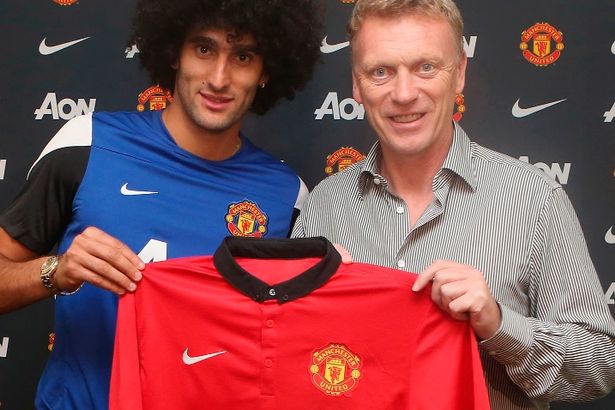 Speaking of unconvincing, nobody was remotely convinced by United’s transfer business in the summer. Starting with their interest in Cesc Fabregas. Fabregas clearly had no interest in joining them, yet United made two daft bids that had no chance of being accepted by Barcelona. Not signing Thiago Alcantara was different, it was a worrying sign. At one point he looked to be in the bag for a reasonable fee: €18m. Not only that he was just what they needed, a classy midfield player who suited the side they already had, only United, for whatever reason, elected not to seal the deal. Bayern Munich, the European Champions, didn’t hesitate. The weeks passed, and the pressure mounted on Moyes to do something.
Then at the end of the window there was the Ander Herrera fiasco. Surprisingly, stupidly, Mesut Ozil, one of the world’s best playmakers by anyone’s standards, was made available by Real Madrid. United, or rather Moyes, decided to buy Marouane Fellaini instead. Ozil eventually went to Arsenal for only £15m more than United paid for Fellaini. But Ozil isn’t a central midfielder I hear you say, well Fellaini isn’t either.
Even better, United decided to buy Fellaini at the last minute, paying £4.5m more than they would’ve needed to a month earlier. So not only did Manchester United hiring Moyes not make sense, but their transfer strategy didn’t either. Of course Moyes couldn’t help himself, fresh off a defeat to Liverpool, he delivered the woefully transparent excuse that the reason he waited until last minute to sign Fellaini was because he tried to get both Fellaini and Leighton Baines from Everton in a package deal. So that couldn’t have happened in July Davie?
Back to Fellaini. Let me be emphatic, he is rubbish, and appropriately so, as he’s the perfect embodiment of everything David Moyes believes in.
For the past two decades the quality of the central midfielders at United has continuously fallen somewhere on spectrum between great or very good; Roy Keane, Ince, Beckham, Giggs, Scholes and yes even Michael Carrick, while not a top rate midfield player, is a pretty good one. There have been duds over that time, there always is, but crucially they never lasted long.
As a central midfielder Fellaini isn’t even a dud in the sense that Anderson has been, or Veron was, or Kleberson or Djemba-Djemba were. He’s worse than that. He moves mechanically, and makes slow decisions whilst in possession. He does however know how to use his elbows and his physicality, which is just as well considering there’s little skill or nous to his game. The problem is his strengths, as a central midfielder, are of little value to this United side. While those players I listed earlier in this paragraph all failed, at least they failed with some semblance of hope that they’d be able to play the brand of football Ferguson demanded. Fellaini, thus far, hasn’t even attempted to put up a façade in this respect. Not that he could even if he wanted to. He’s playing the Moyes brand of football in a Ferguson side, and it’s an ugly and ineffective combination.
It’s not a surprise Fellaini looks woefully miscast. I always felt that Fellaini was highly likely to be more valuable to Everton, with the style of football they played under Moyes, and the way that Moyes utilised him, than he would be to any other club. Well that’s not true, Fellaini would tear shit up at Stoke City, wouldn’t he? Moyes pigeonholed Fellaini at Everton, partly it has to be said out of necessity rather than choice, into a position foreign to his game and strengths, and it’s continuing at United. If Fellaini’s anything it’s an anachronism. He’s a back to goal, aerially dominant, lumbering, slow footed and witted old fashioned centre forward, the kind that were commonplace in English football in the seventies and eighties. It was laughable to see him masquerading as number ten at Everton, but now he’s masquerading as a central midfield player for Manchester United. I’m not sure which is worse.
It’s a frightening glimpse into the future for United fans, the signing of Fellaini is the best indicator of the sort of football Moyes aspires to. Moyes signed Fellaini, not because he was being ambitious, but because Fellaini’s sort is all he knows. Like most middle managers, like Hodgson, Moyes distrusts those who create and who think differently to how he would. As a manager, if you don’t understand something how can you hope to analyse or control it? How else do you explain his marginalisation of the inventive and skillful Shinji Kagawa, whose ex-manager, Jurgen Klopp, has publicly derided the treatment of by Moyes. Most top clubs would love to have Kagawa at their club, like the manager of the club Kagawa left to join United, clearly.
Hodgson did the same thing at Liverpool. He signed players who he understood, who he felt were most likely to understand him and who were best suited to his methods, not those who were suitable to the profile of the club he was managing. To middle managers the status of the club and the expectations around it are irrelevant. They’re incapable of evolving, of embracing the risk that comes with change, so they stick to what got them the opportunity in first place. There’s a principle among Italian coaches that when you’re on top that’s then you change – from a position of strength. The same philosophical trait can be found in great managers, like Bob Paisley, who was unafraid to dump two legends in Phil Thompson and Emlyn Hughes, key components in a successful side, for two younger less heralded players – who also turned out to be upgrades – Alan Hansen and Mark Lawrenson. Hodgson distrusted, or should I say distrusts (he’s still active, somehow) flair and skill in favour of the functionality he understands. At Liverpool he bought and favoured less capable players like Paul Konchesky, a journeyman, and Christian Poulsen, a past his best clogger who couldn’t pass a dodgy Guinness inflected turd never mind a football. They were deigned to replace the more gifted, younger players Hodgson inherited, like Emiliano Insua, now at Atletico Madrid, and Lucas Leiva, a Brazilian international with twenty caps. Worse still he encouraged young home grown players like Martin Kelly to hoof the ball aimlessly instead of showing composure and passing it. ‘Poisoning the well’ I believe the term is.
Thankfully for United they have a far better side than Liverpool did when Hodgson arrived. So there was less scope, and far less justification for Moyes to do any damage by making multiple personnel changes this summer. It’s just as well that Ferguson left him a squad full of experienced winners like Vidic, Van Persie, Carrick, Giggs, Rooney, Ferdinand and Evra, good players in their prime like Valencia, Kagawa and Nani and good young players like Smalling, Rafael, Jones, De Gea and Januzaj.
Where Moyes can do serious damage, in the short term, is on the training ground. You can already see the deterioration in United’s general play since Moyes took over. Given the disparity in both the results and performances from last season to this, with the same squad, it’s clear that if Moyes is to survive, he has to do something that Hodgson couldn’t: recognise that he needs to change, have the ability to conceptualise the correct changes, and then implement them. Essentially he has to break the habit of a lifetime – distrust the methods he believes have lead to him deservedly getting the Manchester United job, and do so from a position of weakness.
After the defeats by Manchester City and West Brom some Liverpool fans were tweeting #MoyesOut. This made less sense than David Moyes being manager of Manchester United. I suggested that tweeting #MoyesIn made more sense, as they had waited for years for Ferguson to go, and now that he has, and he’s been replaced by Moyes, didn’t they all want it to continue for as long as possible?
So I say leave it to Manchester United fans to get #MoyesOut trending on Twitter. Maybe the campaign will work. For the sake of their sanity and Manchester United’s prosperity, they’d better hope so, sooner rather than later.
 Wichita Lineman Was A Song I Once Heard
You must be logged in to post a comment.