

Does leafleting work?

elections_2010_ukip_1yes leafletUKIP leaflet

I’ve been getting quite a few leaflets from various political parties through my letterbox recently, more than seems normal. I’ll concede that my sense of what constitutes a normal quota of leaflets is completely notional.

Leafleting is a habitual element of living in a town or city. I imagine it probably happens in villages too, though I can’t decide whether it happens more or less often in them, or whether the need to leaflet is less or greater. I have little experience of them, so my understanding of how village and rural communities operate is informed by idyllic representations in popular culture, The Wicker Man excepted.

Then it struck me, I don’t have a bloody clue about this, and by this I mean leafleting and whether it’s effective. Clearly I admit to having none about village life.

And what defines a leaflet as being effective? What’s the main aim behind leafleting? Making people aware they (the parties) exist? That a vote is forthcoming? Setting out policy? Trashing the campaign pledges and or positions of their opponent(s)? Or is it all of these things, and as such the aim is to get someone to change their vote completely?

Until recently I scoffed at the idea that political leaflets had even a nominal influence in affecting voting tendencies and therefore helping decide elections. My apathy was embroidered by my impression of most leaflets tending to come from supermarkets, local takeways and charities, and they do. As such any kind of leaflet, even if it was benign or worthwhile, became synonymous with junk mail, which is a nuisance. It doesn’t help that they all look and feel cheap too; single pages or a folded piece of A4 laminated plastic paper, usually collecting on the floor, trying their best like a stealth banana skin to deck you as you enter the front door. Not only were they a health hazard, they were garishly ugly, usually and easily crumpled and occasionally damp, a waste of natural resources, but also time consuming, as they require you to allot your precious time and effort, assuming they hadn’t broken your neck first, to putting them in the bin.

There is another, better reason why I’ve looked upon political leafleting disparagingly, as I always took it upon myself to find my own sources and therefore reasons on which way to cast my vote. The mere idea of having my vote informed, or even worse my mind changed, just, just by a leaflet seemed like a staggering abdication of intellectual responsibility.

I’m a man of very few talents, but one of them is my innate ability to find a way of being ignorant or hypocritical, or in this case both.

The cause this leafleting binge is the upcoming vote to elect our representatives in the European parliament on the 22nd May. I’m ashamed to say that this vote had barely registered with me. And yes, one of the leaflets re-reminded me of the impending vote, after the slip from the electoral roll that came through my door a few weeks ago intially informed me that I was eligible to vote. Before that I had no clue it was happening. I could offer an excuse or three, but you don’t care. So much for intellectual responsibility, eh?

I suspect the turnout will be meagre, and will reveal that most folk, like me, have little interest in the EU vote, probably because they don’t know anything about it, how it works, or how it affects them directly. Now I see that leafleting is the best possible antidote to ignorance or apathy on such matters. For us Scottish residents our disinterest has some logic, given Westminster dictates our involvement in Europe for us.

So reminding folk that the EU vote was taking place had to be one of this leaflet’s main aims, and that it did successfully. Now we come to the best part, it turns out it was a leaflet from an endangered species – The Scottish Conservatives. I found it to be amusing and ironic that the Conservative party are looking to gain votes in an EU parliament just to blunt its effectiveness. In the same leaflet they request that we vote ‘No to Scottish Independence’, yet they want you to ‘Vote “Yes” to a real change in Europe’, it goes on, sadly, ‘We want a different type of Europe; one that returns power to Britain and that works for the people and not the politicians’. It’s hard not to be insulted by this hypocrisy, the fucking cheeky bastards. The plan is clear – win the general election next May, actually gaining a majority to form a government this time. One of their campaign pledges, as outlined inside the leaflet, is to hold a public referendum on whether the UK should become a fully integrated member of the EU, or whether it should leave, by the end of 2017. It’s likely that the Tories would only hold this referendum if they believe the public would vote to leave the EU. Remember, they’re Tories, they lie, a lot. This Tory EU leaflet was nothing but an excuse to campaign against the popular topics of Scottish independence, demonization of EU bailouts and immigration. If you manage not to be riled up by any of this, for good measure they also spell out the ‘successes’ of their economic policy. Honestly.

Now I’m looking at this through the prism of being a Yes voter and someone who believes in fairness, so of course I’m going to view a leaflet from the Scottish Conservatives in the most cynical of lights, and deservedly so. It’s an organisation/party/business built on the deployment of inherently unfair policies and who wants a No vote to help maintain them.

Still, this got me to thinking of more important and pressing matters, no snide comments thank you, about how (read ways) the Yes campaign is choosing to get its message across.

One of these ways is through leafleting.

Number of leaflets I’ve received from the following over the last six months:

Yes Campaign – 4

Labour – 2

SNP – 1

Tories – 1

Green – 1

UKIP – 1

A few thoughts; the Yes campaign and the other parties are leafleting for entirely different purposes. Yes is campaigning for Independence while the rest are primarily concerned with the EU vote, for now at least. Regardless, as you can see the Yes campaign has twice as many without any competition from its supposed rival, Better Together. There are two obvious ways to interpret this, both likely to be coloured by your existing position on the referendum, should you yet have one.

One, the Yes campaign must feel that it’s a damn bloody effective way of confronting folk with the message and facts, as unlike the EU vote, The Yes campaign and Better Together (for the sake of fairness) have the advantage of everyone in Scotland who isn’t in a vegetative state already being aware of the referendum. If you’re so inclined, it’s easier to elide the existence of the EU vote, but not the September referendum. Two, if you’re a typical cynical self loathing No voter, that the Yes campaign are getting desperate in resorting to measures such as abundant leafleting.

The above information is a problem for me given I’m a Yes voter who’s deeply sceptical of the effectiveness of leafleting altering the outcome of this particular referendum. If you removed the reason behind this referendum being held, and the cause of any existing bias towards one side of the campaign, I’d probably find my opinion aligning itself with the cynical perspective.

At least this characterisation of the Yes campaign’s desperation leafleting would suit the complete and utter ambivalence behind Better Together’s lack of methodical canvassing. I haven’t had a leaflet from Better Together come through the letterbox yet, nor, living in the West End of Glasgow, have I seen a billboard advertising the virtues of voting No, which is fitting, as there aren’t any. There have been several Yes billboards positioned as you enter the city centre, two biggies along Maryhill Road running throughout April, and others dotted about the West End, but none from Better Together. I was made aware through Twitter of one Better Together billboard existing in the East End. Though I’ll believe it when I see it, and like Victor Meldrew I probably still won’t if I do.

Clearly Better Together feels they don’t have to advertise or leaflet extensively, as with their own form of belligerent incompetence and their arrogant assumptive reliance on voter apathy they feel they have it in the bag.

As I’ve found to my cost, cynicism and apathy can be reductive forces, as they invariably lead to ignorance and failure. Not reading political leaflets out of spite or dislike for its author, and for leaflets generally, is a mistake. As is a party or a cause failing to distribute any. I’ve already given one example, had I ignored the Conservative leaflet, just because of my logical hatred of Tory bastards, then I wouldn’t have been reminded of the EU vote. Had it not existed or stated its intention, that would’ve provided the same result.

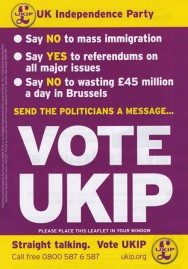
Even better was to come, a few days later a UKIP leaflet came through the letterbox. Joy unconfined.

I’ll keep it brief, without hesitation, I threw it straight in the bin. After all, it’s a leaflet, from UKIP, that’s what it deserved, right?

A threat still remains a threat even if you choose to ignore it. The basis and totality of the rise of UKIP’s popularity is based on the notion of what we assume them to be, not finding out what they actually are. This applies to those who are opposed or disposed to their crude, divisive stance on immigration. It’s designed not to encourage further investigation.

So was this leaflet. I thought I knew all about them and what they are, a slick repackaged version of the National Front. That’s why I threw the leaflet away without looking at it, but, after a conversation with someone who had the misfortune to acquiesce to curiosity, I had to have a look for myself. Their policies, as outlined in the leaflet, went beyond my initial assumption and Farage’s conniving and capable verbosity, which allows him to elide facts when faced with them. They are downright crazy. I hesitate to call them policies. We all know of their stances on immigration which are central to their appeal with the disaffected, but the other stuff shows their fascistic base; full privatisation of the NHS, full deregulation of the banking sector, one set tax rate for all – 31% – and draconian cuts to public services across the board. It all reads like Oswald Mosley’s Thatcheristic wet dream, where only the blue bloods and the aspirational thrive while everyone else barely survives, if they do at all.

On the surface their leaflet’s garish colour scheme was benign enough. Farage’s face was absent too. The exterior focus was, of course, on immigration and Europe. It’s layout was reminiscent of a cheap curry house and or kebab menu, and as such it seemed less threatening than that infamous BNP leaflet that was kicking around in the lead up to the last general election. You remember it, right? Of course, how could you forget Nick Griffin’s spherically porcine mug, with his even fatter fringe and that unsettlingly static glass eye, the kind of ailment that’s usually a consequence of a nonce that’s copped a bashing or four when he was accidentally placed in gen pop.

It’s easier for me to pan and be glib about not reading leaflets from political organisations, such as UKIP, who I’ll certainly never vote for. But the thought of holding the same stance towards the Yes leaflets just isn’t feasible.

First, there’s the number, four. Four in six months! How could you not take heart from that?

Plus, because I was a Yes voter before a leaflet ever arrived through the letterbox, and having reached a Yes vote of my own volition, I could have guiltless gander at the latest Yes leaflet, to pique my intrigue. Would my blanket disdain of leaflets continue? This time I hoped not.

About the latest Yes leaflet, I have a few observations, good and bad.

We might as well start with the cover, of a hand wielding an electric current between the finger tips, with the message ‘An independent Scotland would be the most powerful nation in Europe’. In the abstract I like the image on the front cover, it’s striking, and most leaflets tend to have only text, and the immensely unappealing dour saggy faces of the party leadership. The image is also nuanced in a way which probably won’t resonate as it should with those it’s trying to convince. The message being to those who will vote No primarily because they dislike Alex Salmond and his, according to them, tendency for being arrogant, defiant and unashamedly proud, that he isn’t the sole focus or strategist of Yes campaign. He is only a supporter of it, and that this vote is much more important than him. He is the First minister, and the leader of the party that currently holds a majority in Holyrood, who wants Independence, of course he’s going to be at the forefront of any campaign for Independence. In fact there is no picture of him to be found on the leaflet and his name doesn’t even appear on any of the four pages.

That isn’t to say that Alex isn’t an asset, he is, put him in a debating arena armed with the factual strength that the Yes campaign is based puon and he’ll boss that shit. The point of the Yes leaflet is entirely about the message, to engender consideration of the possibilities devolved from the pettiness that frames the debates surrounding party politics and politics in general.

The claim on the front cover is bold. The nays will focus on its validity, but that clearly isn’t the point. The point of it is to entice you to read on, where a series of clear bullet points about Scotland’s potential, and stagnation by remaining in the UK, are mapped out on page two.

Even better there’s a form on page three where you can fill out your details and receive a guide, an abridged version of white paper I assume, of the benefits of a Yes vote. There’s also a questionnaire provided to gauge opinion on Scottish Independence. Question one is a scale from one to ten, on whether you’re for, undecided or against Independence. The second question is restricted to just the three tick boxes for each option.

This is heartening as it means that the Yes campaign is collating polling data. I wonder what it’s telling them. You suspect most of the responses are likely to be Yes or favourable, as we tend to be enthusiastic lot, but how many of the undecided have responded positively or have asked for further information? Because it’s easier to formulate opinions based upon direct experience, I’m extremely cynical of the all polls which suggest that a No vote is more likely at this stage, when I’ve yet to meet a No voter.

The only blight on this leaflet is that you’re offered the chance to win an iPad if you fill in the questionnaire. Enticing people to fill it just for a miniscule chance of an iPad is cheap. I understand the logic behind dangling carrots, but one person returning the leaflet whose main goal is to win the iPad devalues the authenticity of the information received.

Unlike the other leaflets I’ve received recently the Yes leaflet gives you more bang for your imaginary buck. It might seem like a triviality, but a leaflet that is weightier and fatter has a more satisfying feel to it when you pick it up. Like a book. It conveys effort, and a passion for its content and purpose. Even better the extra stuff inside interested me. It had a page from banthebomb.org of the benefits of scrapping trident, even though trident wasn’t mentioned you knew that was the reference. There was a letter from two disillusioned Labour candidates who have switched to Yes, and another page from Labour voters for Scottish independence – which rightly states that ‘voting “Yes” for independence in 2014 doesn’t mean you’re voting for Alex Salmond & the SNP’. There was also a supplementary smaller single page from the Yes campaign, more a card than a leaflet, with a number of links to pro-independence blogs: wingsoverscotland.com, bellacaledonia.org.uk, bbc.scotlandshire.co.uk amongst others. It leaves you no excuse to find all the information you need to vote Yes, and it tells you that people, when they find out the facts, tend to defect to a Yes vote.

Overall this latest Yes leaflet is the best leaflet I’ve received so far, it has the most content, it has an unfussy layout, and provides a variety of perspectives on various issues that will be decided upon, by us, if we vote Yes.

But still that question remains, does leafleting work? In the context of this referendum I’m not sure, but given the number of Yes leaflets I’ve received in last six months, and seeing the thought that’s gone into their design, I’m hoping that my scepticism is completely unfounded.

Posted in Politics | Tagged , , , , , , , | Leave a comment

Song Of The Day – Buick Mackane by T. Rex

From the album ‘The Slider’ (1972)

Posted in Song Of The Day | Tagged , , , , , , , | Leave a comment

Song Of The Day – Chicken Bones by John Grant

From the album ‘Queen Of Denmark’ (2010)

Posted in Song Of The Day | Tagged , , , | Leave a comment

Why is David Moyes, David Moyes?

david moyes tragic

So David Moyes has been sacked by Manchester United, what did we learn?

About football? Not a lot.

Inevitably and frustratingly in the aftermath people have dwelt on the trivial questions. There’s been the endless, tedious dissecting as to why Moyes failed, when it’s blatantly obvious, and whether United were right or wrong to sack him, and to do so now. Who will they hire to replace him? Who can they get? How much will they spend on players this summer? On and on it goes, rinse and repeat.

Watching the whole debacle of Manchester United’s season unfold made me return to one question:

Why is David Moyes, David Moyes?

That may seem like a strange question, but let me explain what I mean.

The superficial answer is simple, David Moyes used to play football professionally.  Similar to a lot of other footballers who retire, he then became a manager.

The reasons behind this are likely to be benign and straightforward. Most folk need to earn a living, and Moyes had spent his whole adult life playing football. More speculatively, and it’s a hideous cliché that’s often trotted out, perhaps Moyes was driven by an unfulfilled playing career, whether it be through injury or a lack of talent, and that this fomented his drive to be a manager. It was the only remaining route for him to reach the top of the game.

None of this is unusual, and that’s just the point, some how, some way, Moyes, a normal to be gracious, uninspiring and unremarkable, to be less so, manager suddenly became a figure of intrigue. He became ‘the chosen one’. He was labelled ‘a winner’, despite having never won anything. That more people didn’t find this peculiar, was, well, peculiar.

And that’s where we find our answer, the creation, rise and fall of David Moyes, football manager, is subject to context.

Contexts are malleable, and things that are malleable and undefined are subject to corruption by human influence.

The seeds of Moyes’ demise were planted during his Everton tenure. Having taken over when expectations were meagre – Evertonians had been scarred by too many flirtations with relegation – Moyes kept them up. He continued to keep them up, comfortably. He got them into the top half of the table. He got them into Europe. He managed them to a fourth placed finish. Then, having reached that threshold, he started to come up short, or rather his anachronistic, simplistic tactical methods and modes of thinking met their ceiling. He tantalised Everton fans with hope of a true revival, reminding them what their club once had while paradoxically what they wouldn’t and couldn’t have again if he remained.

By this point it had been a decade in charge at Everton for Moyes. His reign was deemed as success, contextually, due to where Everton were when he arrived. If you chose to, you would see that the characterisation of these kinds of achievements as successes is a disingenuous, cheap and lazy form of marketing the mediocre echelon of the Premier League product. The Premier League sells itself as the best league in the world, so the more successes and success stories it can conjure the better. When Moyes, a manager who had won nothing, was inexplicably transferred to United, a club that tends to win stuff, therefore is expected to, his limitations were placed in a context where they could be given no sanctuary.

His dismal failure at United was inevitable, but that Roberto Martinez, his replacement at Everton, and the possible, previously thought of as improbable, league winning success of Brendan Rodgers at Liverpool, have, from Moyes’ perspective, cruelly combined to expose the excusing myth on which his favourable reputation was built: that to contend and ultimately win that you need to have the financial resources of your foes. The excuse was that Moyes, at Everton, never had the resources to compete. That Everton could still achieve fourth this season with two games remaining (even though it now looks unlikely), playing a more aesthetically pleasing brand of football than Moyes would dare aspire to or is incapable of developing, having spent far less than Spurs, Arsenal and, in the ultimate of ironies, United in the last twelve months alone, dents that theory. And if Rodgers is able to mastermind Liverpool’s first title in twenty-four years, while going up against the financial behemoths of Chelsea and Manchester City, it will destroy it.

It should destroy the narrative that David Moyes’ tenure at Everton was a success. The events of this season should recalibrate how other instances of similar ‘successes’ and those who are given kudos for overseeing them are viewed, but more than likely it will not. Through a lack of critical thinking and or tribalism, we aren’t inclined to challenge the mediocrity of this culture, a culture we are complicit in shaping.

I have no sympathy for Moyes, he had the cynical wherewithal to realise the opportunity afforded to him by this narrative, and that he chose to accept its validity. Moyes was all too happy to inculcate it to insulate himself. He used it, not to challenge and better himself, but as a means of maintaining people’s acceptance of him as he was. He spoke glowingly of being in charge of the ‘people’s club’, a petty euphemism which insinuated that folk who were grounded, knew their place, and weren’t likely to demand something he couldn’t deliver, were likely to support Everton. Not only was it a slight on Evertonians, but it was breathtakingly arrogant, ignorant, and it spoke of a self loathing, self serving, self regarding defeatist complex in which Moyes revelled. He had taken a club on its knees, stood them up again, then psychologically cut them off below the knees again, priming them, with the use of petty tribal hatred, to accept mediocrity. Moyes certainly didn’t want Evertonians to be like Liverpool fans, driven by ambition and having expectations of being in contention to win trophies. He encouraged Evertonians to wear his mediocrity as a badge of honour, and sadly, some did. All Moyes’ rhetoric did was galvanise and intensify the hatred between the two clubs, as distraction from the disparity in culture between them. Liverpool were busy challenging for and occasionally winning trophies while Everton weren’t. That was fine with Moyes though, as long as Evertonians were looking in anybody’s direction but his if and when someone was brave enough to break ranks and pose the question as to why.

Fittingly by immuring himself in this defeatist culture, and the widespread acceptance of narrative that underpinned it, it would help seal his fate at United. When he tried the same defeatist shtick at United, people, en masse, immediately saw him for what he was.

That Moyes wasn’t able to adapt his tactical concepts and his training methods was no surprise. One standard of mediocrity is the inability through nurture or experience to conceive of the world other than it is. Moyes couldn’t conceive of what was required of him at United, as we enabled the creation of the conditions that never forced him to, as we couldn’t conceive of him belonging to another context.

And that’s the only thing that changed, the context in which David Moyes existed. Not David Moyes. Given this it’s appropriate that he failed to live up to the narrative that was bestowed upon him as the ‘chosen one’. The change itself, and the language used to support it, betrayed his constitution by creating the belief that his methods would translate without him having to change. Given how the majority had viewed him to this point, how he was lauded, Moyes was quite entitled to believe that what he’d done at Everton, what he’d ‘achieved’ earned him the job at United. Here we find a strange phenomenon, the notion that by deeming Moyes as the chosen one, and as a winner, who would make sure the story (read success) would continue, it alone would be enough to transcend the reality and evidence of him and his career, and that he was capable of the adaption that would be required to truly succeed.

Some will say that Alex Ferguson was entitled to believe that the winning culture he’d created and bequeathed could have transformative powers over Moyes. If Moyes believed the narrative of his time at Everton, that he was a winner in waiting, then he would be at United, as United would mould him into one.

This is no surprise as we see daily examples of hubris which is disparate from reality. It is but a desperate last feint at avoiding acceptance. In United’s case it was the acceptance of the inevitability of change. Ferguson going was a seismic change, Ferguson picking his successor made the change seem less perilous. The simplistic train of thought went as so – Ferguson was a man who judged himself by success, sorry let me be definitive, make that winning trophies, and he knew what that took, as such, if he’d picked Moyes, then surely he saw some of those attributes in Moyes.

As we’ve found out being a king and being a kingmaker are two different things, which require two different methods of analysis. Ferguson looked for someone in his own image, when there simply wasn’t another and instead of finding the best man, he settled for the narrative surrounding one who might, finally, given the chance, be the most like him. It’s difficult to make cold calculated decisions within a vacuum, to look at your flaws truthfully and objectively, and those of others, without nebulous insidious external influences and perceptions clouding one’s judgement.

This inability is pandemic in our culture, and part of that culture is the Premier League, a product which is built on shameless greed and hype. As such it needs figures, characters and caricatures of interest to consume and repeat the narrative cycles on which it is predicated.

One of these narrative cycles is the battle for Premier League survival. If we look at Moyes specifically, he is a symptom of what I call the middle manager complex, which has many facets to it.

Facet one. The Premier League is a conglomerate. All of the decisions made by its members (clubs to you and me) are taken with financial ramifications as the primary consideration. As a result, managers who are able to get teams into and keep them ensconced on the Premier League gravy train are now seen as a commodity. Yes, that means that Tony Pulis and Sam Allardyce are now seen as commodities. Pause for a moment to consider this. Before, in the pre-1992 days of greater financial parity, there was less importance placed on simply remaining in the top division, the accent was building over a number of years for a sustained chance at success.

Facet two. Hubris and mediocrity. These middle managers exist and are enabled through the ineptitude of chairmen and owners, who, imbued with hubris of success in other fields, are largely unable to recognise that identifying talent in football management is a vastly different challenge. That means those who who have proven track records of attaining midtable mediocrity become safe bets. This is aided by impoverished expectations. As outlined above at Everton under Moyes, teams and fanbases often become immured, through various modes of subtle propaganda, into aligning their expectations based on how wealthy their club is or isn’t, relative to others. Some call it realism, others pragmatism, and there is an element of sincerity and truth to those counter arguments, but it also breeds a culture, a philosophical approach which strives to maintain the average and the belief that this is a form of success. This is understandable, as belief in it prevents thoughts of discontent. It maintains the perpetual hope that things will change for the better, eventually, some day. No football fan wants to be discontented or without hope. It’s akin to the process of buying a lottery ticket and the range of delusional emotions it incurs. This week will be the one. You can feel it. You picture how it will change you and your life, until it doesn’t. By the time next Friday has arrived you’ve forgotten last week’s disappointment.

Facet three. Xenophobia.  Moyes’ reputation is a legacy of mediocrity, and that mediocrity was elevated through the assistance of a fawning media, who, with their specific form of delusional, deeply illogical, contemptuous xenophobia, were desperate for a successful British management story. There was pride in seeing a British manager, who’d paid his dues too, get the biggest job around over some Johnny Foreigner. That his credentials, be it his experiences in football, and his methods were unsuited for it, were irrelevant to the where he was born, of Ferguson’s approval, and most of all, in the intellectual stock that some had placed in Moyes, that they were right about him being a success at Everton, and that this would finally be validated when he arrived at a big club like Manchester United.

The various forms of these celebrity public contracts of mutuality are pitiful. All of them are founded upon displacement and projection, a method of distancing personal self loathing, disenchantment and insecurity by living vicariously through the success of others. The most famous and extreme example of this is Tiger Woods. You all know what happened there, right? Woods fucked around, got caught, and his wife left him. This happens every day all over the globe, but because it was Woods it was different. Why did he feel compelled to give that strange, grovelling press conference to apologise to millions of complete strangers?

Remove the context and it’s a completely perverse intrusion. But the answer is we all, whether we wanted to or not, had a stake in creating him and his gigantic brand. It was our creation as much as his. He got famous quickly, remarkably, deservedly through his remarkable abilities, and we all, no matter how fleeting, paid some level of interest. Some of us went further than that, we believed him to be something he wasn’t, we wanted him to be something he couldn’t be, because we knew we couldn’t be that either. Therefore someone else, someone with a brilliant gift, should shoulder that burden for us. Woods, of course, was complicit, just as Moyes was at Everton, as he was happy to go along with the narrative as long as it suited him, and he cashed in on it. Ultimately, for purposes of consolidation, mediocre minds conjure a persona synonymous with the talent they see. Like Woods had no chance of living up to his persona, Moyes didn’t in his vocation, and any contextual shift destroys the guise we’d helped create.

The usual reaction is to hold them to account, not for failing themselves, but for failing us. Contrition, in some form, is the means of salvaging the narrative, as it allows both parties to elide the recognition of their ludicrous behaviour and potentially start the process all over again. That’s why Tiger chose appeasement and it’s why David Moyes waited for Manchester United to sack him.

Moyes of course diverges from Woods in that he was given his professional cache undeservedly, while Woods earned his. Moyes’ talent, what there is of it, belonged in a certain echelon, an echelon that most of us wouldn’t like to admit that we belong to and likely always will. Most of us will live unremarkable lives – comparatively speaking – but seeing (helping?) someone unremarkable like Moyes succeed in defying that likelihood gives you hope that you can transcend your circumstances, and perhaps, nature.

I suspect that Moyes will return to management relatively soon, and when he does it will be to a context to which he is suited, where he can be himself, where he can be successfully mediocre and the masses can applaud him for it, applaud themselves, starting the potential cycle again. Personally and selfishly I hope Moyes doesn’t return and he retains his position as the perfect analogy of the cultural and psychological defect that created him: the decay of critical thinking that has lead to the lauding of mediocrity, then the fetisizastion of its inevitable failure, a process that offers us the opportunity to devolve to forms of introspection, but that appropriately, we seldom do.

And why did I say appropriately? Well, we made David Moyes in our own image.

Posted in Sports | Tagged , , , , , , , , , , , , , , , , | Leave a comment

Song Of The Day – R.L. Got Soul by The Jon Spencer Blues Explosion

From the album ‘Now I Got Worry’ (1996)

Posted in Song Of The Day | Tagged , , , , , , | Leave a comment