Mad Men is reaching its end, but what sets it apart is that it never will.

mad men header

The only downside to a great TV show is that it has to end.

As the end of Mad Men nears it brings the sobering realisation that we’ll no longer be able to observe the complexities that constitute Don Draper, Betty Draper, Peggy Olsen, Joan Harris and Roger Sterling.

No other show has been as dependent on its characters as Mad Men. All fiction is, of course, reliant on its characters, but Mad Men stands alone as a show whose plot is secondary to your intrigue in them. They are the plot. Occasionally there’s boardroom strife, power plays, client foibles and creative arguments, but they are only the means of expediting behavioural examination.

Along those same lines I did consider Breaking Bad, but its universe belonged to Walter White. Pinkman, Fring, Skyler, Mike et al just existed in it. They were merely the collateral that allowed his metamorphosis to be documented. Their destruction by White satiated our voracious intrigue in the process that created him in the first place.

As characters there are superficial similarities between White and Draper, both had alter egos, both came to rely heavily on them. The difference is White created Heisenberg to compartmentalise and essentially quarantine what he was becoming and that he liked it. Don stumbled into his accidently and opportunistically. It offered a route of escape from a life being guided to likely ruin, or at best mundane insignificance. A life he knew he was better than. Being Don Draper offered Dick Whitman a blank slate that allowed him to conjure a bespoke caricature for any purpose or direction.

Here we can consider Don Draper as emblematic of a notion, wilfully embedded as a truism in America’s cultural psyche: that you can be anyone and thus achieve anything.

Don is the anecdotal antidote to that notion. Only when you pretend to be someone or something else, are you liberated to be yourself. As Don Draper, he, and his life, is both a success and a failure. It is both the truth and a lie. He is both his true self and not. He is both content and discontent. Weiner attempts, by using Don as a peculiar oxymoronic example, to convince us that we don’t have a choice as to who we are, and that our lives are controlled by circumstance and often detrimental choices made as a result of those circumstances. You can’t be anyone and achieve anything. There is no such thing as equality.

Even if it is difficult to envision Don Draper patrolling a used car lot in the late nineties in some Essex town that’s only good for driving through or past without stopping, sporting a Stuart Hall mahogany tinge, cheap aftershave, an even cheaper Goldie Looking Chain, and an ear ring, learning of Don’s history forces you to consider such alternatives. You come to realise that the scenario of Madison Avenue is irrelevant. It’s just where odd circumstances combined with Don’s talent allowed him to ascend to.

Don-Draper-2

Early on Don was fearful of the truth of his desertion being exposed. Yet he willingly held onto the evidence that could expose him and his deception in a small box locked in the top drawer of his office at home. Occasionally we were gifted scraps of evidence as to why. The box was overtly symbolic of Don’s need to escape Dick Whitman, the life he should’ve lead, but it was also the only true physical documentation he had left of his past. The box represented Don’s sanctity, as Don had become enveloped into a culture of hedonism, he became a hedonist too.

Don isn’t fazed by reinvention, or by starting over, but as we reach the end, perhaps Don has come to believe and realise that his salvation lies in making the best of the self he is today. He knows he’s a really good Ad man. As muddled and perverse as the narrative of self that’s been perpetuated by the culture that surrounds him is, it’s all he has left. His meltdown at the end of season six was his catharsis. There was no point hiding the truth when he’d never lived a lie, he simply sold a version of himself that people believed. After all, selling delusion is Don’s talent, only he had used it to con himself. It made him liar and a perpetually dissatisfied one at that.

Intriguingly we’re given no definitive answers as to the source or causes of Don’s abilities. We’re presented with ample evidence that can corroborate whether Don’s creative mind is innate, as a consequence of the nomadic nature of his early life, which developed his recognition of the possibilities of reinvention, or a cumulative effect of both. We saw Don’s impulsive creativity in his switching the dog tags with Draper’s corpse. Then in his pre Sterling-Cooper days as a salesman of cars, then of women’s fur coats where he was discovered by Roger Sterling.

At various points throughout the show’s run, in flashbacks to his childhood, we witness Don learn the unforgiving nature of growing up impoverished in rural Pennsylvania. Then as a teenager living in whorehouses, continually exposed to shifting circumstances, often lonely, leaving him displaced and perpetually fearful of destitution.

So it was no surprise that Don strove for a sense of place, and possibly the notion that success would subsequently grant him it. Betty Draper, his first wife, comes to symbolise the fallacy of this notion to Don, and ultimately he becomes jaded by the delusional morass of cultural groupthink that she assumes. Don was living ‘the dream’ with all its generic facets, and found it totally unfulfilling because, just like being Dick Whitman, he hadn’t truly chosen it, or he had chosen it and it didn’t satisfy him as he’d hoped. Don’s numerous affairs have become his means of escape from the insidious relationship pattern he keeps slipping into. It leaves us wonder whether someone like Don ever be truly satisfied by adhering to the conventions of a cultural paradigm, when it enticed him to abandon his identity.
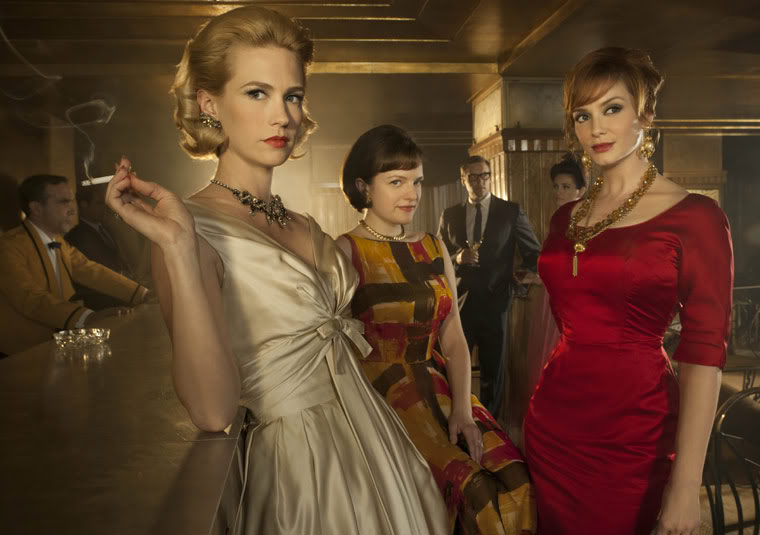
betty-peggy-joan

Betty is a systemic anachronism, typical of what was once pervasively and inevitably endemic. Nearly all the opinions and desires held by Betty are now meeting resistance, not only from the next generation, but from this current one. Betty can sense she is being left behind, yet she seems unable or unwilling to adapt. Instead we see the juxtaposition of her hypocrisy, she proclaims defiantly that she speaks Italian and used to be a model, yet she married a man that will allow her to reprise the same customary and inconsequential status she had with Don.

The show’s creator Matthew Weiner makes it difficult to consider Betty’s character fairly, when compared to Peggy Olsen, who consciously, like Don, eschews a path that she was deigned for – motherhood, for personal and professional validation, or with Joan, who achieved both with far less capital than Peggy. Here Betty, and the sphere she inhabits, epitomises the widening divergence in cultural expectations women could have of themselves towards the end of the sixties. We often cut to Betty in the kitchen brooding about the vacuous trivialities of middle class life, or arguing with her teenage daughter whenever she shows an independent streak. She is glamorous, vain, shallow, self-loathing, manipulative and entirely beholden to mores that betray her potential.

Joan ultimately becomes the shows most admirable character as she rejects the traits that Betty acquiesces to. Like Betty she is a stunning figurine of femininity, but she chooses to use this to her advantage and, as best she can, she tries her best not to let it define her or the decisions she makes. At several points we see her at her formidable best, she rejects the ‘opportunity’ of being demoted into a homemaker by her Army doctor husband. She pushes Roger Sterling away when he refuses to commit to her and acknowledges the realisation that he’ll never be capable of changing. Joan knows she deserves better and is prepared to wait for it.

The cost of Joan’s success becomes central to the best episode of the show’s run. She has the opportunity to guarantee that the firm wins an account by satisfying the whims of a grotesquely fat client. As an enticement the men of Sterling-Cooper place an incentivised value on her doing this, she would gain a percentage of the firm. This scenario is so agonising because Joan is the only character in the show that you can root for without reservations, yet the reality is laid bare that for all her endeavour, her success is still entirely determined by others. When Don calls at her door and tells her not to degrade herself, and it is revealed he is too late, it leads us to question would Joan have gone through with it regardless? At this point we’re inclined to see it from Joan’s perspective, to doubt whether Don’s motives were pure, or driven by his hubris in wanting to win the account without Joan’s assistance. Given what she was likely to earn as a result as a now single mother, it can be viewed as a selfless act, but even if this is the case, seeing her capitulate and demean herself, having come so far, leaves you bitterly disappointed that life can be so cruel.

Joan’s dilemma brings me back to how Charlie Brooker described the show. For those who were born well after the sixties, this show provides access to an alternate universe. One where glamour and aspiration made the misogyny, racism, homophobia and hedonism that pervaded the upper echelons of society seem normal. Once you look past the superficial façade that Mad Men offers, and the era it belongs to, you realise that many of these attitudes still exist, albeit in less emphatically elitist numbers and forms. Now you’re far more likely to encounter them in suppressed and dismal spheres, be it embittered private enclaves, the anonymity offered by a football terrace or one of social media’s many shitty symposiums of hatred.
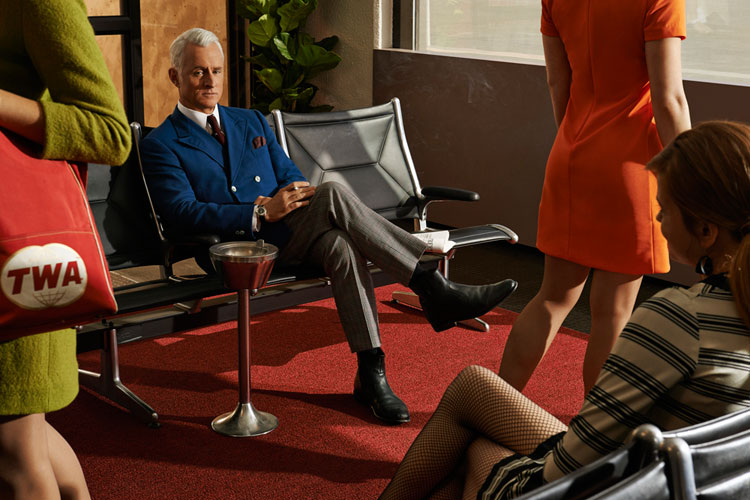
roger sterling

On this egocentric terrain the character of Roger Sterling exists. What a marvel. It’s hard not to be enamoured by a combination headstrong hedonism on crack cocaine mixed with razor sharp wit lying on a bed of high functioning alcoholism. Roger Sterling also serves to emphasise the difference between then and now, as only someone that brash and that conceited could exist in an era where the boundaries of diplomacy were yet to be definitively defined. For Mad Men he is of course often the comic interlude; his quips straddle the fine line between crude and cringe, insightful and impertinent. Most of it is harmless stuff. He plays the part of the rascal, controversy is his covert defence mechanism set against a world that will soon render his strengths and manner undesirable.

Only Roger Sterling would marry a Jewish secretary then ask how culturally integrated a Jewish client is ‘fiddler on the roof: audience or cast’. Don asks him ‘what do women want?’ Roger’s answer is, ‘who cares?’ It is but an immediate preface to a train of thought where Roger attempts to find an answer. We find other paradoxes, later on he takes LSD, enamoured by the idea that it can offer him genuine levity or an epiphany, rather than hoping it will actually have any kind of lasting effect on him. To today’s culture, that’s sliding irrevocably into the doldrums of insufferably pious conservatism and a reverence of mediocrity, the bravado, arrogance and complete lack self-awareness Roger exudes is jarring, but it also frees him to think on his own terms. We could do with more of that type of free thinking today, albeit without the chauvinism and the black face routine.

In many ways Roger’s the photo negative of Don. Sterling is of an affluent background, deigned to be a success due to it. However, just like Don he lacks fulfilment, bringing us back to the notion of success and happiness and whether they can ever be truly achievable within preset social and cultural structures.

Roger Sterling’s daughter rejects these structures in the final series by absconding to a hippie camp in rural New York. Roger and his ex-wife go to retrieve her. Roger attempts to understand her decision to leave, and they share a moment of rare tranquillity. In this moment Roger realises, perhaps for the first time, without the usual means offered by the city to distract him, what his nature has cost him. Throughout this scene she wears a fixed smile, but her silence conveys dismay, after Roger confirms that his emotional abandonment of her has made her conjure false memories of him to fill the void. In this moment he realises it’s too late to repair his relationship with her, one of the legacies being that he cannot prevent her from repeating his mistake.

That’s good writing, which requires good acting and is therefore interesting. It’s also instructive of why Game Of Thrones is so fucking boring, and is infinitely more popular than Mad Men. Game Of Thrones’ complete lack of nuance is an appropriate analogy of today’s culture. Its fanboi’s can vicariously project the desirable goals that constitute and motivate many of the characters in Thrones onto the modern sphere, where preservation of ones self, wealth, position and a lack of empathy are lionised and encouraged as aspirational facets by the self-entitled. Game Of Thrones doesn’t require them to care or think about its characters or their plight, because they aren’t constructed sufficiently. There’ll always be a duplicitous warlock, some angst ridden self-entitled dickhead with a chip on his shoulder, or a generic brain-dead savage to replace the fallen, and in the mean time you can get a kick out of the inevitability of their predecessors being dismembered or disembowelled.

Meanwhile Mad Men’s characters will stay with us and survive after we’re denied access. We’ll all think about Don, Betty, Peggy, Joan and Roger, what the seventies will look like with them in it and how the seventies will affect them.

The final scene of this series posed us questions we’d previously considered, but had no reason to yet face. Is Don losing his mind? Is he having a nervous breakdown? Is he depressed due to being alone? That he cannot envision a future better than the present? That for all he’s achieved, for all he believes he has, this is the best he’ll do?

That’s the greatness of the show, it invokes questions we can all relate to, and it doesn’t give us those answers easily, because, like Don Draper, there is no truth, only what you can make it.

Posted in TV | Tagged , , , , , , , , , , , , , , | 1 Comment

Song Of The Day – Long Snake Moan by PJ Harvey

From the album ‘To Bring You My Love’ (1995)

Posted in Song Of The Day | Tagged , , , , , , , | Leave a comment

Song Of The Day – Myrtle Avenue by Floating Points

From the EP ‘Shadows’ (2011)

Posted in Song Of The Day | Tagged , , , , , , | Leave a comment

Previewing the World Cup Final

brazil world cup header

Well my friends we’ve reached the end, but as to how we got here, where to begin?

We might as well start with the first semi-final between Brazil and Germany. The shock and awe which it induced, to be crass, turned out to be the nearest sporting equivalent of the 11th of September attacks.

I was left with mixed emotions. I correctly predicted that Germany would advance, and, in a way, I was right about the manner in which they achieved it, just not its proliferation. They waited, kept possession, until the Brazilians lost patience and or discipline, before scything through them. It was effortless and unselfish football.

But this German idealism was the photo negative of a macabre scene, one of self-loathing, self-pitying and ultimately resentment from the (mostly) middle class white demographic in Brazilian society that populated the ground. Eventually they came to deride a mainly black or mixed race group of now pampered footballers, who used to (mostly) be poor, just for failing to show the application required when their artificial expectations of them had crested.

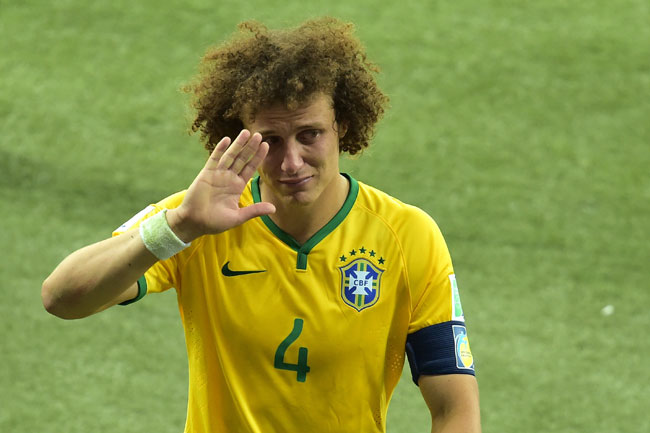
david-luiz-crying

People have claimed after the fact that the scale of this collapse had been coming for Brazil. This sort of pointless, preening, pious, (hey alliteration) self-aggrandising stating-the-obvious-after-the-fact bollocks always amuses me. It was no surprise that a Brazil side lacking its best defender and only top quality attacking and best player lost to what was, in the abstract, a better side. But 7-1? Nobody picked that, nobody expected it.

Except the select few spawny bastards who put money on 7-1 to Germany. I hate you with a passion that’s usually only reserved for the likes of James Corden, or any other public figure that has become totemic of the vacuous sycophantic reverence that’s shown towards forms of mediocrity these days.

This Brazil side wasn’t held to that fatuous standard by its public, not at first anyway. There was hope rather than expectation, that fan euphoria and promising early results would transcend the inevitability of this side meeting its ceiling. The flaws in this Brazil side were evident from the outset. Scolari wrongly banked on overcompensating with pace and strength to hide an enforced deficit of intelligence and skill. This was epitomised by his preference of Paulinho over Fernandinho to start the tournament. Fortunately Scolari could rectify that mistake, as he included Fernandinho in the squad. But there were others who didn’t make the cut, whose inclusion would’ve pleased the traditionalists and aesthetes, better represented the footballing ideals that tend to pervade the psyche of the Brazilian public, and would’ve likely forced Scolari to adopt a more progressive concept of play. Lucas Moura would’ve offered pace and incisive dribbling, Coutinho a player of immense skill, balance and vision would’ve offered Neymar a genuine technical equal, and Roberto Firmino scored over twenty goals for Hoffenheim this season gone, he’s attracting a lot of interest from some big clubs due to it. Brazil were always going to be short of quality up front, especially as Alexandre Pato’s injuries have failed to clear and Leandro Damiao’s fall was as sudden and precipitous as his meteoric rise.

It’s unclear whether including any of these players would’ve changed the outcome. I’d say it’s unlikely, as Oscar, Willian and Bernard are all technically accomplished players, and they all played significant minutes during the tournament.

Other than a chronic lack of top talent, this was a team who became captivated by the delusional narrative that surrounded it. That tone was set by Marcelo and David Luiz. They defended as if there were no conceivable consequences to their individual actions and decisions within a team framework, almost as if they believed they were deigned to win. It was the opposite of the German attitude, it was self-indulgent and self-serving and Scolari enabled them, by condoning it as part of the team’s success in previous matches. Scolari’s failure to reign in their impetuosity was costly. It nearly proved their undoing against Colombia, but for a set piece goal and wondergoal by David Luiz, which no doubt only served to vindicate the player’s self-righteous notion of destiny.

Against Germany Brazil’s inability to keep possession was always likely to cause problems, but it was exacerbated by the team’s inability, as a collective, to understand the offside rule. It reminded me of a match in the Premier League between Manchester United and Arsenal at Old Trafford three years ago. It finished 8-2 to United. Arsenal had the superficial excuse of only having a makeshift back line available that day. And Arsene Wenger had the reprieve of there being a competitive game to follow it. There was no next game for Brazil if they failed, unless you count the third placed playoff. Only fucking FIFA would inflict such a dismal spectacle of twenty-two men, wallowing in self-pity and playing in a resentful half arsed manner, on humanity.

Brazil’s full backs, like Arsenal’s against United, tracked runners six yards behind while the centre backs stepped up, or just showed a lack of application and cohesion in stepping up themselves. Like United did that day, the Germans kept attacking the same way, waiting for the inevitable mistakes to facilitate their neat play. Marcelo, Maicon and David Luiz were the worst offenders; they did what they wanted, when they wanted. They were completely oblivious to where their teammates were, and what they were doing, as they were with Thomas Muller, Miroslav Klose, Mesut Ozil, Toni Kroos and Sami Khedira, who couldn’t believe their luck and the space they had to operate in.

Bastain Schweinsteiger, positioned himself regally between Germany’s centre backs and, along with Kroos, dictated the game with neat triangles and their teammates offering perpetual third man running. They regularly found the void between defence and midfield, the visual analogy of Brazil’s now terminally syphilitic brain.

The fourth goal summed up the difference between the sides. Fernandinho, a fine player, now infected by the malaise around him, dithered on the ball. Khedira and Kroos pounced, unafraid of what Brazil had to offer in possession should they fail to dispossess Fernandinho and he was able to slither beyond them. Luiz, Marcelo and Maicon were somewhere else, psychologically, metaphorically. So were Germany, they were in the final.

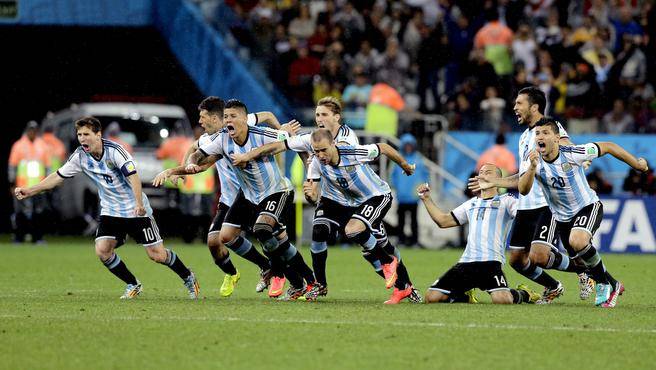
argentina penalty shootout win

Where they’ll play Argentina.

I could write a thousand words about their game against the Netherlands, but I’m not a fucking masochist. It was awful stuff. No doubt it was right up Rafa Benitez’s and Jose Mourinho’s street.

The Dutch did their usual thing of playing the Mourinho-esque bunker football that he’s laughably lauded as a genius for by bird-brained football pundits. At least Van Gaal has the excuse of not being able to conceivably buy anyone. This is what he had to work with, but even so the Dutch have enough talent not to devolve to using a plodding back three, with two limited but hard running wing backs sitting deep and two destroyers in front of them. Starting with seven defensively minded and positioned players is a limiting paradigm, and it’s sad to see the Dutch adopt such a tactic. The Dutch vintages of 1974 and 1988, hell, even the European Championships of 2000 seem to belong to another country.

Worryingly, looking forwards to the final, Argentina weren’t much better, and certainly not good enough to break down the ghastly Dutch concoction they were faced with. Germany will afford Messi more terrain to work in than he had here, and while they’ll still double mark and occasionally swarm him, it won’t be with the ferocity that the Dutch used, nor will it be with as many defenders goalside, or with the whole team condensed from such a deep starting position.

It was fitting that something typically synonymous with Dutch football and Louis Van Gaal would converge disastrously with the poverty of the talent it attempted to inculcate. Just why was Ron Vlaar, a technical mediocre artificially elevated by a negative system, allowed to take the first penalty in the shootout, when Huntelaar, Sneijder, Kuyt and the utterly brilliant Arjen Robben were available?

We’ve heard the causes, or excuses as to why, but their arrival is always inevitable in the aftermath of failure. It was either astonishingly arrogant and or stupid on Van Gaal’s part to allow it. There’s no doubt that Vlaar felt confident heading into the penalties. He’d contained Lionel Messi. But Van Gaal should’ve seen past this temporary psychological buoyancy, and that his tactics had largely created it. In such circumstances it’s not a stretch to imagine Van Gaal seeing Vlaar as an extension of his own successful strategising, and believing in its transformative powers. Of course we’re talking fine margins here. If Vlaar scores then Van Gaal looks like a genius for allowing Vlaar to take it, and that notion must’ve sat well with the bravura hubris that innately permeates Van Gaal’s thought processes.

It would’ve been logical to have Robben, Sneijder, Kuyt and Huntelaar taking the final four penalties in the shootout, provided you were ahead, but they weren’t, and in the end Huntelaar didn’t even get to take one, as the Argentineans scored all of theirs. That’s a waste of resources. Louis Van Gaal, as punishment for offending the thought police, aka the sabremetrical community, you will now be disowned by your friends, family and work colleges, and someone with the clap, having eaten four packets of Wotsits, will piss in your mouth.

Football is a game often complicated by the human psyche’s susceptibility to vanity, pressure and the fear of failure. In sports they are the three pillars of rationality. Here Van Gaal failed to contemplate the latter. The lesson here is simple, use your best penalty takers first, as they’re more likely to score and put you in a position to win. Or to put it another way, in that situation you should ask yourself WWGD? (What Would Germany Do) Score them all and win is the answer. Good riddance to this version of the Netherlands. May they return to us with the adventure, pace and skill that befits their shirt’s mythology.

germany success

So, how will the final go?

First we have to accept that Germany is at an advantage here. They have the better team, they have a greater abundance of technical ability, particularly in midfield, and Argentina are coming off a days less rest, and having gone to extra time.

Argentina has Lionel Messi, so they have a chance. However, he looked exhausted against the Netherlands, and tried to do too much on his own. At this point he clearly doesn’t trust many of his teammates to help him or help themselves.

Argentina needs to score first, if they’re chasing the game, against a side that keeps possession so well, they’ll be in difficulty.

Germany plays a brand of football that can lend itself to open contests, but only if they’re behind, as we saw against Ghana in the group stages. They play a high line in an attempt to punish the opposition’s technical deficiencies, allowing them to win back possession and to have immediate and multiple passing options. Forget the Brazil game – that was the outlier. A mundane and realistic example of how well this can work was against France in the quarter-final.

The best hope for Argentina is to defend stoutly, and use their strength – Messi and the abundance of quick attackers they possess – to penetrate the German backline on the counter attack. The problem is Jogi ‘Bear’ Low, what a fucking fantastically conglomerated name/nickname that reads as, has now sussed his best line-up for his favoured tactics. Per Mertesacker, too slow for the high defensive line, is gone. Boateng and Hummels offer greater mobility and technical stability. By moving Philipp Lahm to full back it essentially offers Germany, when in possession, another highly technically accomplished player in a position which is so often populated with athletes that play without nuance, the kind which Germany were fielding earlier in the tournament. Lahm has the stamina of a full back, but turns, shimmies, passes and thinks like midfield lynchpin. And he’s a leader. Quite a player.

Moving Muller to a wide position makes it harder for the opposition to account for his whereabouts. It also liberates him from the duties of a centre forward and plays to his strengths; off the ball movement and an innate ability to be in the right place at the right time. Miroslav Klose will start again, and he’ll occupy, ironic use of occupy here as he was born in Poland, the two Argentinean centre backs, allowing Ozil, Muller, Khedira and Kroos to float in and around whatever spaces he can create. Expect the Germans to target Marcos Rojo in particular, whose positioning and ability to defend in space is highly questionable.

I’m in little doubt that Argentina will field three midfielders against Germany, Biglia and Mascherano are destroyers rather than artistes, and without help they simply won’t be able to withstand the pressure that they’ll be put under. They struggled to create or dictate against a Dutch midfield that retreated, this German midfield won’t. Enzo Perez will probably be the third man. He played well against the Dutch, and can beat men in bursts. He’s also versatile enough to operate on the flank should Argentina look to start Higuain with Messi just behind. Argentina needs someone other than Messi to calmly create time and space, and keep possession in crowded areas. Perez can do this. It would help Argentina immensely if Angel Di Maria’s workrate and pace is available, he’s flawed but he’s also easily better than Ezequiel Lavezzi. It wouldn’t surprise me if we see Gonzalo Higuain sacrificed with Messi moved up front, with Di Maria and Lavezzi offering outlets on the flanks in an attempt to access the space beyond the German full backs. In theory this would create more room to liberate Messi’s creative dribbling and hopefully passing, which he did too little of against the Dutch.

We know that Germany will field an unchanged team and we know how they’ll play. There’s two ways of looking at this, that it makes it easier for Ajeandro Sabella to plan against, or as I prefer, it makes it more likely Germany will be comfortable and ready to perform. I don’t think this Argentinean defence or team will be able to cope with the relentless passing, creativity and movement of Germany’s midfield and attack, nor the intelligence of its pressing without the ball. They will score at least twice.

Argentina has the world’s best player, and may he shine in the biggest game in his career. But football’s a team game, and Germany has the better side.

Prediction: Germany 3 – Argentina 1

And above all may the game be as exciting as the scoreline suggests.

I’ll take this opportunity to apologise in advance to the nation of Germany, the German national team, all Germans, German supporters and those who bet on them to win for dooming their team and their dreams. I’ve been on too good a run, so I’m due to get one catastrophically wrong. Sorry.

PS. I just want to thank the thirty people who have read my blog this month. I really appreciate it. You’ll be glad to hear that the end of the World Cup means I can go back to writing insufferably earnest and pretentious articles about politics, music and culture. Because having no readers is fun.

Oh, and I almost forgot, the end of the World Cup means no Adrian Chiles for a while. With any luck Fabio Cannavaro’s botoxed smile will wear off, the horror of his ordeal will psychologically break him, and he’ll break Adrian Chiles into little pieces which Patrick Vieira will then freeze and eat incrementally over the winter. Bon Appétit.

Posted in Sports | Tagged , , , , , , , , , , , , , , , , , , , , , , , , , | 1 Comment

Song Of The Day – Dolly Dagger by Jimi Hendrix

From the album ‘Rainbow Bridge’ (1971)

Posted in Song Of The Day | Tagged , , , , , | 1 Comment