A while ago I discovered a blog called ‘Music Ruined My Life’. As it was a blog full of albums and how these had shaped the author’s musical taste, and therefore life, it made the title glib and ironic. However, as with all ironies, they all originate from a basic truth.
Recently I’ve discovered the theme of ‘Music Ruined My Life’ to be true…ish. Never before has there been so much music. We have a combination of the passing of time and the internet to thank for that. The cumulative effect of this coalescence has created an expectation of relentless gluttony, as access to music, past or present, is instant now. As a consequence time has become completely commoditised. The amount that anybody can set aside for discovering and listening to music has become more precious than ever. You have to do more with less. It poses the question, can or should this be viewed as a problem?
Continuing with ironies, the musician and composer Matthew Herbert suggests that we need to stop making music and listen to all the recorded music that’s been created throughout history, as a large amount of it hasn’t been listened to. This is of course impossible and impractical, but as an idea it’s morally succinct and instructive of the doubt we all have as to whether our own tastes have been informed by a sufficiently holistic exposure to the many genres of the medium. Herbert continues to make music, and he should. All of us possess an intrinsic need to create, something, anything, no matter how esoteric, insignificant or trivial it may seem to someone else.
Sadly this leads to be bad music being made, and part of listening to music is experiencing bad music. Consider it a contractual obligation of sorts that also helps to refine the palate. However, eventually you become jaundiced by mediocrity, especially the thought of sequestering any amount of time to it. Taking that to an extreme, it can lead to a lack of motivation to discover new music organically, as now it’s followed by the knowledge that there’s always something better you could be listening to instead. Often, too often, I find myself capitulating to this notion. Just let some other sucker do the crate digging and then tell me what might be of value.
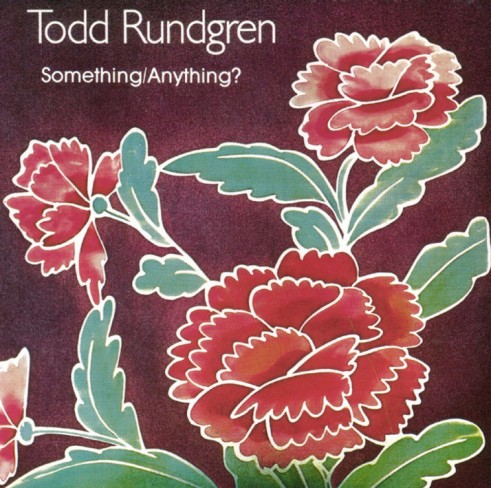
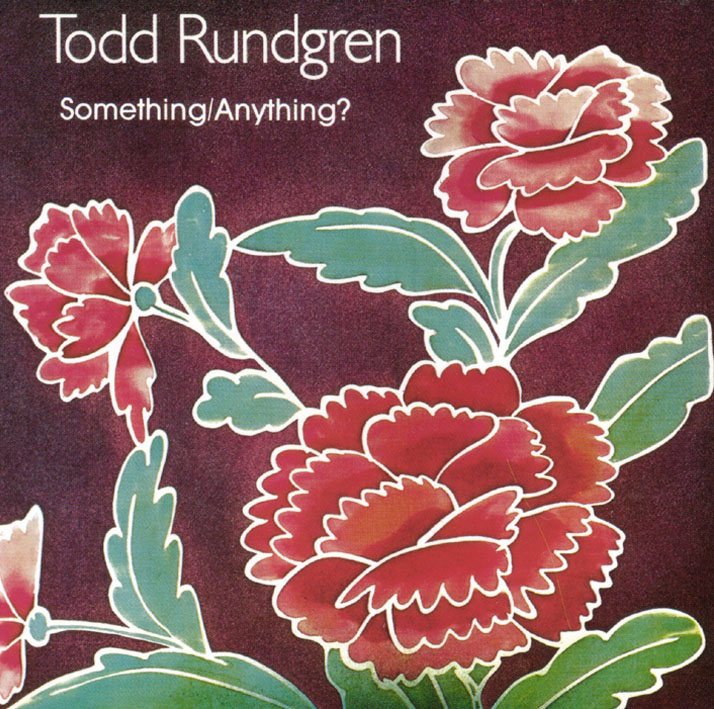
And that’s how I happened across “Something/Anything” by Todd Rundgren. It was rated high on one of those generic best of the seventies lists that all decent music review websites feel compelled to generate for each decade. Thankfully this album belonged on this list, like all the other classics of its vintage; Exile, Ziggy Stardust, Tago Mago, Led Zeppelin IV, What’s Going On, etc, etc. It showcases great song writing, pure and simple, and that never fails to crush your silly bouts of contemplative ennui.
I’d say Rundgren, it’s seems frivolous to call him Todd, is of a similar profile to one of my favourite bands, who were also at their height during the seventies, Steely Dan. They’re something of a niche commodity that dabbled with mainstream recognition, but that this was ultimately assuaged by prioritising and preferring writing and recording to touring. Nothing suggests that Rundgren has the same aversion to touring, but like Becker and Fagan he’s a prolific songwriter, under many pseudonyms, and a highly thought of producer and arranger. Given how good “Something/Anything” is, the majority of which Rundgren wrote, arranged and produced by himself, it and he should belong to the pantheon of great bands and solo artists of the period. But my prior ignorance of Rundgren’s career leads me to question whether he received the extensive accolades and exposure his work deserved.
The first few bars of ‘Saw The Light’ makes a statement, but of what? It delivers an immediate pastiche of a mid sixties pop fare. It’s bedded on a piano in intermediate key, with the periodic use of deep drum bass acting as the register, it’s punctuated with high pitched symbols and the guitar inflection and dreamy vocals so popularised by the early Beatles. You could imagine the vocal melody being one of John and Paul’s that they couldn’t agree on. The lyrics are appropriately populist cheesy kitsch too, ‘And I love you best/it’s not something that I say in jest/cause you’re different from all the rest…and while I ran off before/but I won’t do it anymore’.
In retrospect it was wise that ‘Saw The Light’ would open the album and be the first single released from it. It’s accessible, likable and therefore relatable. But having experienced the whole album, I find it an odd choice to open the album. It’s emphasises Rundgren’s talent but not his character. You encounter his sarcasm on ‘Intro’ – its title is sarcastic too, as it isn’t technically the album’s intro, just to the B side – where he shows a self depreciating side in encouraging you to partake in a game where you listen for the technical and production flaws on the album which he largely produced. On ‘Saving Grace’, an odd, demonic distorted slurring voice acts as a prelude to yet another slick ballad. At the beginning of ‘Slut’ Rundgren openly and ironically jokes about changing the name of the album to ‘throw money’, before a vibrant Stonesy composition helps fulfil a rather pugnaciously cadenced account of being in a state of tanked up desperation, to the point where he’d settle for a chick with ‘saggy thighs’ and ‘baggy eyes’.
Then there’s ‘Wolfman Jack’. Rundgren prefaces the song by shouting ‘hey baby you’re on a subliminal trip to nowhere’. Why I’m not completely sure. There are parallels with Warren Zevon’s ‘Werewolves of London’ here, and I do wonder whether Rundgren’s effort might’ve partly provided inspiration for Zevon’s effort that arrived later in the decade. Rundgren’s Wolfman works an analogy of a single alpha male’s predilection for bedding bored and or dissatisfied married women, while Zevon’s is an existential fable of a Werewolf cavorting about London.
This is an album that vacillates randomly. And you come to realise that this is the point, the only things these songs are indicative of is Rundgren’s talent, and the disparate and fractured nature of the record’s conception, if anything, fomented it, as it was recorded over multiple sessions, with copious amounts of drugs being consumed experimentally by Rundgren. The title, “Something/Anything”, sums it up perfectly. It’s about the songs, about a songwriter choosing to free himself from conforming to an overarching ethos or method, or the pretentions of marrying ideas to limiting concepts.
That meant nothing was off limits to Rundgren. There are some delightful oddities and odd moments to be found. ‘I Went To The Mirror’ is a stoner lick that approaches a bucolic aesthetic. His gravely tone is reminiscent of Mick Jagger’s on a hollowed out Stones demo from “Let it Bleed Sessions” called ‘I Don’t Care’. On ‘I Went To The Mirror’, Rundgren sounds even more inebriated, like a weakened embittered drunkard who’s slept out in the cold for the most of the night, eventually it fades, suddenly returning with a sinister and austere bluesy guitar. ‘The Night The Carosel Burned Down’ borrows from Sgt Pepper’s ‘Being for The Benefit Of Mr Kite’, its distorted harmonium is a precursor of the sound that would characterise much of Rundgren’s next album ‘A Wizard, a True Star’.
On the majority of the ballads Rundgren’s lyrics are of course broadly applicable, but he’s at his best when does relent and revert into anecdotal personal reflections, as he does on ‘Cold Morning Light’, ‘We sit and drink Victorian tea, and your face wears a smile for me’. These also occur on the album’s more comedic offerings.
‘Some Folks Are Even Whiter Than Me’ is an interesting offering considering the climate of the time in which it was released. It’s only with the application of retrospective contexts does its message carry a significant prophetic weight, reflecting that the demographics of society were irreversibly changing with the shifting modes of cultural identification. Rundgren sidelines himself as someone already unwittingly affected, ‘Some folks is even whiter than me/Some folks is even blacker than me/I got myself caught in the middle somewhere/And that’s just where I want to be’. From here he mocks those still resistant to society inevitably changing, and therefore changing them, through the lazily divisive and futile tribal stereotyping, Some people never can be satisfied/Less they push somebody else around/But I can’t give no aid or take no side/I just watch them drag each other down’. Add in the relentless tempo, which cites amalgamations of black and white music converging, the frenzied Jerry Lee Lewis piano of ‘Great Balls of Fire’, the Maceo Parker-esque sax, that R’n’B guitar so popularised by (mainly) white players, just imbues the song’s message with a nuance than runs deeper than the barbs of lyrical cynicism.
I could offer thoughts on every single song on this album, as they all deserve scrutiny, but there are twenty four of them. So yes, of course my favourite song from the album would be the one where Rundgren wasn’t the principal song writer. The warming melody of ‘Dust In The Wind’ belies a man’s melancholic regret, lamenting past his indiscretions when faced with the consequences of the here and now. It would fit seamlessly onto one of the Stones classic albums from the late sixties to early seventies. It’s a sublime composition, with the guitar solo encouraging the sax to shine, while a beautifully simple piano melody runs throughout. Rundgren voice transcends its ability here, his accent reminiscent of Gram Parsons unfussy delivery, and the chorus is sung as rambunctiously as any of Van Morrison’s hooks necessitated.
What this song does so well is emphasise the lesson to found in this album’s conception and execution. It teaches you not to become immured by doubt, to go with the flow, to hang loose and not over think things. As you can’t experience everything, similarly you can’t do everything. Given his immense talent as a songwriter, you would forgive Rundgren for being egotistical and provincial in taking measures to prevent including ‘Dust In The Wind’ on this record, but he wasn’t. He realised than when something’s good, anything that makes that something better is worth it. That attitude applies to finding good music, only when you accept that music is imperfect and subjective, and the process of finding it completely random, will you discover it.


 Wichita Lineman Was A Song I Once Heard
You must be logged in to post a comment.