
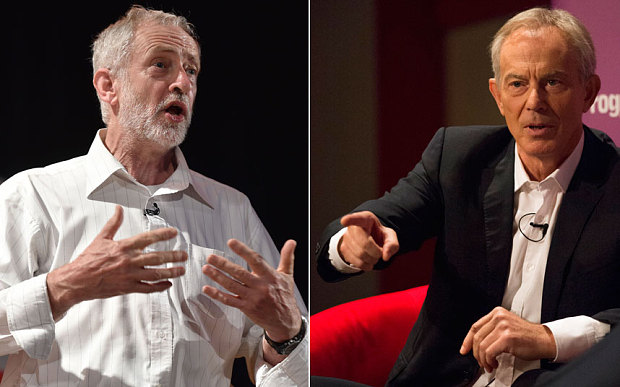
Jeremy Corbyn – a symptom of the Labour party’s malaise.

corbyn blair labour decline header

Nine months ago I wrote that Labour’s decline was in part due an obtuse allegiance of its members and hardcore voters to the party name. Well, to quote his Bobness ‘things have changed’.

A schism has formed. Broadly speaking there are accusations from the left and its commentariat that the cravenness of the neo-liberal Blairites has demolished Labour’s credibility and corrupted its traditional values. The Blairites claim Jeremy Corbyn, with his pseudo-socialist manifesto, to be unelectable, meanwhile the predominantly right wing press is getting to have its cake and eat it. Corbyn, as a figure, is a gift to them. As much of the media belong to a corporate monopoly that benefits from maintaining the right-wing political status-quo, it has every incentive to demonise Corbyn for what he represents – change.

Even better for the corporate media, if, as I suspect, it turns out that the parliamentary Labour party ultimately rejects Corbynism and defies the wishes of many of its members to change course, it will have helped influence an entirely different change – to leave the left without any affiliation to a mainstream party.

You suspect that the left, whether it be the trots or the unions, know that this is their last chance to reclaim a significant influence within the party. So the fight for what the Labour party is, should be and who and what ‘holds the party’s values’ has become woven into the narrative of Jeremy Corbyn’s ‘surprising success’. The result is his bid for leader has become the battleground where a disingenuous and destructively polarising debate between two extreme affectations of Old and Nu Labour is taking place.

Forgotten in all this is everyone else, be it Green voters, UKIP voters, SNP voters, those that didn’t vote, the elusive floating voter, or better yet those lifelong Labour voters who could be described as social democrats. You know, folks who silently conflate aspiration and altruism and are surely the largest demographic that are or could become Labour members and voters. What do they think of all this?

They’re watching and they’re unlikely to be impressed by it. I’m certainly not. What’s interesting is that both extreme positions within the party are the party’s faith based endeavours.

The Blairites see appealing to Thatcherite modes of aspiration and maintaining society’s grotesque economic hierarchies and elitism, views they’re convinced are held by the wider electorate because it reinforces their own lofty stations, as more important and necessary than prioritising social welfare, or ‘justice’, to quote the spin. Plus, that social justice ‘stuff’ can be done surreptitiously when in power, or something. And yeah, it’s hard not to guffaw at the real hypocrisy of Blairites claiming that Jeremy Corbyn is unelectable only months after Labour’s disastrous election performance was predicated on a campaign of diluted Cameronism.

The motivations of the Corbyn acolytes are no better or any less self-immolating to enhancing the party’s appeal. The entryists believe that purity in opposition is better than any forms of compromise that ensures power. So they’re certain to ignore his rather odd dalliances throughout his years of back-bench obscurity with holocaust deniers, some shady fundamentalist people and organisations, a sketchy foreign policy based on encouraging dialogue (just how to do you negotiate with ISIS Jez?), and his proposal for People’s Quantitative Easing, which is really a euphemism for inflation. That last one sounds as if it was conjured with the aid of a damp Costa Coffee napkin, or whatever trendy coffee house affluent socialists drink at. Mainly, you suspect, because his supporters will lap it up at his tour of schools, community centres and town halls.

More interesting, and telling, is that the other leadership candidates are all lagging behind Corbyn. That most of his proposals; to renationalise the railways and power, scrap trident, to properly police corporate tax evasion, and to abolish tuition fees is being met with such enthusiasm shows us that the parliamentary arm of the party has stopped thinking, innovating, and, if I can put it crudely, has simply lost touch with the wider electorate and understanding what they want.

So it’s no surprise that they’ve failed to find some commonality and ultimately an identity with policies that clearly diverged from the Tories. Say, the kind that could resonate with a broad spectrum of voters, such as Yvette Cooper’s pledge to reinvigorate the Sure Start scheme. Instead they were, and some still are, pre-occupied with living in and inflating their own bubbles of self-gratification, be it unveiling a fucking cenotaph of pledges, making tea cups with derogatory slogans about immigration, indulging in stereotypical middle English class rhetoric about ‘working families’, or using lies that anyone able to use Google could debunk. The campaign came over as dishonest at worst, clueless at best.

labour mug

But lessons haven’t been learned. Now they’re barring members from voting on the suspicion they may have voted and or campaigned for another party, you know, the kind they should be trying to win back. It gives yet more ammunition to the Tories and the media to attack the party, and it’s reinforced the paranoia of the Corbynites, who believe this to be a nefarious attempt by the nebulous Westminster elite to fix the leadership election.

Internal backlashes and attempts to apportion blame were inevitable in the wake of the Tories gaining a surprising majority. While Corbynism is an effective conduit for antagonism to be aimed at the political classes, the Labour party leadership election also offers the dismayed Labour voter an immediate platform to punish the party for what they see as its ideological capitulation and betrayal.

Best of all this impending chaos was fuelled by intentions that have become highly ironic. Jeremy Corbyn was initially placed on the ballot as a phoney attempt to appease the left in the party. The act patronising, its message equally so – that you still matter, or rather that your votes do. We know you’ll vote for us because you always have done, or you feel you have no choice but to. But for the first time in eons the left within the party were able to align the means with the motivation. Now marginalised and with nothing left to lose, they feel they can exercise their choice without the fear of it costing Labour an election victory. Regardless of whoever is voted leader, Labour’s chances of winning in 2020 appear slim.

This resentment towards the parliamentary Labour party from swathes of its supporters has been building for a while. Whether it be for revoking clause four, the Iraq war, being wedded to needless privatisation, the piousness and fawning establishmentarianism that characterised the Blair premiership, or the recent and craven tendency to adopt many Tory policy positions and rhetoric to ‘compete for votes’ yet losing millions of them and ultimately power in the process.

Today, tomorrow, or next Tuesday most Labour voters will walk past a church, the community centre or go to their local supermarket and they’ll see posters asking for foodbank donations. It’s a grotesque form of emotional blackmail when the second poorest demographic in society is asked to help the poorest by supplementing the shrinking welfare state.

Then they’ll go home and watch the news, invariably they’ll be presented with polished Blairites who use the platitudes and clichés synonymous with the Blair/Campbell/Brown apparatus. Their incessant insistence that austerity is necessary is one. It smacks of conforming to the political class consensus and that reeks of a sense of entitlement, that they’d be doing us a favour by ‘balancing the books’. People know that once elected MPs have access to significant sources of wealth, but they’re unaffected by austerity, and as the expenses scandal showed, they simply don’t suffer the consequences either.

Combine those two dipartites and it’s hard not to be angered and disillusioned. Even if I understand why Labour MPs are saying austerity is necessary, and that their mass abstention on voting against the disgraceful Tory welfare reforms made no difference to the outcome, folks who believe in the party name are invariably less capable of reconciling these facts with their now jaundiced perceptions of Nu Labour’s effectiveness.

The least Labour MP’s could’ve done is turn up to vote against the Tory welfare ‘reforms’. Put forwards a motion to amend the bill later? Fine, but, if you’re truly against the welfare bill, at least produce an act that shows a modicum of solidarity with people who are forced to use foodbanks, are being sanctioned by the DWP for missed meetings at the job centre when they’re attending job interviews or worse, the seriously incapacitated having their benefits stripped for non-attendance, or fined £350 for stealing Mars bars worth 75p because they were skint due to having their benefits cut and therefore starving.

Sustained exposure to poverty and forms of imposed degradation will invariably foment extremist thoughts, and if possible responses.

So it’s no surprise that, in this context, when someone bases their leadership bid on impassioned egalitarianism, the kind that is perceived to be the antithesis of the current results of the Westminster conglomerate’s political values, and in Labour’s case illogical strategising, that people will migrate towards that person.

For the sake of the Labour party Jeremy Corbyn needs to win the leadership election and the Labour party needs to unify and see how his leadership plays out. Not doing so risks losing a section of its core support to irrevocable apathy at best. After all fighting for votes on the centre right terrain on many issues and policies hasn’t worked, and it’s a myth that it will for Labour. At least by trying a different approach, one tinged with radicalism, and seeing what comes of it, maybe Labour can finally purge all their current delusions that the sanctimonious attitudes its loyal voters, members and elected MPs espouse, and their tendencies to indulge in varying extremes of self-interest and ideology, and the inevitable mediocrity it encourages, aren’t the causes of its failing.

Will Self recently said that “Labour is too broad a church”. I suspect he’ll soon be proven right, and it’s all because Labour and its members can’t decide what denomination it should be.

Posted in Politics | Tagged , , , , , , , , , , , , , , | Leave a comment

Song Of The Day – Writing Poetry On Your Forehead With The Tip Of A Hunting Knife by Shit And Shine

From the album ’54 Synth-Brass, 38 Metal Guitar, 65 Cathedral’ (2015)

Posted in Song Of The Day | Tagged , , , , , , | Leave a comment

Song Of The Day – Harvest Time by Pharoah Sanders

From the album ‘Pharoah’ (1977)

Posted in Song Of The Day | Tagged , , , , , , | Leave a comment

Essential Listening: Muslimgauze

muslimgauze header for blog

Let’s consider the bastardisation of the word ethnic. Its contextual use is invariably pretentious and therefore so is the question. Similar to the incessant use of ‘iconic’, its overuse means it no longer carries gravitas. Now it simply means – indigenous and distinct to a culture or region. How drab.

It should mean; an entity or a thing that not only enriches its cultural progenitor, but promotes intrigue in and improves any existing perception of it. By listening to Muslimgauze the word ‘ethnic’, in this sense, is reclaimed, as it takes Islamic and Persian sounding music and sounds and makes them accessible.

But any medium, and music is no different, only augments its appeal through experience. When it comes to Muslimgauze, a good entry point for the uninitiated is a series of Muslimgauze mixes on Youtube, called the ‘Muslimgauze files’, collated as a tribute to Bryn Jones by a bloke called Ash McBride. Now I would say that as it was my initiation. The four albums I’ve been listening to all featured tracks that caught the ear on these mixes. I will concede that given the sheer volume, and it appears (so far), universal quality of the material, just randomly selecting a handful of albums without any prior knowledge would likely be just as effective. Indeed, a ten CD box set titled “Muslimgauze: Chasing The Shadow Of Bryn Jones” is surely the most extensive compilation to be committed to wax so far.

Bryn Jones, the man behind Muslimgauze, was a reclusive sort. He was pre-occupied with his craft and the processes of it; writing, mixing and recording. Self-promotion was at best a secondary concern, an inconvenience even. Popularity or the possibility of it the same, these were things that might interrupt him or unsettle his creative boudoir. Even worrying about sales was a fringe concern. The result today is that the Muslimgauze project sits in relative obscurity, and therefore someone first encountering Muslimgauze today is likely to do so either accidentally, incidentally or via a personal recommendation.

You can speculate as to what prompted Jones to first conjure the Muslimgauze project. Without question it’s in retaliation to the growing antagonism shown towards Islamic culture within his lifetime, and the subsequent treatment of his material by swathes of the music industry, but there’s little doubt he also saw the genre as an enticing canvas on which to experiment.

Upon listening to a group of Muslimgauze releases it’s apparent that each form of experimentation, by splicing the old and new, the contemporary and traditional, is a rejection of the limitations brought by adhering to tradition, in particular the meaning and application of it in the overarching cultural psyche. In the context of the here and now these works repudiate the idea of indigenousness as rooted. Here we have a product that borrows its inspirations and sounds from Islamic culture, a culture which is perceived to eschew the mores and modes of Western modernism by the west, that is successfully bastardized by a Mancunian with synthesizers and modulators, and this happened pre the hysteria of 9/11, in the eighties and nineties no less.

Superficially “Azzazin” incorporates little that’s immediately synonymous with Islamic and Persian music. It’s likely that those who are familiar with Muslimgauze’s thematical intent will weed out or isolate the sounds and inflections that are derived from it.

All the tracks are unnamed on “Azzazin”, so there’s no implied meaning beyond the album title. To speculate, this retreat may have given Jones the freedom to withdraw from concerted politicisation, to centre the focus on the musical value of the work and widen the scope for experimentation. Perhaps he couldn’t think of any names that fit, couldn’t be arsed thinking some up, or just didn’t have the time.

“Azzazin” focuses on the template that characterises many Middle Eastern rhythms, transposing them into a series of darker melodies that are ridden with abrasive glitches. The layering for most of the tracks is formulaic, usually condensed to only two strains, as found on ‘Azzazin 2’, or on ‘Azzazin 6’, imbued with fractured vocal samplings and random instrumental sounds whose surprising verbosity threatens to overwhelm the dark lethargy that surrounds them. Their sudden strangulation, making them fractured beams of expression attempting to escape, only enhances to the album’s sinister tone. Within the Muslimgauze cannon “Azzazin” best reflects an effect of genre tourism, as the music drifts further from the ethnic elements to an original concept, it signifies counter-cultural exchanges invariably foment normality. Sixty years ago nobody went for a curry, now practically everybody does.

One of the posthumous releases under the moniker, “Iranair Inflight Magazine” carries many of the same structural techniques found on “Azzazin” and “Narcotic”, but through employing the contrast of a baritone dubbing of Tombak or Daf like sounds, and a high frequency of electro glitches, it creates a distinctly effervescent ambiance. Not for a minute are the sounds and style of the traditional instrumentals which foment the underlying melodies, say sounds that could come from Persian instruments like the Dozaleh, appear unfettered, as on occasion it’s hard to decipher when and where they end and the distortion begins.

It’s uncertain what period of Jones’ life this material comes from, but there are clear experimentations with tempo on “Iranair Inflight Magazine”. There’s also distinct nod, at least stylistically, to the meandering hesitancy and sparseness of hazed inebriation that characterises Jamaican dub. This can be heard on ‘A Small Intricate Box, Which Contains The Blue Opium Marzipan’, replete with drug associated title no less and on ‘Mysore Cochin Bangalore’, which, oddly enough, sounds similar to how I’d imagine Jamaican creole would translate ‘my sore arse in Bangalore’ to. A load of bollocks surely, but Jones pulls off these cultural juxtapositions or makes the listener make them, and that if anything is one of his greatest strengths as a producer.

muslimgauze narcotic

On the album cover of “Narcotic” we’re presented with an androgynous chubby person of various feminine and masculine features wielding a pistol. This may have some popular reference which I’m unaware of, but to the (possibly) ignorant it’s borrowed seventies kitsch or a stereotypically western style satire. The album contains many fragments of vocal samplings which appear to be lines from songs, clerical outbursts, and, you suspect, from popular Middle Eastern movie and TV culture, or maybe not.

The authentic tone of strings and percussion share many similarities with those on “Zul’m”, where “Narcotic” diverges is employing the Aphex Twin sensibility – the chaotic randomness on ‘Effendi’ immediately springs to mind. Isolated rave sonics and grooves appear, and when they do, they do so with a mania and clarity, and in ‘Believers of the Blind Sheikh’ they eventually melt into the layers of percussion. Unlike “Zul’m”, on “Narcotic” the strings and percussion are largely separated from each other to emphasize the album’s hallucinogenic aesthetic. Those irresistible Persian strings elevate and separate from the electronic enhancements on ‘Sadaam’s Children’, where a sparse offering of melodic strings are augmented unobtrusively by globular electro inflections, this combination mirrors the solemn subtext of the song’s title. Layers of drums are offered the same treatment on ‘Nazzareen’. The electronic distortions are subdued to begin with, replaced by repetitive bursts of string inflections, which at the end drift off into a sinister dustbowl of contorted metallic shimmering and muddled voices shrouded in atmospherics of wind meeting sand. It’s reminiscent of Demdike Stare’s darker offerings, and I’ll go out on a limb here and say that hailing from the same city they’re fans of Muslimgauze too.

As for “Zul’m”, it’s one of the finest records I’ve listened to, and it comes closest to truly bridging the aesthetics of electro and the traditional material, mainly due to its subtlety and seamless mixing. When the electronic inflections do appear they belong in these traditional sounding narratives.

‘Curfew, Gaza’ is a prime example, it’s a ten minute long repetition of a solemn flute allayed by a series of tempestuous electro thuds and hand drums. On ‘Fakir’ layers of Sitar-esque strings are piled on profusely, embellished with drums arrangements and a perishable but warm mantra like cry.

The two finest offerings on “Zul’m” place the emphasis on strings, percussion and drums, merging or dubbing them into satisfying crescendos. ‘Indian Summer of Benazir Bhutto’ contains a ravey garnishing of chimes, a morphing synth and the acceleration of various drums layers, while ‘Shiva Hooka’ centres around a high pitched piercing distortion of, say, a Persian Ney. It’s intertwined with a rhythmically slow synth wave that is shrouded by intermittent chimes, eventually a clicking ushers in the final symposium of all the sounds, which together evoke an extremely satisfying psychedelic hedonism.

While there is a thematic similarity between the albums, the diversity in their delivery, particularly between “Iranair Inflight Magazine” and “Zul’m” to pick two, suggests that I’ve only just scratched the surface. It’s likely that trying to get a full flavour of the Muslimgauze catalogue from just four albums is a daft enterprise. So that means I’ve just have to listen to more of it.

And the recent discovery of that intent is a massive surprise. Not that I had an aversion to it, but before I had no inclination to examine Middle Eastern music. In Muslimgauze Jones created a cocktail that contains enough familiar elements to liberate my inherent ambivalences, and, as a consequence, destroys the notion of the traditional and truly ethnic in music being incompatible with the tastes that characterise the current zeitgeist. Whether intentional or not, and I suspect it wasn’t Jones’ primary concern, that’s still quite an achievement.

Bryn Jones died in 1999. Terrifyingly that was half my lifetime ago, yet until last month I’d never heard of him or the Muslimgauze moniker. Even if we can’t truly comprehend the talent it took for him to be this prolific, you can see how Jones became consumed by the utopia that indulging in cultural vicariousness, and making it his own, could offer. The result? For those of us working our way through the catalogue, the mystery is sure to endure for a while yet.

Posted in Essential Listening | Tagged , , , , , , , , , , , | Leave a comment

Song Of The Day – Downtown by Alex Chilton

From the album ‘Step Right Up: The Songs Of Tom Waits’ (1995)

Posted in Song Of The Day | Tagged , , , , , , , | Leave a comment