
Representing a non-fiction period piece set in the Soviet Union with English dialogue seems ridiculous. In fact, it is. The question is whether the narrative and performance is capable of sufficiently wrestling your attention away from the elephant’s ginormous arse.
I forgot it within twenty minutes. Starting with the palpable dread as the firemen attempt to put out the fire enveloping the reactor building, and it doesn’t subside. We all know what is likely to happen to them and those who were working in and near the reactor, but at this stage we have no idea how the reactor exploded. Intrigue and suspense resides here, because I, and I suspect quite a few others, have no idea how a nuclear reactor works. The show does an excellent job of explaining, in layman’s terms, the intricate functions of nuclear reactions and reactors. Said exposition works because the Soviet Central Committee who task a blithe Boris Shcherbyna with investigating the immediate aftermath didn’t either.
Shcherbyna’s initial dismissiveness of nuclear scientist Valery Legasov’s warnings is a jarring reminder of the latter Soviet Union’s bureaucratic dysfunction, a myopia sustained by decades of tradition, cronyism and obstinate indoctrination, ‘our power comes from the perception of our power’ Gorbachev correctly opines when the consequences of the disaster become apparent. Stellan Skarsgard conveys Shcherbyna’s epiphanies so well, the implications begin to erode the edges of his faith in the Party apparatus, at various stages he is shown staring into space, forlorn, beaten, as though, for the first time, he can visualise it all falling apart. His shock made me consider the binary nature of contemporary attitudes towards nuclear power, and how they have been framed in the culture. The extremes of Chernobyl and Hiroshima have made the word nuclear a trigger. It’s now synonymous with death, disease and destruction. More than that, the lingering notion that we cannot be trusted to not destroy ourselves.
As someone who is pro-nuclear power, the process where Shcherbyna definitively cuts through the initial obfuscation, and Legasov’s suspicions are validated, that the core is open and what the actual radiation level is, is as shocking as it is captivating. The show tries to remain neutral, but this is an emotive subject and it’s inescapable that Chernobyl the series will only re-inforce people’s existing positions on the issue. Did you know that a gram of Uranium creates eight-thousand times more energy than burning the same volume of coal? Those who oppose it won’t care about that, because we’re shown the horrifying cost if it goes Pete Tong – firemen and plant workers literally decomposing whilst still alive, babies dying within minutes of being born and household pets being abandoned and later executed.
Folk who believe in its merits will place the blame not on the science, but human error, greed and hubris – the promise of promotions, which motivated Dyatlov, Fomin and Bryukhanov, seem utterly comical and trivial when juxtaposed with the heroism of those who risked their lives and health to clean up their idiocy. Technically Chernobyl might have been a failing of officious Soviet statecraft tampering with scientific process, as Legasov ultimately concludes, but it was only part of the cocktail. Unsurprisingly throwing together a mix of personal aspiration, authoritarianism, state secrecy and extending command economy cost-cutting to nuclear reactors is a bad mix fam.
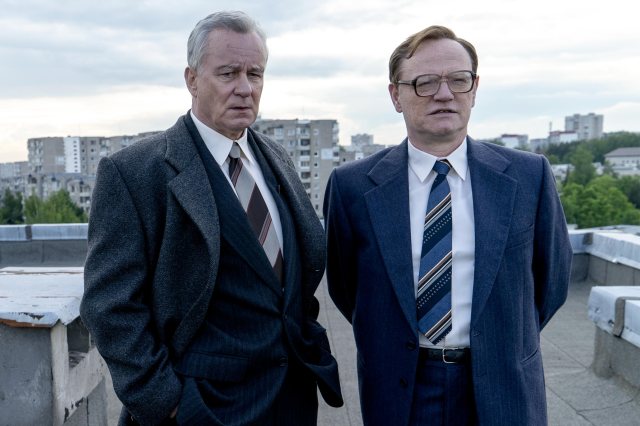
Much has been made of the show’s specific inaccuracies, but who cares? A liberal attitude to dramatization and characterisation aids the drama at specific points. It makes sense to create a fictional composite for Legasov’s support team of scientists, centralising the work of dozens into one character, Ulana Khomyuk, truncates the depiction of chronological events. While it is preposterous that only one person could investigate how the state redacted crucial information about the reactor’s failsafe, who dwelt upon it whilst watching? Stellan Skarsgard and Jared Harris, who play Shcherbyna and Legasov, are fantastic, so why question whether the growing bromance and mutual respect between the two was genuine? It, and Legasov’s awkwardness and sincere naivety ‘about how things work’, are sources of levity in what is an entirely sombre body of work.
The head of the KGB, Chairman Charkov, is a delight. He’s an unassuming wee cutie pensioner, the sort you’d see at your local bowling green, sporting a wobbly gait, glasses as thick as they are wide with suit jacket sleeves that are far too long. However, this belies his immense authority, which sees him speak with a ruthless assurance only a seven foot-three brick shithouse could get away with. Little doubt he’s arrested thousands and will happily have your toenails removed if need be. He delivers the best line in the series when Legasov questions why the KGB are following him and Shcherbyna ‘But you know the old Russian proverb? Trust, but verify. And the Americans think Ronald Reagan thought that up, can you imagine?’
Visually it’s flawless. It’s well worth watching for the recreation of the reactor explosion in the final episode alone. Its representation of mid-eighties Soviet Union has received praise from the realism zealots, but as an eighties kid, all it did was reinforce my perception of it as a drab place sustained on the fear of reprisal and ran by sycophants. The disparity in topography between the affluence of Moscow, a cultural hub with ostentatious centuries old architecture, and Pripyat with its Stalinist topography of totalitarian tower blocks and weathered concrete, exposes the hypocrisy of the ‘classless’ Soviet model. Even better Soviet fashion is shown in full glory; bad perms, crap taches, worse glasses, a dour palette of colours, ghastly designs on carpets and curtains, turtle necks and ill-fitting unflattering clothes (okay, we had all this shit too). Legasov’s suit is ludicrously massive, the commodious trousers are amazing. The constant use of comrade, while authentic and justified, I also found amusing. Only because it’s normally used by your self-styled champagne socialist millennial professional types earning 60k a year, who have no clue of what the struggle entails, and whose contribution to their comrades equates to only pontificating about how disgraceful the Tories and zero-hour contracts are on Twitter. These cunts boil the piss.
For those of us who we were blissfully unaware of the epic scale of ineptitude that caused Chernobyl or what its consequences truly were, now we know. Chernobyl is so effective because it doesn’t patronise us with (too much) sensationalism, it lets us decide for ourselves by engaging us with a hybrid of opulent cinematography, political neutrality, dramatized realism, which allows it to school us with science.
 Wichita Lineman Was A Song I Once Heard
You must be logged in to post a comment.