
Snobbery and decay, when it comes to music consumption preferences, for some this is the only way.
Adopting such a tribalistic paradigm becomes ridiculous when taken to the extreme – because Leonard Cohen or Joni Mitchell aren’t Bob Dylan to some, they’re not worth the bother. The gatekeeping of a band, songwriter or an album as the undisputable standard, asserts that there should be no genre at all. All very tragic and insufferably boring.
Inverted snobbery is equally pitiful. Being a successful poseur of arcane taste requires anti-intellectual conceits and dishonesty masquerading as excessive obstinacy. Mainstream consensuses are for the squares. How others perceive something and how your opinion was formulated matters far more than what you truly think. Often, it’s cheap attention seeking by being contrarian, and it’s easy to ridicule the taste of others as trite when only you know of and or “get” obscure acts.
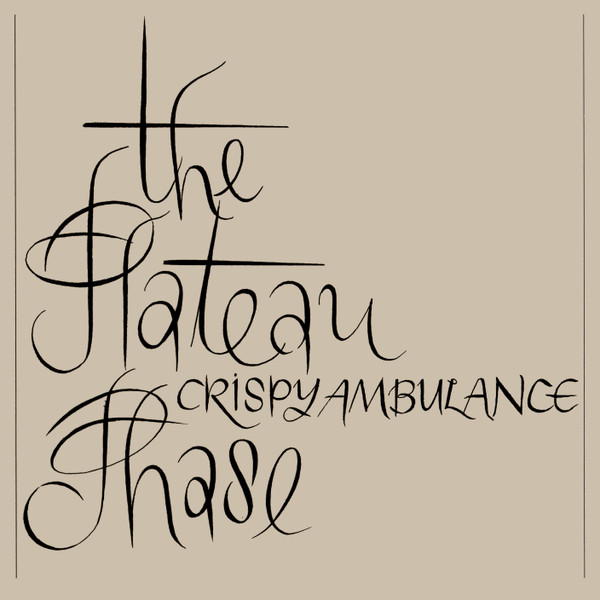
I’ll concede that all of the above accusations of inverted snobbery could be levied at me here, and I can’t be bothered to refute them. I won’t claim that Crispy Ambulance’s The Plateau Phase is better than Joy Division’s two albums, but I do prefer it. And that makes me wonder why it is barely mentioned as one of the best albums of the post-punk genre. To be specific, when talking about post-punk, I’m talking a specific sub-trait: post-punk that’s thoroughly Mancunian, seated in a distinct time and place of the late seventies to early eighties; pessimistic, abrasive, almost morose – The Fall and Joy Division operating as the archetypes.
When discussing music challenging daft narratives is equally susceptible to vanity and snobbery. It’s not that it’s a problem sharing the minority view, that Joy Division’s reputation is inflated, but that it potentially aligns with fucking Morrissey of all people is. Always the first to anoint himself a member of the taste police, his comments in 1984 on Joy Division are revealing, he “didn’t take to them that much”. That their aesthetic was superficial, surmised more eloquently by George Michael as “pretentious and contrived”. In a state of boorish insecurity, dare I suggest jealousy, Morrisey focused on Ian Curtis’s death as the overriding reason they were (and are) held in such high esteem and above all other post-punk contemporaries. People are fickle and so there is an element of truth to his latter assertion, but the subsequent claim that their ascent to success was peddled as accessible and replicable on the back of Curtis’s death is a clear shot at Tony Wilson more than a deeper analysis. Let me surmise by saying all this stuff is bullshit.
It’s truer to say Crispy Ambulance and their album The Plateau Phase have been enveloped, and somewhat washed away by a wave of cultural groupthink, almost a cod mythology, surrounding Joy Division and the accompanying exceptionalism that often demands emphatically exclusionary outcomes. It makes me wonder what other bands suffered a similar fate. Strip away all the surface and the only problems both the band and this album have is that they aren’t named Joy Division (it’s a much better band name that Crispy Ambulance, admittedly), therefore the album doesn’t have the rep that Unknown Pleasures or Closer have, and, more acutely, that it came after both. The last is the most problematic, as it’s susceptible to accusations of plagiarism, unoriginality and perhaps a degree of cynicism by the absolutist crowd.
While both were excellent albums, it’s safe to concede that the timing of Ian Curtis’s death somewhat inoculated Joy Division from becoming besmirched by the adverse excesses of the fame thresher. The band’s abrupt end left it perfectly mummified as it was, a forever nostalgia that cannot be sullied by a lacklustre band reunion tour twenty years later. Excellence tends to only be fortified by scarcity or a truncated run, see Jimi Hendrix, and in the case of Mark E. Smith, abundance. Instead of replacing Curtis with Crispy Ambulance’s lead singer Alan Hempsall, as they’d done after one Curtis’s unsuccessful suicide attempts, Bernard Sumner and Stephen Morris decided, wisely, to migrate away from Joy Division’s post-punk sound and aesthetic by reforming under the New Order moniker, which also gave their new project necessary distance from all this nonsense.
Releasing your album later does provide access to a wider palette of influences from one of music’s most vibrant eras. And The Plateau Phase has so many that it’s hard to list them all, but it’s the album’s emphasis of post-punk’s capability to be holistic that appeals.
“Simon’s Ghost” features an Eno-esque mellow drone over soothing strings. “Wind Season” wouldn’t look out of place on XTC’s album White Music. The pace of the baseline on “Bardo Plane” is very Comsat Angels. Much of “Death from Above” mixes ambient drone and library music over a very slow base chord. “Federation” is a typically chaotically disparate punk composition. On “Are You Ready” marching drums gives way to base thrashing and a dense guitar bars. “Travel Time” features languid vocals and mellow guitar work that feels very Cure. The first half of “Concorde Square” is very derivative of Joy Division’s “Transmission”, with Hempsall clearly showing his superiority as a singer when compared with Ian Curtis’s excessively drawl monotone.
“The Presence” is a real show stopper, and one of the best post-punk tunes. You’re treated to thirteen minutes of an undeniable baseline and drum sequence. Pessimistic, sinister lyrics delivered with real angst marry with thrashing guitar chords that arrive satisfyingly in strata. It’s aggressive as punk but as infectious as new age pop. It would’ve been perfect in Grosse Point Blank during the sequence where Martin Blank kills the Basque hitman at his high-school reunion, and made both the song and movie 1.64% cooler.
But that wasn’t to be, as, I suspect, most have never heard of The Plateau Phase. As I get older, my willingness to discover new music shares a kindship with Scott Walker’s creative journey. He became more avant-garde and open to experimentation as time went by. This makes The Plateau Phase a test, not of taste, but receptiveness – to something that isn’t “new” in an old genre, and to the shifting of the post-punk lexicon. If you still prefer Joy Division and their offerings, I’ll happily yield. But just not at the exclusion of this excellent album.

 Wichita Lineman Was A Song I Once Heard
You must be logged in to post a comment.