
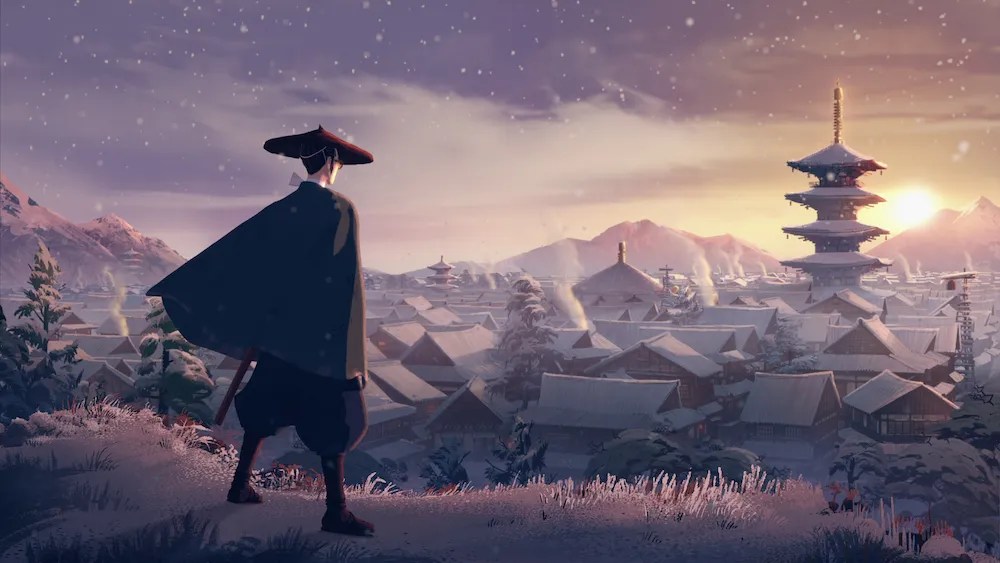
Need an escape from the grim coverage of Israel victimising Gaza, or, on the benign end of the grim spectrum, that sad melter on your street covering their house with Christmas tat and lights in early November? Well Blue Eye Samurai on Netflix comes thoroughly recommended as an antidote to both. It may have violent imagery, but delivers it with guile and panache, and while mostly set during winter, Christmasy it isn’t.
It does, however, have hurdles to clear. And very few of them are of its own doing. First, I flashed back to watching HBO’s Chernobyl and being irritated with the preposterousness of a Soviet era dramatization acted in English. Pernickety, yes, but said adaptations inherently carry a cultural insincerity that has always bothered me. With Chernobyl you begrudgingly accept this, and then forget it, thanks to the excellent writing and production. But for those first fifteen minutes, before it’s gripped you fully, you swither over whether you can buy in. Blue Eye Samurai thankfully succeeds as Chernobyl does. But I found it harder to be sympathetic with it being animated, and therefore not limited by actors being unable to speak the native language.
Seeking out the Japanese dubbing and giving it a go did occur, and when it did it seemed a bad idea, as it was animated to accompany English dialogue – and one of Blue Eye Samurai’s best features is the dialogue. Watching anything that’s been badly dubbed is excruciating. I did this with Fellini’s 8 ½ for ten minutes on Amazon Prime (it was set this way by default – cunts), until I found the experience too unbearable that I simply had to seek out if there was the original Italian dialogue option with English subtitles. Beautiful animation or cinematography is no substitute for the distraction caused by bad dubbing or dialogue. People will tell you that Tenet by Christopher Nolan is a smart, excellent movie, and it is kind on the eye. In truth the constant exposition makes it a slog. The experience was so exasperating that it felt as though I was failing a theoretical science exam I hadn’t studied for, instead of watching a movie. Thankfully, Blue Eye Samurai strikes the right balance between showing and telling and doesn’t treat you like a muppet in the process.
Blue Eye Samurai is set from 1633 in Edo Japan after Westerners were banned from the country, a fact I did not know of. This is central to the main protagonist’s mission, she’s hell bent on killing the few remaining whites still lingering as an attempt to reconcile the impossible – a feeling of duty to maintain Japan’s culture from nefarious Western influence (and how right they were) with her impure status as a half white half Japanese half breed. This makes the use of English dialogue contradictory. More confounding still, some accents aren’t fully seated in their Americanization, there’s a twang, or indigenous accent deliberately added to some. It’s a peculiar inconsistency at first but eventually made sense within its own context, as it successfully aided characterization. Forgive me my inverted jingoism here, but there’s surely no way that a version of Blue Eye Samurai written in Japanese would feature Masi’s verbal diarrhoea. He’s there to supply levity, and as a loveable stock loser plotting his own path to heroism against all odds. His journey would feel more admirable if he didn’t talk too quickly in a stream-of-consciousness manner, an annoying quirk synonymous with the insufferably faux American dialogue found on a haughty TV drama series aimed at the middle classes.
Little doubt there’ll be those such as me who just aren’t good enough not to take aspects of Blue Eye Samurai uncritically at face value, or who will see it through the dishonest lens of contemporary identity politics. The chest binding and the gender ambiguity of the lead character (even though it has been common throughout history for women to masquerade as men for safety, and Blue Eye Samurai doesn’t shy away in showing how women were traded without say, often by relatives, for profit) will satisfy the woke crowd and trigger conservatives. No doubt some Vegan, tofu eating, tree hugging, pansexual, trans-identifying Guardian columnist will argue the lead character is a trans-man without knowing it. There’s no arguing with this kind of stupidity, when it’s Mizo’s mixed race which others her in this hyper-specific era of Japanese history, defined by an ethnic exceptionalism, that we in the West don’t associate with Japanese culture.
Ultimately, these are superficial, and in my case, idiotic, gripes and flaws for bozos to fixate over. All preoccupations are dissolved by beguiling animation combined with a ripping yarn. This is so good it cannot be denied. I thoroughly enjoyed that all influences are referenced unashamedly; Miyasaki’s design and attention to detail, borrowing Kill Bill’s female swordsman protagonist, spiffy training montages and music, Kurosawa’s Seven Samurai’s honour code and imperative, even the grimy, earthy aesthetic of Sekiro. The people who made this have the best of taste.
Crucially, and this does matter, Blue Eye Samurai appears to have been hand drawn, instead of rendered by some smug fat failed graphic designer incel twat who knows how to leverage video editors and AI to generate images with minimal effort. Digital production making things easier for Disney Studios to churn out identikit disingenuous fluff brings one advantage – it’s far easier to gravitate toward and appreciate the sincerity of animated pieces, such as Blue Eye Samurai, that have been produced in analogue with tactile means.
I binge watched all eight episodes of Blue Eye Samurai over a weekend. This feels particularly egregious given it was created by a group of very talented people who take pride in their craft and endured and poured everything they had into this. But it’s that acknowledgement which makes me wish they’d gone the extra mile and made it in the tongue native to its setting and era to reduce any incursion of unwelcome and nonsense forms of Western projection, including my own. It deserved an additional layer of authenticity to make it bulletproof from cultural ignorance and stupidity.

 Wichita Lineman Was A Song I Once Heard
You must be logged in to post a comment.